


 CDN NEWS |
  US NEWS







Why difficult-to-wire locations can become safety blind spots, and how wireless technology can help operators expand gas detection coverage
Gas detection is a well-established part of industrial safety, particularly across oil and gas production, processing, pipelines, terminals and refining facilities. Yet even at sites with extensive fixed gas detection systems, gaps in coverage can develop.
The reason is not necessarily that the hazard has been overlooked.
In many cases, the challenge is infrastructure.
A new monitoring point may be hundreds of metres from available power, signal wiring or I/O. Reaching it can mean engineering, trenching, conduit, cable installation, electrical work and potentially coordinating the work around operating equipment. At an existing facility, what appears to be the relatively simple addition of one gas detector can quickly become a much larger project.
That raises an important question for operators:
Are gas detectors being located where the risk is greatest, or where installing them is easiest?
Why Gas Detection Gaps Develop
Energy facilities change throughout their operating life.
Equipment is added or modified. Processes change. New potential release points are identified. Temporary equipment is introduced. A management-of-change review may highlight an area requiring additional monitoring that was not part of the original facility design.
Potential applications can include:
- Wellheads and remote production equipment
- Compressor stations
- Tank farms and storage areas
- Flare and flare-gas recovery systems
- Gas storage wells and terminals
- Analyzer buildings and shelters
- Pipe flanges and other potential leak points
- Loading and unloading areas
- Temporary work or maintenance areas
Westech Industrial can identify applications and locations such as wellhead equipment, gas storage tanks, pipeline compressor stations, flare-gas recovery systems and underground storage wells as locations where wireless gas detection can provide additional monitoring.
The challenge is that the safest detector location does not always coincide with convenient electrical infrastructure.
When running new wiring becomes sufficiently difficult or expensive, additional detection points can sometimes be postponed or eliminated from the project altogether.
Wired Versus Wireless Should Not Be an Either-Or Decision
Traditional wired fixed gas detection remains an important and appropriate solution for many applications. A permanent wired detector with dedicated power and signal infrastructure may make excellent sense when that infrastructure is readily available.
Wireless fixed-point detection addresses a different problem.
It provides another option when a facility needs continuous monitoring but extending conventional wiring to the required location is difficult, disruptive or disproportionately expensive.
Rather than viewing wireless gas detection as a replacement for an existing wired system, operators can consider it as another tool for closing coverage gaps or expanding an established detection strategy.
That distinction matters.
The goal should not be to install wireless technology simply because it is wireless. The objective is to make it easier to position detection based on the actual hazard.
Moving Toward Risk-Based Detector Placement
One of the most valuable aspects of eliminating signal and power wiring is greater flexibility in detector placement.
Consider an analyzer building at a refinery.
A North American refinery documented by United Electric Controls wanted fixed monitoring for hydrogen sulphide and methane so operators could determine gas conditions before entering remote analyzer buildings. Conventional wiring was considered impractical because of the distance from the control centre.
The facility already had a WirelessHART network nearby. Wireless fixed-point detectors were added and integrated into that network within a day, allowing H₂S and CH₄ readings to be transmitted back to the control centre. Importantly, the absence of new wiring also allowed detectors to be positioned near pipe flanges identified as likely release points.
That illustrates the larger opportunity.
Removing some of the infrastructure constraints can allow detector location to be driven more directly by the hazard assessment.
Detector placement still requires proper engineering. Gas characteristics, potential release sources, ventilation, prevailing air movement, equipment configuration, personnel exposure and the site’s hazard assessment all need to be considered.
Wireless technology simply provides additional flexibility in implementing that strategy.
Where Wireless Fixed-Point Detection Can Be Particularly Useful
For Canada’s energy industry, there are several situations where wireless detection may deserve consideration.
- Remote production and well sites
Canadian energy operations can cover large geographic areas, and monitoring points may be located some distance from established infrastructure. Wireless detection can help add fixed gas monitoring around wellhead valves, production equipment and other potential release points without requiring a dedicated signal cable back to the control system. UE specifically identifies WirelessHART gas detection for monitoring wellhead equipment and natural-gas storage applications. - Tank farms and storage facilities
Storage areas can contain numerous possible release points spread over a considerable footprint. Additional methane, H₂S or other gas monitoring may be desirable even where new cabling would be difficult to justify. - Flare systems
Flare lines, knock-out drums and vapour-recovery equipment can present another infrastructure challenge because of their distance from existing I/O.In one refinery application documented by UE, WirelessHART detectors were evaluated for monitoring H₂S and combustible gases around two emergency flare areas. The project illustrates not only the benefit of avoiding long homerun cables, but also the importance of properly designing the wireless network itself, including gateway location, mesh configuration and antenna strategy. - Existing facilities and brownfield projects
Adding instrumentation to an operating facility is often more complicated than installing it during original construction.Wireless fixed-point detection can be particularly attractive for brownfield projects because it may reduce the amount of new conduit, wiring and supporting infrastructure required. - Temporary or changing monitoring requirements
Turnarounds, temporary process changes and evolving operating conditions can create monitoring needs that may not justify a permanent wired installation.A detector that can be relocated provides operators with another option when the risk location changes.
Wireless Does Not Mean “Install It Anywhere”
The reduced wiring requirements can make wireless detectors easier to deploy, but a successful application still requires engineering.
Before selecting a wireless gas detection system, operators should consider several questions.
Is there an existing WirelessHART network?
If so, the new detector may be able to join the existing infrastructure. If not, a suitable gateway and network architecture will be required.
What does the wireless path look like?
Distance, structures, process equipment and detector locations can affect network design. WirelessHART uses a mesh architecture, but the gateway and network still need to be planned appropriately.
What gas needs to be detected?
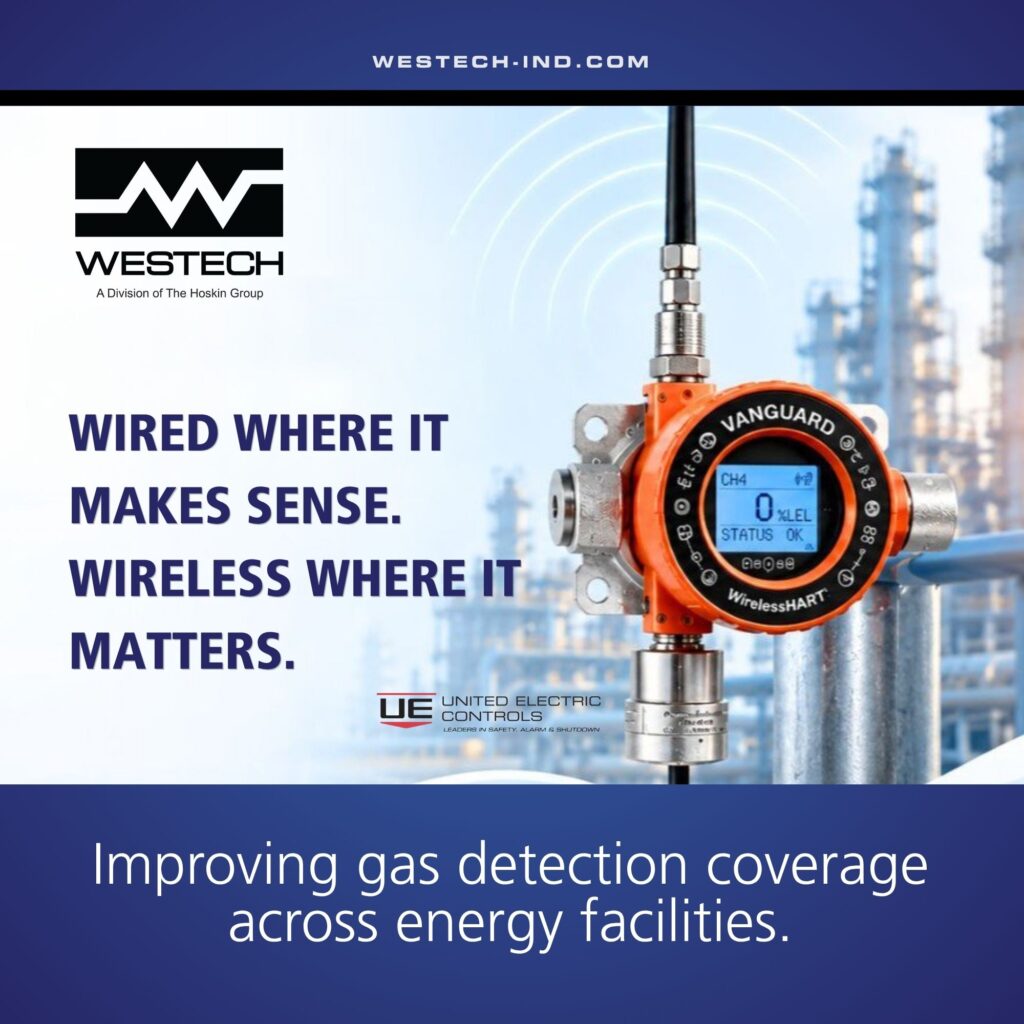
Sensor selection should be based on the actual hazard. For example, UE’s Vanguard WirelessHART fixed-point detector supports methane, hydrogen sulphide, carbon monoxide, ammonia and propane.
What hazardous-area classification applies?
The detector selected must be appropriate for the classified location. UE offers different Vanguard configurations for Groups C and D/IIB locations and Groups A, B, C and D/IIC locations.
How will the information reach operators?
Detection is only one part of the system. Operators also need to consider how gas readings, alarms and device information will be integrated into the site’s DCS, SCADA or other monitoring environment.
What is the maintenance plan?
Wireless does not mean maintenance-free. Sensors still require appropriate inspection, bump testing and calibration, while batteries need to be incorporated into preventative maintenance planning. Vanguard, for example, is designed around a five-year battery and provides external access for bump testing and calibration.
These considerations are important because the real value of wireless detection comes from a properly engineered system, not simply from eliminating a cable.
Looking Beyond the Initial Installation
When assessing wired and wireless alternatives, it is useful to look beyond the purchase price of the detector itself.
The complete installed cost of a conventional detection point can include engineering, cable, conduit, trenching, junction boxes, I/O, electrical labour, commissioning and the operational impact of completing that work in an active facility.
Wireless technology can remove or reduce several of those requirements, particularly in locations far from existing infrastructure.
There are also longer-term considerations. A monitoring point that can be moved or expanded more readily may make it easier to respond to future changes in the facility.
The economics will vary significantly from site to site, which is why the right question is not simply “Is wireless cheaper?”
A better question is:
“What is the most practical way to achieve the gas detection coverage this facility actually needs?”
Closing the Gaps
Gas detection strategies should evolve along with the facilities they protect.
For some applications, conventional wired detection will continue to be the preferred solution. For others, particularly remote, difficult-to-wire or changing locations, wireless fixed-point gas detection can provide a practical way to expand coverage without undertaking a major infrastructure project.
The technology is particularly valuable when it enables operators to stop designing detector locations around available wiring and start putting greater emphasis on where the potential release is most likely to occur.
Ultimately, that is the objective: the right detection technology, monitoring the right hazard, in the right location.
About Westech Industrial
Westech Industrial provides industrial gas detection, instrumentation and process solutions to Canada’s energy sector. Westech is a Canadian distributor for United Electric Controls and offers the UE Vanguard WirelessHART® Fixed-Point Gas Detector and related UE solutions across Canada.
For more information about wireless fixed-point gas detection, WirelessHART integration or determining whether wireless detection is appropriate for a particular application, contact Westech Industrial.
Share This:






















On The Verge: Energy Sector Primed for New Wave of Growth – ATB Economics