


 CDN NEWS |
  US NEWS







By Tim Conn – Special to EnergyNow
For decades, many oilfield service companies have grown through reputation, relationships, field performance and word-of-mouth.
Those fundamentals still matter. But the market has changed.
Customers now research suppliers online before making contact. Competitors are building stronger LinkedIn profiles, publishing technical content, producing video and using better market intelligence. And now artificial intelligence is accelerating that change.
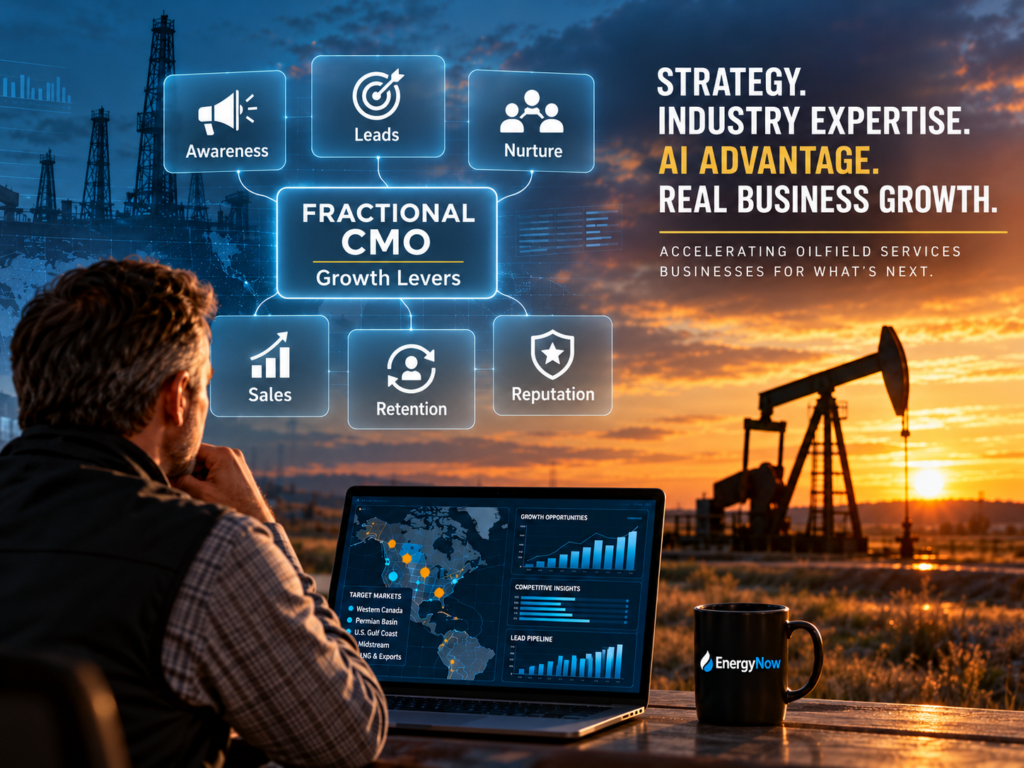
For most small and mid-sized oilfield service companies, hiring a full-time Chief Marketing Officer that is up to speed on the rapidly changing world of AI may not make financial sense. That is where a Fractional Chief Marketing Officer, or Fractional CMO, can provide real value with competitive advantages.
What Is a Fractional CMO?
A Fractional CMO is an experienced senior marketing executive who works with a company on a part-time basis rather than as a full-time employee.
Instead of hiring a CMO for 40 or 50 hours every week, the company gets the portion of senior-level marketing expertise it actually needs.
A Fractional CMO is not simply someone hired to post on LinkedIn or redesign a brochure.
A strong Fractional CMO helps management answer bigger questions:
- Who are our best customers?
- Which markets should we pursue?
- How are we different from competitors?
- Are sales and marketing working together?
- Where should we spend our marketing budget?
- How do we turn marketing activity into sales opportunities?
- How can AI help us do all of this faster and better?
Oilfield Experience Matters
Oil and gas is not a generic B2B market. Selling drilling technology, wireline services, production solutions or specialized field services is very different from marketing a consumer product. Oilfield buying decisions may involve engineers, operations managers, procurement teams, field supervisors and senior executives.
Technical credibility matters. Safety matters. Reliability matters. Field performance matters. And reputation matters.
That is why a Fractional CMO with oil and gas experience can bring more value than a general marketing consultant learning the industry from scratch.
A good industry-focused Fractional CMO should understand the language, sales cycle, customer structure and competitive environment — and help answer one critical question:
Why should a customer choose us instead of a competitor?
Your Digital Presence Has to be Part of Your Sales Team
The traditional oilfield relationship is still critical, but increasingly that relationship begins online.
Before a salesperson receives a call, a potential customer may already have:
- Visited the company website
- Reviewed its LinkedIn presence
- Researched employees and leadership
- Compared services against competitors
- Read technical content
- Watched a video
- Searched the company online
In other words:
Your digital presence has become part of your sales team.
A company may deliver exceptional field results and still do a poor job communicating those capabilities to the market.
A Fractional CMO can help close that gap.
Then Came…AI
Artificial intelligence has changed the Fractional CMO equation again.
Today’s effective Fractional CMO should understand more than traditional and digital marketing.
They should understand AI.
And that means much more than simply knowing how to use ChatGPT.
AI can now support nearly every part of marketing and business development, including:
- Market intelligence: identifying projects, customers, regions and competitors
- Prospect development: researching companies and decision-makers
- Content creation: producing articles, case studies and social media content
- Sales support: preparing account briefs, proposals and targeted messaging
- Competitive intelligence: monitoring technologies and competitors
- CRM support: prioritizing prospects and improving follow-up
- Marketing analytics: measuring what actually produces results
- Video and graphics: producing professional content faster and at lower cost
The key point is that AI should not replace the company’s knowledge.
It should multiply it.
The expertise still comes from the people inside the company. AI provides a faster way to organize, package and distribute that knowledge.
AI Can Help Smaller Companies Compete “Bigger”
Historically, smaller oilfield companies faced a major marketing disadvantage against large multinationals.



Large firms could afford marketing departments, researchers, designers, digital specialists and outside agencies.
A smaller company might have a president, a few salespeople and someone updating LinkedIn when time permits.
AI is beginning to narrow that gap. A capable Fractional CMO using modern AI tools can help a smaller company do work that once required multiple employees or outside suppliers.
Research can be completed faster. Content can be produced more efficiently. Markets can be monitored more closely.
Sales teams can receive better information. Campaigns can be adjusted more quickly.
That does not mean allowing AI to run the marketing department. Technical claims must still be accurate, customer information must be protected, and content must be reviewed by experienced people.
AI creates the most value when it is directed by someone with industry knowledge and judgment.
Marketing and Sales Need to Work Together
Marketing should not exist simply to make a company look good. Its purpose should be to help grow the business.
A Fractional CMO can connect marketing directly to commercial goals.
For example:
- If the company wants to expand into the Montney, which producers should it target?
- If it wants to enter the Permian Basin, who are the key competitors?
- If it launches a new technology, how should it introduce it?
- If it achieves strong field results, how can those results become a case study?
- If it attends a major conference, how can it build awareness before the event and follow up afterward?
These are marketing questions, but they are also business-growth questions.
Why Fractional Makes Sense
Many oilfield businesses need senior marketing expertise but do not need a full-time C-suite marketing executive.
A Fractional CMO provides experienced leadership without the full salary, benefits and overhead of a permanent executive.
That can also free up more budget for execution, including grwoth strategies, digital campaigns, website enhancement, video, advertising, content creation and AI tools.
The result can be a stronger marketing function with a more flexible cost structure.
The Competitive Gap Will Grow
Two oilfield service companies with similar equipment, people and capabilities could have very different growth trajectories depending on how effectively they use AI and digital marketing.
One may still rely on occasional social media posts and the same brochure for every prospect.
The other may use AI to identify opportunities, support salespeople, create targeted content, monitor competitors and strengthen visibility in key markets.
That difference will compound.
Companies that fail to develop these capabilities while competitors adopt them aggressively may increasingly find themselves at a disadvantage.
The oilfield has seen this before with drilling technology, automation and digital field systems.
Marketing and business development may now be entering a similar transformation.
The New Competitive Advantage
A Fractional CMO can provide an oilfield service company with senior-level marketing leadership without the cost of a full-time Chief Marketing Officer.
Add genuine oil and gas industry experience and the value increases.
Add strong AI capabilities and the role becomes even more powerful.
The next generation of successful oilfield service companies will still depend on good people, good equipment, strong relationships and excellent field performance.
But they will increasingly combine those strengths with better marketing, digital tools and artificial intelligence.
And that may be exactly where the modern Fractional CMO earns a seat at the table.
About Tim Conn
Tim Conn is a certified CMO and the Founder and CEO of MAGCON Ventures and a Fractional CMO for EnergyNow. Tim has more than 30 years of domestic and international experience in oil-and-gas technology, sales, marketing, commercialization and management.
He started his career at Shell Canada in drilling and completions, then worked in markets from North and Latin America to Europe, West Africa, the Middle East and Asia. Through MAGCON, he now helps oil-and-gas technology and service companies sharpen their positioning, build disciplined business-development systems, and apply LinkedIn, CRM, automation and AI to practical growth strategy and problems.
Connect with Tim on LinkedIn: https://www.linkedin.com/in/timothyconn/
Share This:





















COMMENTARY: Ottawa’s Bill C-39 Gives Cabinet Permanent Power Over Project Approval – Fraser Institute