


 CDN NEWS |
  US NEWS







By Mark Parsons, ATB Economics

Key points
- The Prime Minister has announced that the West Coast Oil Pipeline proposed by the Government of Alberta has been designated as a project in the national interest. This comes days after LNG Canada confirmed it is proceeding with its Phase 2 expansion project.
- The designation means that Ottawa will fast-track the project’s federal approvals and reviews.
- If built, the project fundamentally changes the outlook for the Alberta economy, with material impacts on Canada’s economy as well.
“We have to do this. Because the world faces an energy crisis…”
—Prime Minister Mark Carney in Fort McMurray, October 1, 2026
This has been a big week for Canadian energy.
On Monday, LNG Canada confirmed its final investment decision for LNG Canada Phase 2, doubling the capacity of its existing facility.
Today, PM Mark Carney announced that the West Coast Oil Pipeline, now called Pacific Link, is officially proceeding as a project of national interest under the Building Canada Act. This is the first such designation made under the Act.
Over the next year, the Canada Energy Regulator and the Major Projects Office will conduct a review process that will result in a set of federal conditions for the project regarding ownership, benefits, respect for Indigenous rights, environmental protections, and local hiring and oversight. The goal is to have the conditions and federal permits finalized by September 1, 2027.
Shot in the arm for the economy
According to the news release, Pacific Link will “create 140,000 jobs across the country and generate over $20 billion in GDP per year, and $100 billion in government revenue by 2060.”
We have been digging into the economic impacts for some time. Last March, ATB Financial, in partnership with Studio.Energy, estimated the impact of building and filling an oil pipeline to the B.C. coast with a capacity of 1 million barrels per day combined with an additional 500,000 barrels per day of new capacity via expansions to existing pipelines and the construction of the Pathways carbon capture project. We found that filling the pipelines would require about $100 billion in upstream capital spending, in addition to over $40 billion in pipeline construction and around $20 billion for the Pathways project.
Compared to the status quo of largely maintenance and sustaining capital investment, these projects will lift real upstream oil and gas investment in Alberta by around 30% over the period from 2028 to 2036 as shown below. As these investments translate into higher oil production, exports will drive GDP growth.
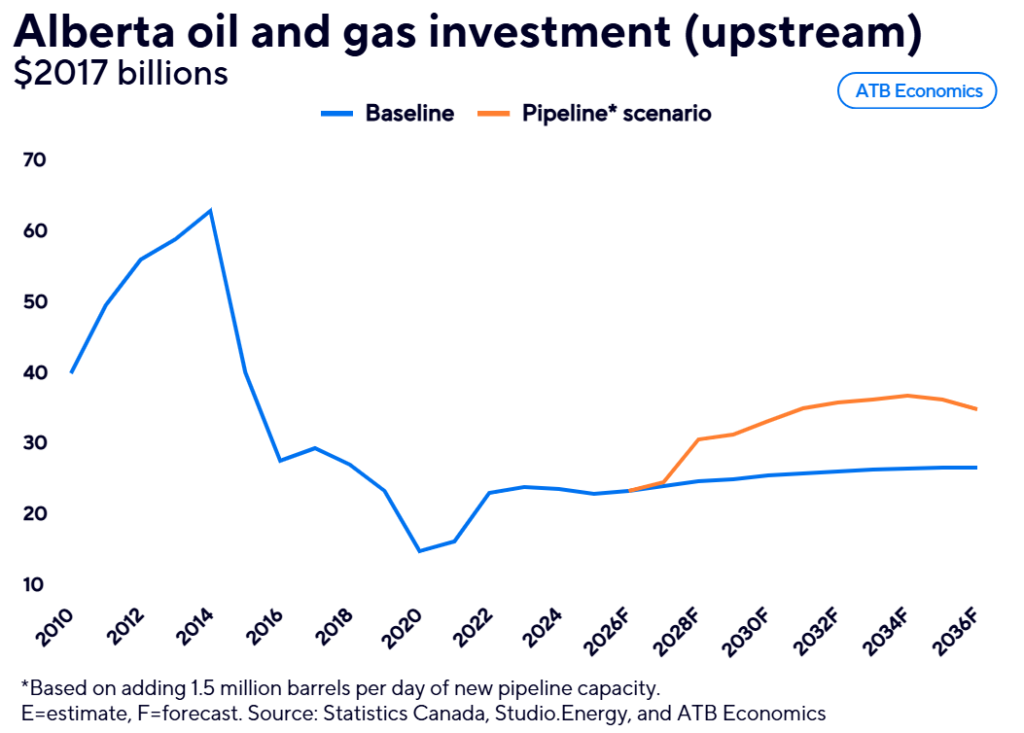
Isolating the West Coast Pipeline and Pathways carbon capture project and assuming construction begins in late 2027, we estimate the annual impact on Canada’s real GDP is $20-25 billion/year (in 2017 dollars) over the period from 2028 to 2036. We estimate the projects will lift Canadian employment by 80,000-90,000 over this period.
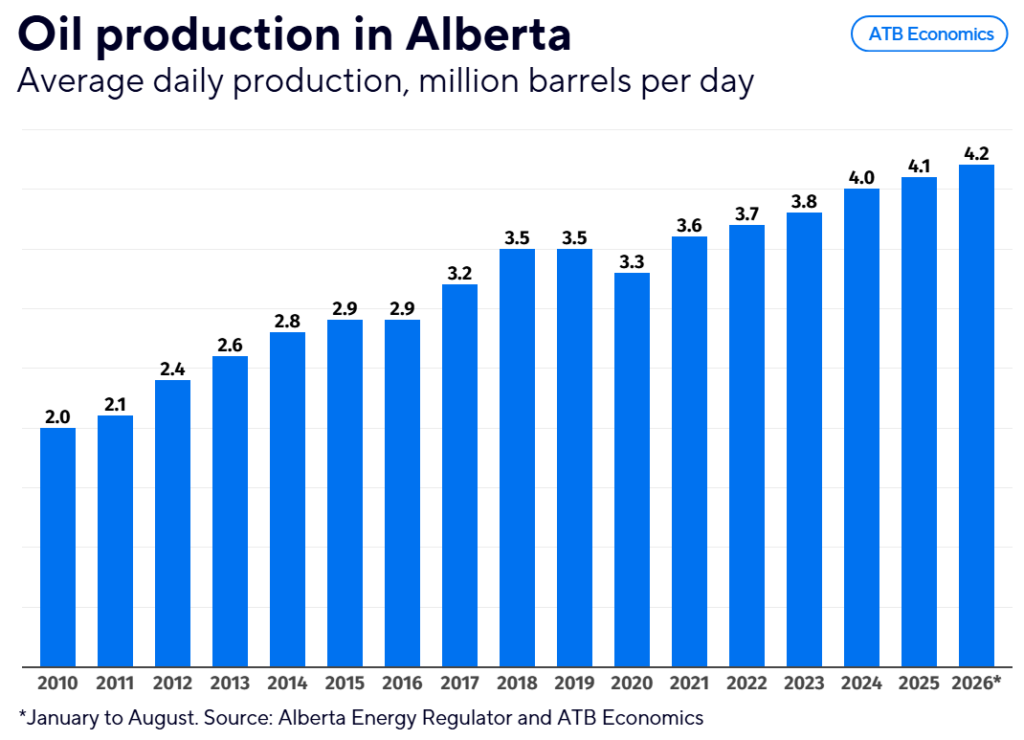
Currently, Alberta produces about 4.2 million barrels per day (see the chart below). Including other provinces, namely Saskatchewan and Newfoundland and Labrador, pushes that total to over 5.3 million barrels per day. Recent production growth has largely come from optimizations of existing facilities, as opposed to new greenfield projects.



Should the project actually proceed (and companies move to fill the pipe), the impact on our forecast is material. Our outlook released last week does not include a new pipeline to the B.C. coast and forecasts Alberta real GDP growth of 2.4% per year over the next 3 years. These projects could push that growth rate to 3-4% in 2028 and 2029.
To understand why the impact is so large, consider the starting point. Energy exports from Alberta represent 76% of its total merchandise exports, and 26% nationally in 2025. Bitumen and crude oil account for most of that at about 67% of Alberta’s exports (18% nationally). Further, oil and gas capital spending was just over $30 billion (in current dollars), or more than 40% of business investment spending in the province last year.
Hitting Mark Carney’s economic goals
Last year, I argued that it would be difficult for the PM to hit his ambitious economic goals without a project like this. These goals include catalyzing $1 trillion in investment over the next 5 years, doubling non-U.S. exports in 10 years, and making Canada an energy superpower.
PM Carney mentioned all three in his speech when justifying the national interest designation.
It’s hard to think of many infrastructure projects that can move the economic needle as much as this one. It’s not the economic impact of building a pipeline that provides the largest jolt—it’s the impact of filling the pipeline through new greenfield projects and expansions, and the long-term lift to production and exports as productive capacity expands.
By accessing overseas markets, the pipeline would also help to stabilize and narrow the price differential Canada receives on its oil, raising producer revenues and government royalty revenues.
Progress has been made in accessing non-U.S. markets with the completion of the Trans Mountain Expansion. Still, the U.S. captured about 90% of Canada’s global oil exports last year. The Pacific Link pipeline would structurally reduce Canada’s market concentration risk.
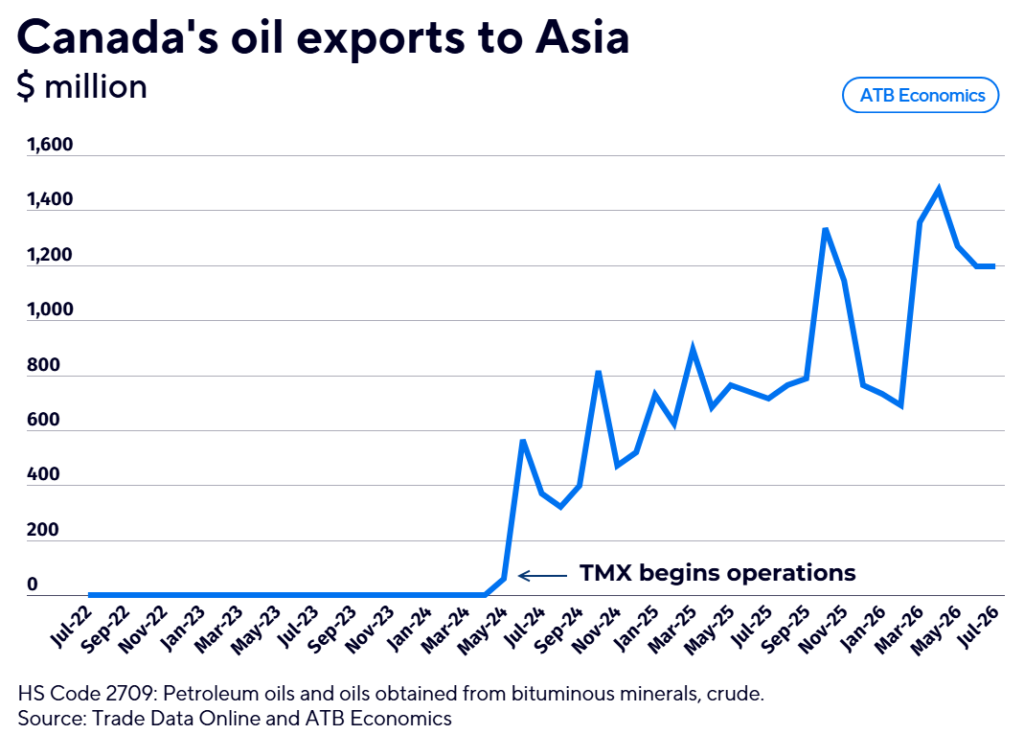
This is progress, but still not across the finish line. We’re still treating it as upside in our forecast until there are final investment decisions.
Backgrounder: How did we get here?
Alberta and the federal government signed an MOU committing to the idea last November, released an implementation agreement in May, and Alberta submitted its proposal to the federal Major Projects Office in July.
Also in July, Alberta, the federal government, and the Oil Sands Alliance signed an MOU aimed at advancing the Pathways carbon capture project that Ottawa has tied to its approval of the pipeline.
That brings us to today. In a joint announcement with Premier Smith, Prime Minister Carney said that the pipeline has been designated as a project in the national interest under the Building Canada Act.
As a result, the federal approvals and regulatory reviews of the project can now be “fast-tracked.”
Share This:






















On The Verge: Energy Sector Primed for New Wave of Growth – ATB Economics