CDN NEWS |
  US NEWS







By EnergyNow Media
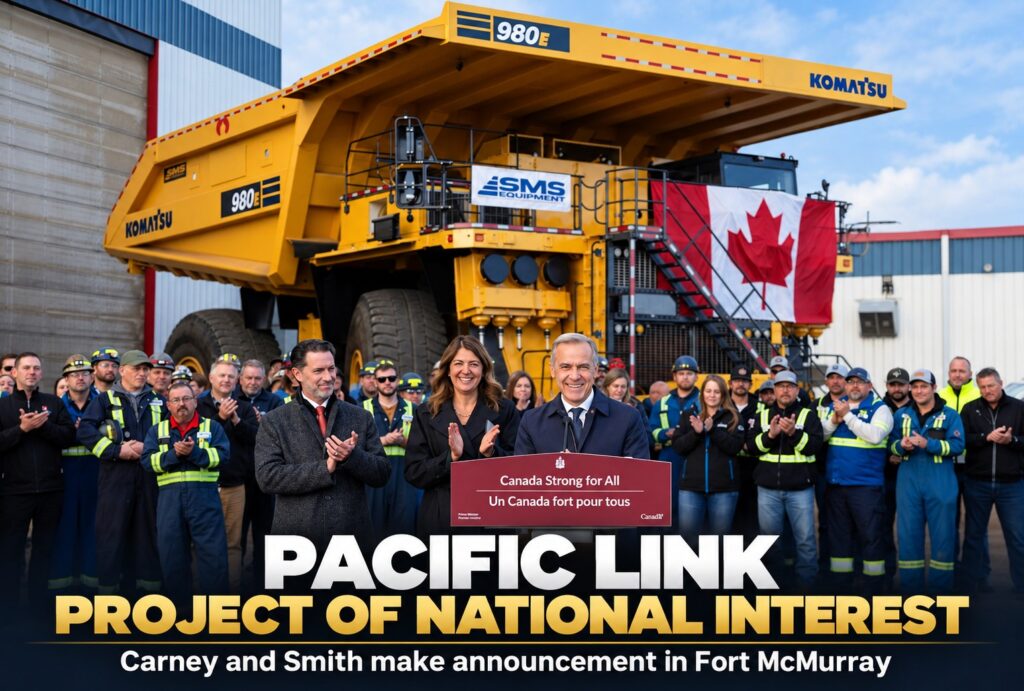
FORT MCMURRAY, Alberta — Canada’s proposed new West Coast oil pipeline has cleared one of its most important political and regulatory hurdles, with Prime Minister Mark Carney formally declaring the project to be in Canada’s national interest.
Standing alongside Alberta Premier Danielle Smith in Fort McMurray on October 1, Carney announced that the West Coast Oil Pipeline — now officially known as Pacific Link — has been listed as a Project of National Interest under the federal Building Canada Act.
It is the first project to receive the designation under the legislation.
The decision moves the proposed one-million-barrel-per-day pipeline into an accelerated federal review process and represents a major milestone in Alberta’s long-running effort to secure additional pipeline capacity to the Pacific Coast.
“Canada has a once-in-a-generation opportunity to become a global energy superpower,” Carney said. “To transform our economy. To diversify our trade. To become less reliant on a single trade partner.”
Carney said Pacific Link is “critical to this mission,” adding that Canada intends to build the project “boldly, sustainably, and in true partnership with Indigenous Peoples.”
The proposed pipeline would transport approximately one million barrels of crude oil per day from Alberta to British Columbia’s southern coast, opening significantly more capacity for Canadian oil to reach Asia-Pacific and other international markets. Reuters reported that the project would run roughly 1,250 kilometres from the Bruderheim area near Edmonton to a marine terminal near Delta, B.C.
For Alberta, Smith characterized Thursday’s announcement as a significant change in the relationship between Ottawa and the province on energy infrastructure.
“Today marks a significant victory for Alberta’s and Canada’s energy future,” Smith said.
“The listing of Pacific Link as a project of national interest demonstrates what can be achieved when governments work together to advance nation-building infrastructure.”
Smith said the project would expand market access, strengthen the economy and reinforce Alberta’s role as a reliable supplier of energy to international markets.
At the Fort McMurray announcement she also described the development as a turning point after years in which major energy projects struggled with regulatory uncertainty.
“For too long, we’ve watched projects with enormous transformative potential get mired down in uncertainty and delay, and today we’re turning the page,” Smith said.
National-interest designation changes the process
Thursday’s announcement does not constitute final approval to begin construction.
Instead, listing Pacific Link under the Building Canada Act allows the project to proceed through a single federal regulatory review process designed to coordinate approvals that would otherwise be handled through several departments and pieces of legislation.
The Major Projects Office, supported by the Canada Energy Regulator, will now lead the federal process. Ottawa says that will include Indigenous consultation, public hearings and reviews of the project’s technical, environmental, social, cultural, health and safety impacts.
The federal government is targeting September 1, 2027 for completion of the conditions required to move the project toward construction.
Carney said the pipeline is central to a wider Canadian strategy aimed at reducing reliance on the United States.
“Today, 90 per cent of Alberta’s oil goes to the U.S.,” Carney said in Fort McMurray.
“Pacific Link will materially reduce that dependence by allowing us to export an additional one million barrels a day to growing markets in Asia.”



Canada currently exports more than 90 per cent of its crude oil to the United States. The Trans Mountain Expansion, completed in 2024, substantially increased access to the Pacific but is already operating at or near capacity.
Ottawa estimates Pacific Link could create approximately 140,000 jobs, generate more than $20 billion annually in Canadian GDP, and produce roughly $100 billion in government revenues by 2060.
Ottawa and Alberta to share ownership
The proposed ownership structure would also make Pacific Link very different from most privately financed Canadian pipelines.
Canada and Alberta intend to share equal ownership, with the federal government participating through Trans Mountain Corporation and Alberta through the Alberta Petroleum Marketing Commission.
Indigenous communities will be offered a minimum 10 per cent ownership interest, supported by federal and provincial Indigenous loan-guarantee programs.
Pembina Pipeline Corporation is participating as the private-sector partner and will contribute engineering, development and project-execution expertise.
Pembina currently expects to hold a 10 per cent economic interest through construction, with the option to acquire an additional 10 per cent once the project is operating. The company stressed Thursday that any final investment decision remains subject to its own financial and capital-allocation requirements.
Trans Mountain Corporation is expected to lead the regulatory process, Indigenous and stakeholder engagement, construction and eventual operation of the pipeline.
Current estimates put the project’s cost at approximately $35 billion to $44 billion, although detailed engineering, route work and procurement remain ahead.
A much bigger Canadian energy strategy
Pacific Link is also closely connected to the broader Canada-Alberta energy agreement.
Ottawa says it is advancing the proposed Pathways carbon capture and storage project alongside the pipeline, while expanded marine infrastructure and environmental protection measures on the B.C. coast are intended to accommodate increased energy exports.
Earlier this week, Carney announced $1.2 billion in new federal spending for ocean protection, marine traffic monitoring, spill-response capability and other measures as Canada prepares for potentially higher shipping volumes on the Pacific Coast.
For Canada’s oil industry, however, the most immediate significance of Thursday’s announcement is market access.
A million additional barrels per day reaching tidewater would substantially increase Canada’s ability to sell crude directly into global markets rather than relying overwhelmingly on U.S. refiners.
“A pipeline to the West Coast is part of our mission to transform our economy, to double our non-U.S. exports over the next decade,” Carney said, describing the broader objective as unlocking Canada’s potential as a global energy supplier.
There are still major hurdles ahead, including Indigenous consultation, detailed engineering, environmental conditions, financing, shipper commitments and final regulatory requirements.
But October 1 represents a significant change in Pacific Link’s status.
What began as an Alberta proposal is now formally designated by Ottawa as a project in the national interest of Canada.
The next test will be whether governments, industry and Indigenous partners can translate that political designation into permits, financing — and ultimately steel in the ground.
Watch the Announcement Here
Share This: