


 CDN NEWS |
  US NEWS









There is a basic credibility gap in how the debates about LNG and other major projects are framed.
By Geoff Russ
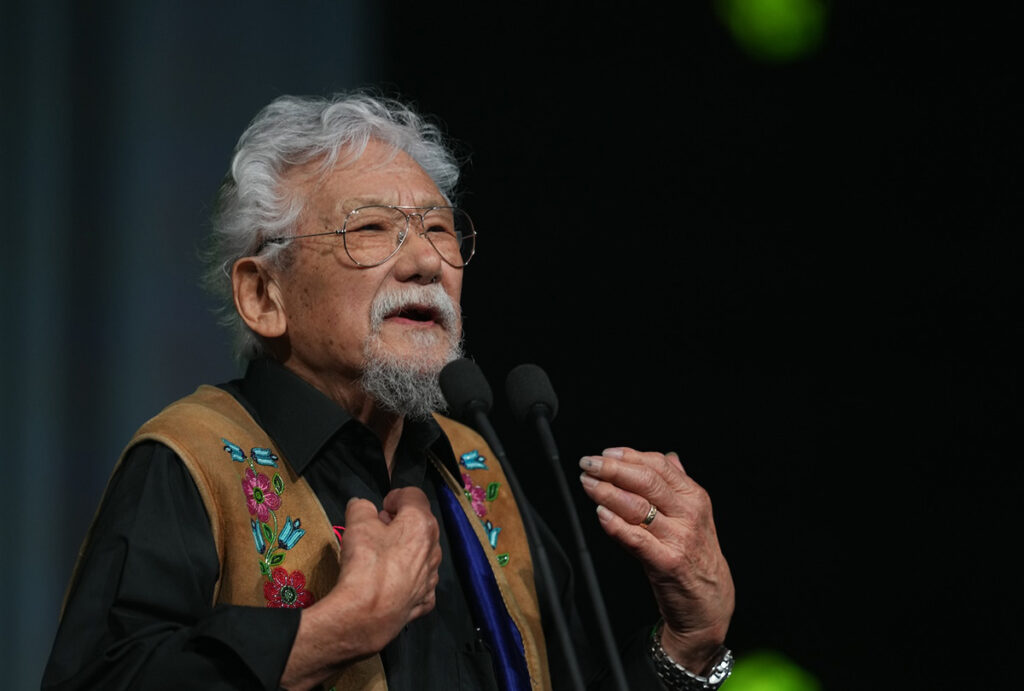
Noted LNG critic David Suzuki speaks during the Juno Awards Gala in Vancouver, on Saturday, March 29, 2025. THE CANADIAN PRESS/Ethan Cairns.
By Resource Works
More News and Views From Resource Works Here
The loudest voices against British Columbia’s liquefied natural gas build out are often the ones furthest from the hard work of building anything at all.
A familiar pattern has set in as the province’s export industry moves from proposal to production. Advocacy groups and professional campaign organizations argue that LNG is a dead end, a fiscal boondoggle, or a climate betrayal. Yet the institutions actually financing, regulating, contracting, and constructing projects are talking about offtake, power supply, engineering risk, and Indigenous governance, not ideology.
Moving from proposal to production
Canada’s first large scale LNG export facility, LNG Canada in Kitimat, loaded its first cargo on June 30, 2025, and brought its second processing unit, Train 2, into production in early November 2025. That is what progress looks like in the real economy, a project delivers a cargo, then it ramps up, solves problems, and ships again.
A February 2026 report from Norton Rose Fulbright describes 2025 as a pivot year, with LNG Canada starting exports and other projects advancing, while global liquefaction capacity is expected to grow sharply between 2026 and 2028, adding an estimated 170 million tonnes per annum.
The report notes that LNG Canada Phase 2 is expected to be a 2026 final investment decision candidate, and that Ottawa’s Major Projects Office has designated both LNG Canada Phase 2 and a second major B.C. LNG proposal as projects of national interest, alongside a related transmission project.
The advocacy narrative vs. reality
Opponents have their own narrative.


A David Suzuki Foundation climate policy adviser wrote in Business in Vancouver that B.C.’s Look West strategy leans into LNG, claiming LNG is mentioned 27 times in the plan while “climate” appears four times, and arguing that the province is betting on an industry facing oversupply. The Suzuki Foundation also urges the public to oppose LNG, arguing, among other claims, that the sector depends on subsidies and preferential treatment.
But there is a basic credibility gap in how the debate is framed.
Campaign groups can publish reports and pressure politicians, but they do not have to secure long term customers, negotiate construction contracts, or guarantee performance. They do not have to run a facility for 30 years, under safety rules, on tight margins, while being audited, inspected, and sued if they breach conditions. They are not accountable for attention, no delivery.
Indigenous ownership and the weight of criticism
On the other side of the argument are project partners whose incentives are brutally simple. If the facility does not ship LNG at competitive cost, it fails. If the pipeline is not built to completion, it fails. If the power supply is not there, it fails. If partnerships with local Indigenous governments do not function, it fails.
That last point is routinely minimized by critics, even though Indigenous participation is one of the defining differences between Canada’s LNG build out and older models of resource development.
In British Columbia, Indigenous governments are equity owners, proponents, and in at least one case, recognized environmental regulators for an industrial project, a structure that required a level of consent and institutional capacity.
None of this settles the climate argument, and it does not erase legitimate disputes over land, wildlife, or cumulative effects. It does, however, clarify what kind of criticism deserves weight.
If a group’s main contribution is to say no, while others do the financing, the permitting, the engineering, the construction, and the governance, then the group is not offering an alternative energy strategy. It is offering a veto, with none of the responsibility that comes with building.
In a world where LNG supply and demand are both shifting, organizations that have never built major projects ought not to dictate the fate of the ones that are being built.
Geoff Russ is a writer for Resource Works, a non-partisan organization that champions responsible resource development in British Columbia and Canada. Reach Geoff at [email protected].
Share This:





















COMMENTARY: Carney’s Command of Canada’s Projects: What Gets Built, What Gets Blocked, and Who Decides – Ron Wallace