


 CDN NEWS |
  US NEWS







By Robert Tuttle and Iain Boekhoff
Alberta’s push for a new oil pipeline to carry 1 million barrels a day to the west coast is colliding with a hard question for Canada’s energy companies: Can they produce enough oil to fill it?
Alberta Premier Danielle Smith has championed the project, which would be one of the largest conduits for exporting heavy crude from her province. It coincides with existing pipeline operators also growing their capacity. As she put it recently: “This is the single greatest expansion of pipelines in decades.”
Smith and Canadian Prime Minister Mark Carney share a goal of diversifying exports to become less reliant on the US. Selling more oil to growing Asian markets such as India and China will allow Canada to get better prices per barrel, they believe, boosting Alberta’s wealth and helping shield the economy from the protectionism that has defined US trade policy under Donald Trump.
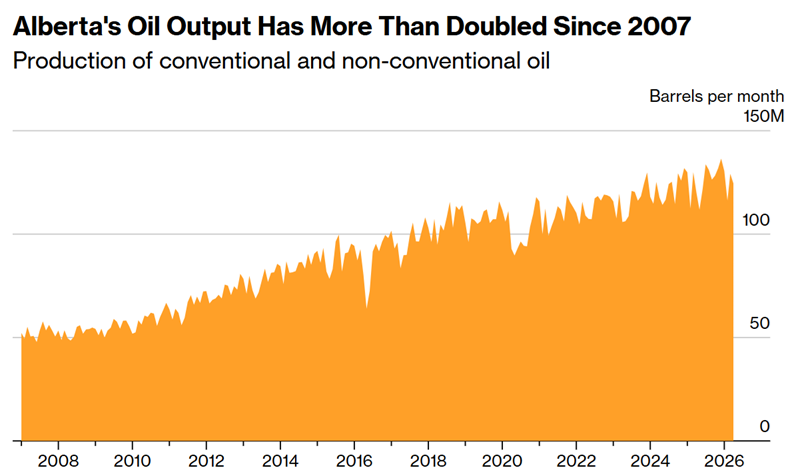
But Alberta producers, which ship a little more than 4 million barrels a day, are raising doubts about whether they can increase production fast enough — or whether they even want to. The economics of pumping more oil out of western Canada look less attractive today than just a few weeks ago, now that tankers are moving again through the Strait of Hormuz and global crude prices are declining toward prewar levels.
Source: Government of Alberta
It’s a question of capital. A new west coast pipeline is certain to cost tens of billions of dollars, and governments are pushing Alberta’s largest oil sands companies to build a carbon-capture system to reduce emissions from their production sites. Executives estimate that may cost more than C$20 billion ($14.1 billion) over time.
Expanding oil sands projects to add more than 2 million barrels a day, the amount needed to fill the new pipelines, would be even more expensive.
Industry leaders and analysts have estimated the industry would need C$100 billion to do all of these things. And there’s an open debate as to whether investors, accustomed to share buybacks and rising dividends, are willing to stomach a pivot to growth.
“To date it has been assumed that the Canadian oil and gas producers will invest tens of billions of dollars necessary to grow production and make the 1 million barrel-a-day pipeline to the west coast a reality,” Cenovus Energy Inc. Chief Executive Officer Jon McKenzie said at a conference in Calgary. “But the reality is Canadian oil sands producers are not investing much beyond sustaining capital today.” He said the industry needs regulatory relief from the Canadian and Alberta governments.
Investment in the oil sands has slumped since crude prices plummeted below $100 a barrel in 2014. Amid surging US shale oil production, prices averaged around $60 a barrel for more than a decade, forcing Canada’s oil sands companies to slash spending, cancel or sideline planned new projects and become more efficient.
Rather than building oil sands megaprojects, companies have grown gradually by expanding existing operations. Between 2015 and 2025, Canada’s oil output grew about 41%, compared with more than 50% growth in the 11-year period before that, Canada Energy Regulator data show.



The slower-growth strategy brought down costs but also changed the kinds of investors interested in the sector, according to Charles St-Arnaud, chief economist at Alberta’s Servus Credit Union. Rather than seeing oil sands as a growth opportunity, shareholders sought more dividends and stock buybacks. And companies have used their surplus cash flow to pay down debts.
“The shareholders are the ones who are going to decide yes or no if the investment happens,” St-Arnaud said. If bigger capital expenditure is at the expense of lower dividends, “it’s not clear those shareholders are willing to go there.”
The curtailment of Middle East exports due to the Iran war has prompted buyers in Asia to look for alternative sources of oil. That may bring back growth-minded investors to the Canadian oil sands or attract Asian countries more interested in supply security than quick returns, St-Arnaud said. Otherwise, he said the expansion projects needed to fill the pipeline space may require partial government ownership.
The Middle East conflict has probably changed investor sentiment in favor of faster production increases, TD Cowen analyst Menno Hulshof said in a video interview. “I think the market on balance is a little bit more open to that, simply because of Canada’s role in the broader energy security conversation.”
Smith has proposed a new oil pipeline to the British Columbia coast as part of her government’s goal to eventually double oil production in Alberta. Carney is more open to the idea than his predecessor, Justin Trudeau, who rejected a similar proposal from Enbridge Inc. about a decade ago.
Carney also agreed to other industry-friendly changes, including lifting a cap on oil and gas emissions, and struck a deal with Smith on an industrial carbon tax.
But the so-called “grand bargain” between Smith and the prime minister has received a lukewarm reaction from oil executives.
Oil sands investment alone will need to double at a time when Canada is competing for money with places that don’t have a carbon tax, said Nick McKenna, president of ConocoPhillips Canada. “I’m challenged to see how I square the ambition with the current cost framework,” McKenna said.
The sharpest words have come from Cenovus’s McKenzie, who said the pipeline to BC was “unfinanceable” under current regulations. He called the carbon tax “insidious” and questioned the value of the carbon-capture project — even though his company is part of the industry group that proposed it.
Alberta is preparing to announce details of its pipeline by July 1, with a goal of starting construction as early as next year. In the meantime, competing proposals are charging ahead.
Enbridge and government-owned Trans Mountain Corp. are planning expansions equal to about 700,000 barrels a day in the next few years. At the same time, South Bow Corp. is teaming up with Bridger Pipeline LLC on a proposal for a new 550,000 barrel-a-day line that’s akin to a smaller version of the canceled Keystone XL project.
Norman Levine, a portfolio manager at Brook Wagman Private Wealth — Raymond James Investment Counsel, said companies can increase capital expenditure to fill pipelines while continuing to pay shareholders. He’s an investor in Suncor Energy Inc., Canadian Natural Resources Ltd. and, since January, Cenovus.
“They’re going to have to take on more debt to expand some, but it will be paid down quickly,” he said. “They’ve seen how shareholders react when times are good. They don’t want to take that away. Bigger isn’t aways better. Better is better.”
Share This:





















