


 CDN NEWS |
  US NEWS







By Julio Mejía and Tegan Hill
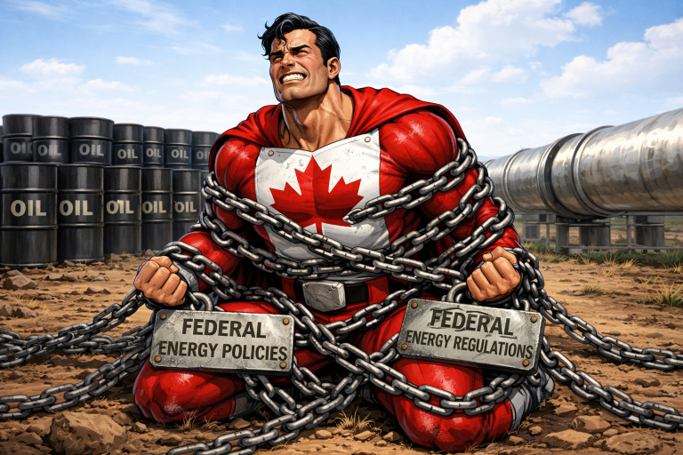
The United States and Iran have signed an interim ceasefire agreement that could soon help restore regular oil and gas flows through the Strait of Hormuz, a vital global energy corridor. But even if the disruption in the strait is resolved, the world urgently needs stable and reliable energy suppliers. Canada is well positioned to help meet that need—if we fix our regulatory system.
Roughly one-quarter of global seaborne oil trade and one-fifth of liquefied natural gas (LNG) shipments pass through the Strait of Hormuz, much of it bound for China, India, Japan, South Korea and Europe. While the strait’s reopening may ease energy markets, this decade has already shown how quickly geopolitical conflicts can threaten global energy supply. The European Union, for instance, was forced to replace roughly 45 per cent of its gas imports and 27 per cent of its oil imports after Russia, which supplied those shares, re-emerged as a security threat following its invasion of Ukraine in 2022. As a result, global competition for energy resources intensified, helping fuel higher energy prices and inflation worldwide.
More broadly, the critical infrastructure of major oil and gas producers in the Middle East remains exposed to the region’s long-running conflicts. Iranian strikes reportedly knocked out up to 17 per cent of Qatar’s LNG export capacity, damaged major refineries in Kuwait, halted Saudi Arabia’s refineries and closed one of the world’s largest gas processing complexes in the United Arab Emirates.
Clearly, the world needs stable and reliable energy suppliers. And if, as Prime Minister Mark Carney warned earlier this year, the world is “in the midst of a rupture,” Canada can leverage its immense resources to improve global energy security and increase prosperity here at home.
Unfortunately, policy barriers limit Canada’s ability to achieve these goals.



For example, federal Bill C-48, enacted by the Trudeau government, bans large oil tankers from accessing ports along British Columbia’s northwest coast, weakening the case for a new Pacific-bound pipeline from Alberta to overseas markets. That matters because Canada’s energy exports remain heavily concentrated in the United States, which received 90.8 per cent of Canada’s oil exports and virtually all of its natural gas exports in 2025.
And Bill C-69, also enacted by the Trudeau government, added subjective criteria—including the impact on the “intersection of sex and gender with other identity factors”—to the review process for energy projects including pipelines. Not surprisingly, in the first five years of this law, only one project cleared the full assessment process, after roughly three and a half years of review. Under the previous system, 17 projects were approved over the same period.
Then last year, the Carney government introduced Bill C-5, which gave the federal cabinet—and effectively, the prime minister—the authority to select “national interest” projects for fast-tracked approval. But while the government identified 15 projects as candidates for fast-tracking under the bill, none have been formally designated for faster approval. In fact, project proponents have warned that this new process could expose them to additional legal challenges related to Indigenous consultation requirements, further delaying approvals. So rather than fix the bottleneck, Ottawa made project approvals more uncertain and dependent on political discretion, not clear rules—hardly an incentive to invest and produce in Canada.
And the Carney government still clings to Trudeau-era policies that raise the cost of Canadian energy projects. These include tighter methane regulations, which will cost the energy industry tens of billions of dollars, and an industrial carbon tax hike that adds costs to transporting, processing and producing energy in Canada—a burden not imposed by other major energy producers around the world.
Indeed, investment in Canada’s oil and gas sector has weakened significantly, plummeting from $84.0 billion in 2014 to $35.7 billion in 2024—a 57.5 per cent decline after inflation. And 2026 investment is expected to continue that trend. The last thing Canada needs is policies that continue to deter investment and leave fewer resources to explore new fields, expand critical infrastructure and provide reliable energy.
As demand for reliable energy grows, Canada’s potential as a global provider of energy security remains largely untapped beyond the U.S. market. Ottawa must enact competitive policies that attract investment and allow producers to supply the energy the world demands.
Share This:






















On The Verge: Energy Sector Primed for New Wave of Growth – ATB Economics