“….. rather than reform the regulations and cut the red tape that discourage vital infrastructure projects, including pipelines, Carney chose to grant himself and his cabinet new powers to reject or bless projects based on their personal preferences.”
Get the Latest Canadian Focused Energy News Delivered to You! It's FREE: Quick Sign-Up Here
The Carney government, after securing a narrow majority through political, rather than electoral, means has consistently advanced an agenda that has been characterized as moving toward a “New World Order.” Carney’s governing style has been increasingly defined by centralized federal decision-making, disciplined top-down strategies with legislation and regulation implemented through a steadily centralized public service. Although these measures do not amount to economic central planning per se, they reflect a CEO management style in which authority is focussed upon strategic priorities that favour rapid execution of favoured projects. Instead of encouraging a market-responsive policy environment, this approach appears designed to direct, if not control, federal agencies with a government run like a “Fortune 500 company,” with little time for consultation and a strong focus on implementing the Prime Minister’s personal agenda – one that is advanced and enabled through the Building Canada Act (BCA), and specifically through the Major Projects Office (MPO). These Acts are designed to streamline Ottawa’s centralized approval powers and accelerate “nation‑building” projects by giving the federal executive, including the PMO, greater control.
Many critics view this as technocratic overreach, particularly given the new powers granted to the Prime Minister and Cabinet to approve or reject projects based on their own preferences, within the very broad criteria set out in the BCA. This CEO style of governance that has centralized regulatory authority is unquestionably a response to the Trudeau government’s punitive, often obstructive, regulatory policies. Carney has moved away from Trudeau-era mandate letters and has instead set out a single set of seven national priorities for his Cabinet. This marks a significant structural change in federal governance, one that centralizes agenda‑setting, tightens strategic control, and fundamentally alters how ministers, departments and the public understand federal direction.
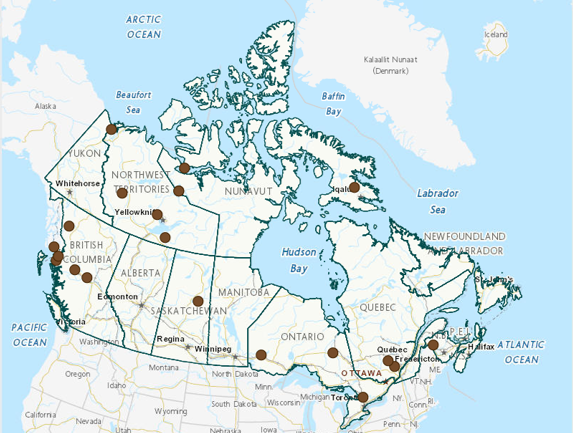
Location of projects referred to the Major Projects Office for further review as of June 29, 2026 – Map from Major Projects Office website
What has all this to do with Alberta?
The consequences of the Carney-Smith ‘Grand Bargain’ that led to the Canada-Alberta MoU that was signed with much fanfare on November 27, 2025 are only now beginning to emerge. One consequence is the creation of two different classifications, with different sets of regulations and different cost structures, for Canadian oil producers. Western Canada’s producers are to be forced to shoulder costly and technically challenging “decarbonization” requirements. This means that Canadian-produced oil would have to enter competitive international export markets at a significant, if not ruinous, competitive disadvantage risking not only corporate profitability but market share. Meanwhile, these policies would allow eastern Canadian oil refiners to import and refine “carbonized” oil from the USA and other countries with significantly looser environmental standards.
Meanwhile, more questions are emerging about the viability of any projects considered under the MoU, not the least of which is their commercial viability. Experts have noted that: “For a pipeline to be commercially viable, you need to have producers saying, ‘Yes, we want this. We’re ready to sign up for it.’ We haven’t heard that.” Many senior industry executives have been loath to embrace the “Grand Bargain” of the MoU as they recognize that investment in the oil sands would have to increase significantly to meet aspirations for Alberta’s production targets. For example, Nick McKenna, president of ConocoPhillips Canada stated that: “I’m challenged to see how I square the ambition with the current cost framework.” Not the least of these concerns is that the Carney government, under pressure from its own Cabinet, now appears to be backing down on a major part of its commitment to the MoU to change legislation and fast-track major projects in Alberta. And then there are the material concerns raised by Kaplan of the as yet undisclosed costs to Albertans and capital investors that will be required to meet the 8 bpd target for oil production – costs estimated at as much as $150 billion.
Now, in a landmark study, Jack Mintz has assessed the economic impacts on Alberta’s competitiveness arising from the Smith-Carney MoU. He concluded that:
“This system does “put a price on carbon” but its effect is to reduce Alberta’s tax advantage. Even with a tax of only $95/tonne of carbon emissions, Alberta loses most of its tax edge for oilsands investment and is at a distinct tax disadvantage for investment in conventional crude and power. Things get even worse at $170/tonne, which was originally planned to kick in in 2030. With that rate of tax, Alberta loses all of its tax competitiveness, except in natural gas.”
A broader conclusion is inescapable: Canada’s carbon policies create tax and economic disadvantages that impact not just Alberta but Canada as a whole. In effect, implementation of the MoU would appear to hobble, if not completely disable, the western Canadian hydrocarbon economy. The MoU provides for significant economic and tax penalties for western Canada but allows a free pass for eastern Canada by imposing inconsistent regulatory measures that consider policies for Net Zero to be not only attainable but desirable.
Significantly, Cenovus CEO Jon McKenzie announced that open‑ended carbon taxes and CCS‑linked decarbonization requirements are untenable, uneconomic and “unfinanceable” for oil sands producers. He stated explicitly: “Industry has been clear that the industrial carbon tax is insidious and it should be revoked.” It is noteworthy that no other major oil sands CEO or industry entity has publicly supported the May 15, 2027, carbon‑pricing deal.
At a time when significant announcements are pending regarding a potential major west coast pipeline from Alberta, industry capital is flowing almost entirely into incremental expansions of existing pipelines, not into new greenfield megaprojects. Only one Canadia oil pipeline (Trans Mountain) presently reaches the western tidewater market. It may not be a coincidence that incremental expansions of existing pipelines currently under way avoid the federal “decarbonization‑first” conditions required by the Carney government for any new West Coast pipeline. Clearly, investors appear to be choosing low‑risk incremental capacity within the existing regulatory framework, rather than working with the MPO, for federally conditioned megaprojects.
At a time of international price volatility marked by falling oil prices, Alberta and the Carney government may be approaching a crossroads, one in which provincial interests are, yet again, confronted by centralized federal decision-making. The federal government has made it clear that “there’s no pipeline without Pathways and no Pathways without a pipeline.” This condition, and others that include requirements for Industrial Carbon Pricing, could yet lead to a breakdown in efforts to finance and advance major projects in Alberta. Given the increasingly wobbly support by the Carney government for its commitments under the MoU, Alberta should carefully reconsider its obligations, and financial commitments, under it. The extraordinarily punitive financial conditions set by the Canada-Alberta MoU could ultimately lead to an abandonment of the Pathways CCUS Project and the collapse of the proposed west coast pipeline. In addition to incurring needless economic costs for Canada, these events could further inflame the separatist argument within Alberta.
Ron Wallace is a former Member of the National Energy Board


 CDN NEWS |
  US NEWS






























SETTING OFF ALARM BELLS: Carney’s EU Deal Threatens Alberta, Energy, & Sovereignty – 170,000 Reasons to Reject Canada’s EU “Associate Membership” – The Nemeth Report