


 CDN NEWS |
  US NEWS







How the newly unveiled national nuclear strategy aims to secure domestic power grids and expand global energy exports
By Karen Graham

By Resource Works
More News and Views From Resource Works Here
Does Canada need a nuclear energy strategy? Yes (domestically), and yes (internationally).
For decades, Canada’s nuclear energy sector has operated in a netherworld, without a clear policy framework or articulation of national interest by the federal government. For provinces utilising nuclear reactors for power generation, the value proposition is likely self-evident, and for those who do not, there has not been a direction or document for policymakers, industry, regulators, electricity sector analysts or the public to reference regarding nuclear’s potential to alleviate Canada’s coming acute electricity strain.
Similarly, the uranium extraction sector has operated relatively quietly, exporting 90% of its world-class production from world-class reserves, but without a strategy connecting extraction to domestic generation, to boosting exports – a significant comparative advantage – or to innovations that will underpin the next generation of reactors propelling domestic and international electricity system applications. Its contribution to energy security around the world is of heightened importance in 2026, and can fulfil its resource potential by increasing production and exports.
Canada’s nuclear energy strategy, announced on June 22nd, acknowledges nuclear’s existing role in the country’s electricity generation (13% of generation in 2023, although only 8% of Canada’s total energy supply), and positions for a realistic export boost – both for the fuel itself, and updated reactor technology. Perhaps most importantly, the federal government unequivocally articulates the value proposition for underpinning Canada’s economic resilience: “Nuclear energy is essential to powering Canada’s future”.
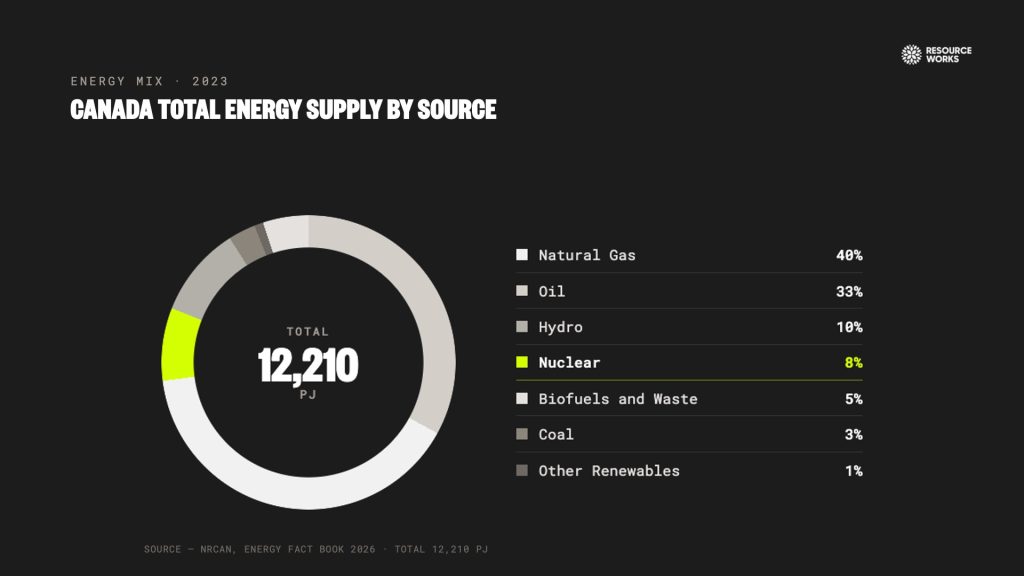
Source: NRCan, Energy Fact Book 2025-6, p. 6
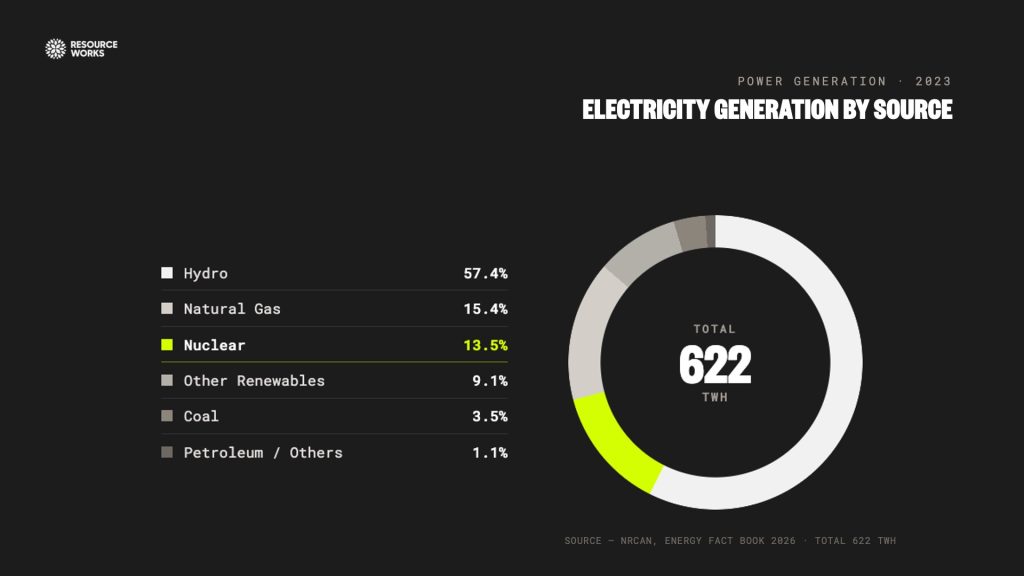
Source: NRCan, Energy Fact Book 2025-6, p. 66
Strengthening Canada’s Uranium Exports
Canada is a powerhouse of uranium production, ranked second in the world, producing 15% of the world’s uranium (behind Kazakhstan at 43%), second in world exports at 14% (also behind Kazakhstan), and third in global known recoverable resources (5.9 Mt) at 10% (behind Australia and Kazakhstan). Uranium forms a 21% share of Canada’s primary energy production, of which 90% is exported.



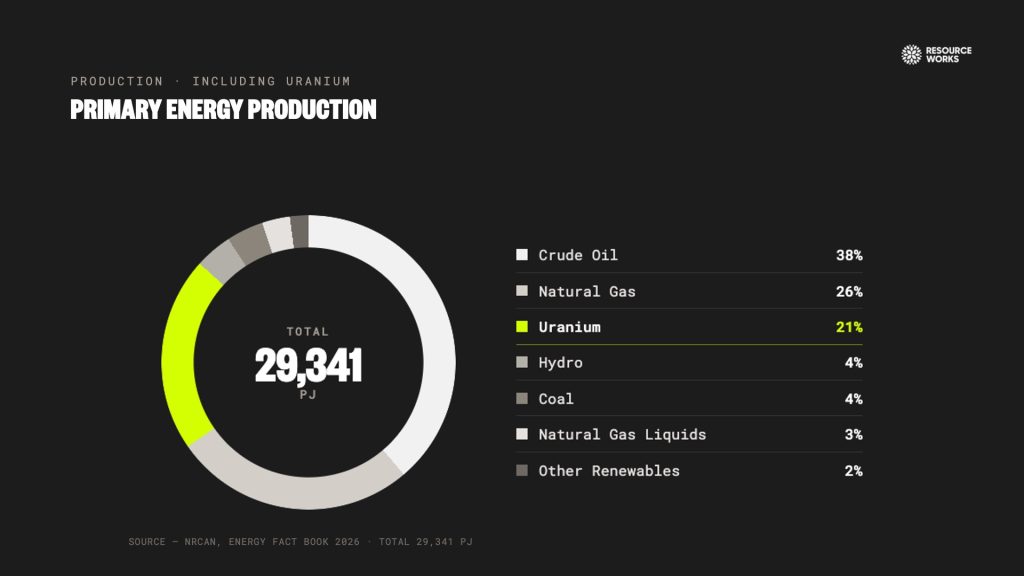
Source: NRCan, Energy Fact Book 2025-6, p.4
Countries are seeking lower-carbon, diversified, secure, and stable energy systems—particularly due to the oil and gas supply shock caused by the closure of the Strait of Hormuz, the looming quantum computing and AI boom, and as the world embarks on the “Age of Electricity”. Expanding exports of uranium means net new revenue for Canada, with associated taxes, employment and Indigenous community benefits. Attributes of Canadian uranium, including international agreements committing to peaceful, civilian uses and transparent reporting to global standards, a predictable regulatory system, and long-established, globally-recognised firms like Saskatchewan’s Cameco, gives it a competitive advantage to leverage Canada’s natural endowment in uranium.
Nuclear energy in Canada
Domestically, power grids from east to west are under strain, partly due to increased demand, not least from increased population, sector electrification and data centres, and partly due to lack of connective infrastructure investments over many decades. As Macdonald-Laurier Institute’s Heather Exner-Pirot points out, “At a time when electricity is increasingly scarce and its availability is a key competitive advantage, Canada’s impending shortage is not just an affordability issue – it is also an economic and security crisis.”
The magnitude of Canada’s anticipated increase in electricity demand is sobering, and not credibly met by electricity procurement planning in many Canadian jurisdictions: according to the Canada Energy Regulator’s (CER) latest scenarios, electricity demand increases from 2023 to 2050 by 44% (Current Measures scenario) or 73% (in the Higher scenario), by far the largest category across all forms of end-use energy demand. The Canadian Nuclear Association estimates that Canada could need 150 gigawatts (GW) of new supply, including 115 GW of non-emitting baseload power by 2050.
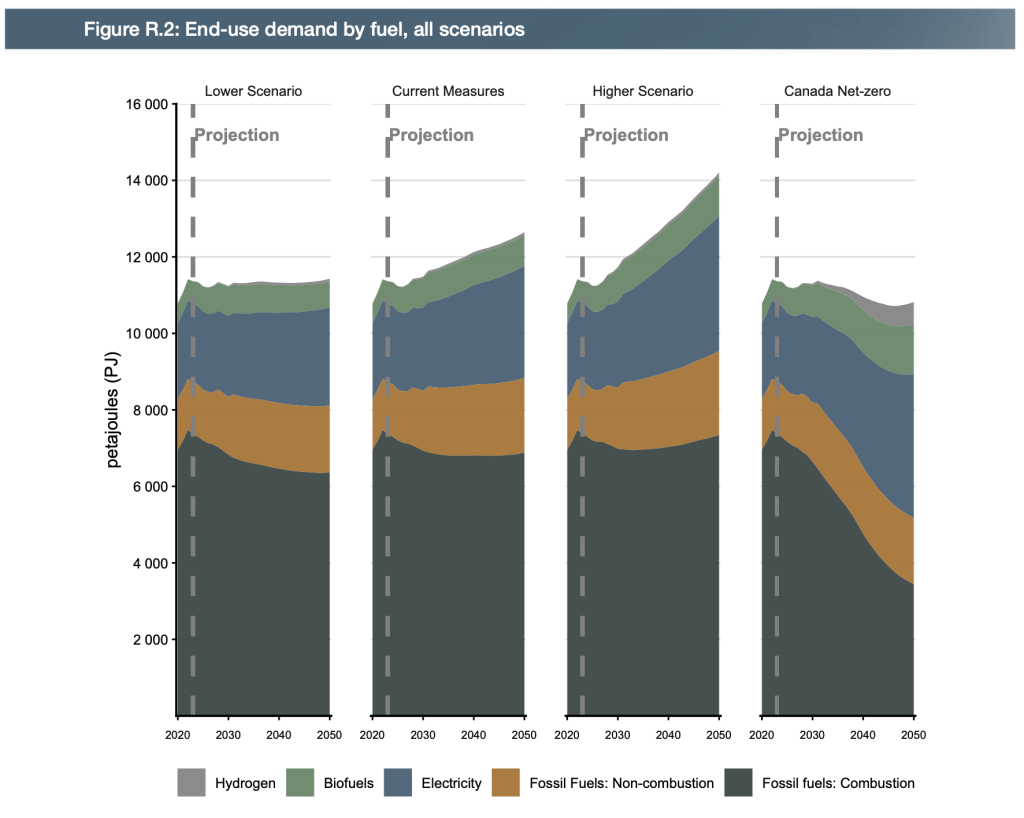
Source: CER, Canada’s Energy Futures 2026, p. 44
The strategy doesn’t specify a target for the proportion of domestic energy to be served by nuclear power (a matter of provincial/territorial jurisdiction), but it does expand on the federal government’s recent National Electricity Strategy, and signals its prioritising of nuclear energy as a non-emitting abundant source of power. One pillar of the nuclear strategy – increasing the availability of nuclear reactors to power electricity grids (CANDU type and Small Modular Reactors “SMR”) – underlines the seriousness and consequences of Canada’s electricity gap, and serves as a nudge to provinces whose electricity policies presently eschew nuclear power.
The benefits of building out more nuclear electricity capacity in Canada are clear: diversification of baseload (i.e. stable), reliable, non-emitting, and above-all secure power from vast domestic sources of uranium; large increments of capacity increases essential for Canada’s credibility in powering sovereign AI and other advanced computing and technology; underpinning growth of the natural resource sectors (a goal of federal and many provincial governments); and flexibility to balance the variability of renewables like wind and solar, which are contributing an increasing share to Canada’s electricity mix.
While Canada’s new nuclear energy strategy leaves some gaps (quantitative objectives across its four pillars, and more precise plans for how—and importantly where—the domestic build-out is expected to happen), it can contribute much more to fulfilling domestic need, and the global opportunity for a tripling or more of nuclear power in the world’s electricity mix.
The views expressed in this article are those of the author, Karen Graham, and do not necessarily reflect the views of the Resource Works Advisory Council.
Share This:






















INSIGHT: The Northern Shield Energy Corridor Provides Energy Security for All Canadians – Yogi Schulz