


 CDN NEWS |
  US NEWS







By Yogi Schulz
Recent years have seen a rapid succession of global energy crises, driven by military conflict, extreme weather, regulatory gridlock and supply chain disruptions. It appears that these various shocks are becoming more frequent. Shocks lead to price spikes and tend to increase the cost of producing, refining and distributing crude oil, condensate, and natural gas. When sustained, these shocks contribute to inflation.
Today’s highly interconnected crude oil, condensate and natural gas markets deliver energy security and competitive prices to every consumer. We sometimes lose sight of this incredibly efficient market amid all the anti-fossil-fuel noise.
Crude oil markets no longer boring
For decades, the price of crude oil was steady, as illustrated by the blue line in the chart below. The cost of refined products consumed by households and businesses accounted for only a small share of their operating costs. Almost no one paid attention to boring energy prices.
That inattention changed dramatically when the Arab members of OPEC imposed the first crude oil embargo in October 1973 against the United States and other nations for supporting Israel during the Yom Kippur War. The embargo lasted until March 1974 and triggered a massive global energy crisis as supplies dwindled and prices spiked. The price has been volatile ever since, as illustrated by the red line in the chart below.
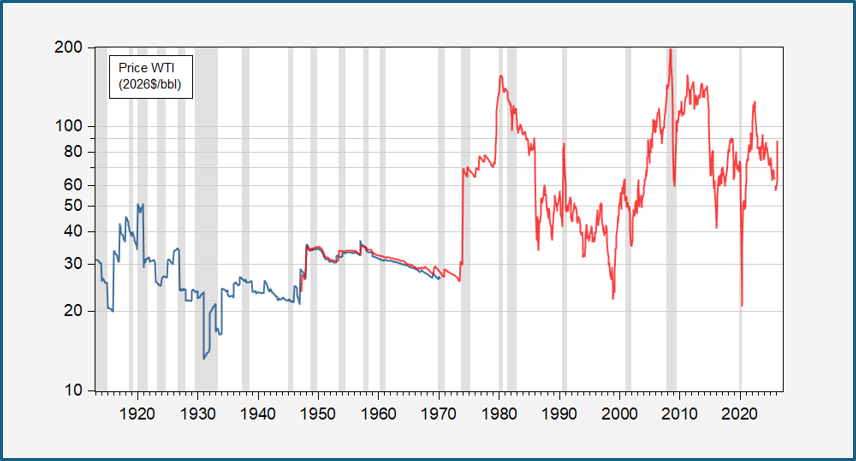
Source: 113 Years of the Real Oil Price (WTI). CPI-deflated price of WTI crude oil, in 2026 $/bbl, annual (blue), monthly (red), both on log scale. National Bureau of Economic Research (NBER) defined recession dates shaded gray, March 30, 2026
Recent major shocks
Recent events suggest crude oil price shocks are becoming more frequent.
First came the COVID-19 pandemic from March 2020 to the end of 2021. It first led to a rapid implosion in demand, followed by an equally rapid resurgence. Both events created price turmoil.
Russia’s invasion of Ukraine in February 2022 followed the pandemic. It led to the following events that have shocked global energy markets:
- Destruction of the Nord Stream natural gas pipelines. This sabotage created a spike in European natural gas markets.
- Many sanctions, including those targeting the sale and distribution of Russian fossil fuels, have been imposed. While these sanctions have been less effective than contemplated, they have increased crude oil prices.
- Ukraine’s drones steadily increased in range and payload. By 2026, drones had damaged a significant percentage of Russia’s fossil fuel infrastructure and reduced crude oil supply.
- A few navies have intercepted and detained some of Russia’s shadow fleet of crude oil tankers. Reduced shipping capacity will increase crude oil prices.
In early 2026, the Iran war started. It has sparked the greatest disruption to crude oil and natural gas production and distribution in history. Military attacks and counterattacks have dominated this disruption, which created a significant spike in crude oil prices. The consequences of the long time required to repair damaged processing facilities will influence energy markets for years.
All these developments continue to add volatility to fossil fuel markets.
Outlook for future shocks
Energy markets have endured various shocks in the past. However, these three recent shocks, in such a short time span, are so large that they exceed the low-frequency historical pattern.
More worryingly, the underlying causes of the recent shocks – geopolitical and trade fragmentation – suggest they will continue for some time. Therefore, the world appears likely to face more frequent shocks in the decades ahead.
The chart below illustrates a few of the more dramatic changes in crude oil export destinations, driven by these factors, that have already occurred.
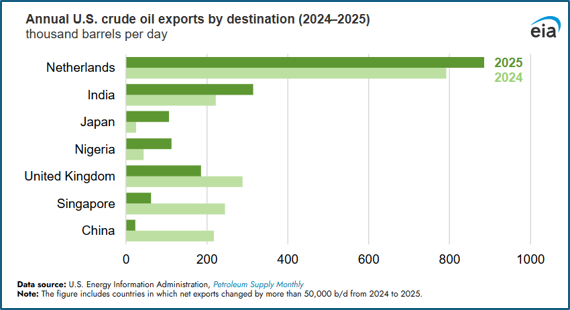
Source: Annual US crude oil exports decrease for first time since 2021, EIA, March 10, 2026
Offsetting the impact of future energy market shocks is the oversupply of petroleum relative to consumption in recent years, as illustrated in the chart below. This trend has kept prices soft and prevented OPEC from achieving its ambition to exert greater control over them. This oversupply will minimize the impact of future shocks because supply originates from many geographically dispersed producing regions.
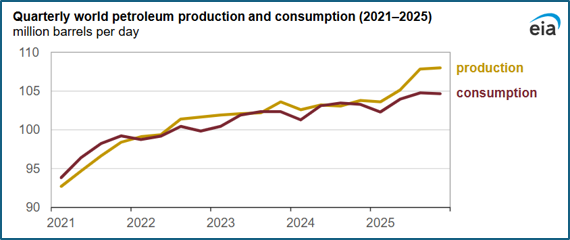
Source: Crude oil prices fell in 2025 amid oversupply, EIA, January 5, 2026
Risk of future military aggression
Multiple regimes have openly stated political and territorial ambitions that they are willing to pursue with military force. If acted upon, these military actions will disrupt fossil fuel supply lines, creating a global supply shock, a price spike and an economic downturn.
Russia has squandered enormous resources to sustain its invasion of Ukraine. There is no indication that Putin has abandoned his vision of an at least partially reunited USSR. His regime has tried to destabilize at least 27 countries. These operations utilize a combination of cyberattacks, hybrid threats, election interference, disinformation, and military shadow warfare. Russia’s many neighbours are all increasing defence spending and readiness.



China has repeatedly stated its position that Taiwan is an inalienable part of Chinese territory. China expects to reclaim it by military action if necessary. China has aggressively reinforced its claim to control over the South China Sea with military action despite the UN ruling against its extra-territorial ambitions. China’s failure to honour the commitments it made to the UK in the takeover of Hong Kong also indicates its determination to pursue its territorial agenda. China’s significant expansion of its military capabilities is causing other nations to take Chinese threats seriously.
Iran is highly likely to remain determined to become the dominant regional power. The current war has not dampened that ambition. This year, Iran repeatedly demonstrated its willingness to attack the petroleum infrastructure of its neighbours. This action breaks a long-standing tacit consensus among Persian Gulf nations against doing so. It is unlikely to abandon its nuclear ambitions as a result of the emerging agreement with the US.
The significant increases in military spending, as illustrated in the chart below, constitute a good proxy for the increasing likelihood of military conflict in the foreseeable future.
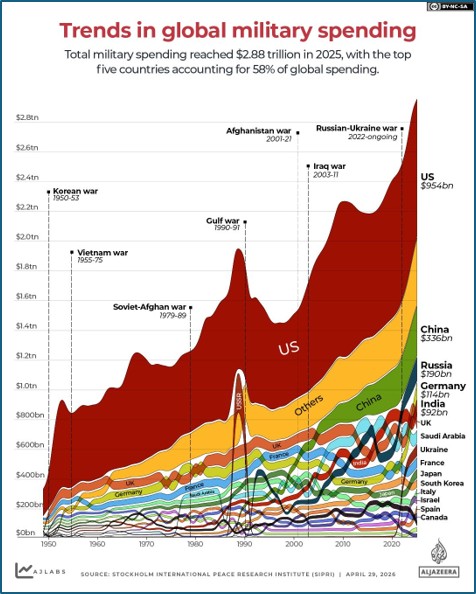
Source: Five charts that show the rise of global militarisation, Al Jazeera, April 29, 2026
Fractured international trading system
Until recently, energy markets were more globalized than ever. Skyrocketing US and OPEC+ exports have improved market efficiency, spurred economic growth, and strengthened political ties between producers and importers.
The growing number of recent trade conflicts has upended the post-war ambition to foster peace through multilateral cooperation, free trade and low tariffs.
US President Donald Trump’s decision last year to impose sweeping tariffs on most trading partners intensified trade strains. His explicit use of America’s energy dominance as a negotiating tool heightened concerns over the long-term reliability of the US as a supplier, reinforcing actions by many nations for greater energy self-sufficiency.
China’s rise as an industrial and economic powerhouse has further weakened the post-war trading order and helped create a two-tier oil and gas market. Beijing has openly flouted Western sanctions, which have expanded greatly over the past decade – importing large volumes of sanctioned crude oil and natural gas from Iran, Russia and Venezuela. China has also avidly supported the emergence of alternative trade, payment, insurance and shipping networks that:
- Reduce the dominance of the US dollar as the de facto trade currency.
- Fragment global financial markets.
- Add to the importance of China’s renminbi (RMB) currency in settling global trade. The yuan (CNY) is the primary base unit of account.
The benefits of free international trading are threatened by energy markets becoming more volatile and fragmented due to:
- Geopolitical tensions, some triggered by recent tariffs, manifest as preferred or undesirable suppliers and customers. While President Trump’s unhelpful tariffs did not affect the trade in fossil fuels, they did impact the petrochemical industry.
- An increase in the number of crude oil, condensate, and natural gas-producing countries. Guyana recently became a significant supplier. Argentina has expressed ambitions to increase its production significantly through new concessions. In the last decade, the US has evolved from a significant importer to the largest producer.
- The ebb and flow of OPEC+ efforts and ability to influence market prices. A few years ago, Saudi Arabia deliberately triggered a short-term collapse in crude oil prices. More recently, a dispute over production quotas caused the UAE to leave OPEC.
- Government interference in energy markets is a misguided effort to reduce fossil fuel consumption or lower prices. While many countries have reduced or eliminated their counterproductive fossil fuel consumption subsidies, others, such as California, Germany and the UK, have tried to control consumer prices.
- Changing sanctions that deliberately disrupt supply chains. European sanctions against Russia in retaliation for its invasion of Ukraine triggered rapid and dramatic changes in the energy supply chains.
- Efforts to interfere with crude oil shipments through intimidation or military action. Iran shut down petroleum and other product shipments through the Strait of Hormuz by attacking a few tankers to intimidate almost all other shippers.
- Highly variable progress in the energy transition by region. China, Europe and North America are making more progress than the rest of the world.
- The interplay between increases in renewable electricity capacity and increasing overall energy demand.
- Military attacks on energy production, refining and distribution infrastructure.
Future occurrences of these events will trigger future energy shocks. The chart below illustrates one example. EU countries, which rely heavily on imported crude oil, rapidly shifted from Russia to other suppliers after Russia invaded Ukraine and most Western countries announced sanctions.
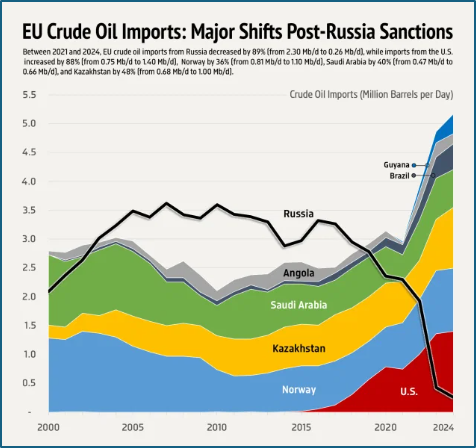
Source: EU Crude Oil Imports: Major Shifts Post-Russia Sanctions (2021–2024), Voronai, May 21, 2025
Energy transition adds new risks
Renewables now account for nearly half of global electricity generation capacity, following a record surge in solar installations in the last few years. Even after reducing capacity estimates to account for intermittency, progress is impressive.
The transition to more renewable electricity generation is apt to accelerate further following recent energy shocks, as reducing dependence on fossil fuels increasingly aligns with governments’ efforts to bolster energy security. The European Union made the point explicitly in a plan aimed at shielding consumers from volatile oil and gas prices.
However, the energy transition also introduces new vulnerabilities. Reduced reliance on fossil fuels could morph into heavy dependence on Chinese imports of low-carbon technologies such as solar panels and batteries for electricity storage. The dependence exists because the manufacturing of these technologies is highly concentrated in China, as illustrated in the chart below. That dependence is already emerging as a source of trade and industrial tensions between China and Western governments.
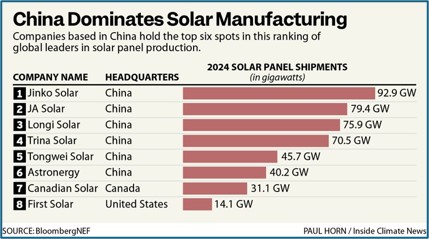
Source: Despite everything, US solar manufacturing continues to power up, Pennsylvania Capital-Star, September 1, 2025
Slowing fossil fuel demand is also likely to intensify competition for market share among major producers – Persian Gulf states, Russia and the US. This competition increases the risk that energy becomes an even more potent geopolitical weapon.
Conclusion
Volatility, rather than stability, will likely be the defining feature of global energy markets. To withstand future shocks, countries will need to build energy systems that are diversified, flexible and, most likely, domestic.
The risk of military conflict, regulatory gridlock and supply chain disruptions remains high and will lead to future energy supply and price shocks.
Even if the energy transition slows climate change, it won’t reverse it. Rising global temperatures and more frequent extreme weather events – droughts, floods, hurricanes, heatwaves – are already disrupting energy production, transport and power grids. The outlook is a sombre one.
Share This:






















On The Verge: Energy Sector Primed for New Wave of Growth – ATB Economics