


 CDN NEWS |
  US NEWS







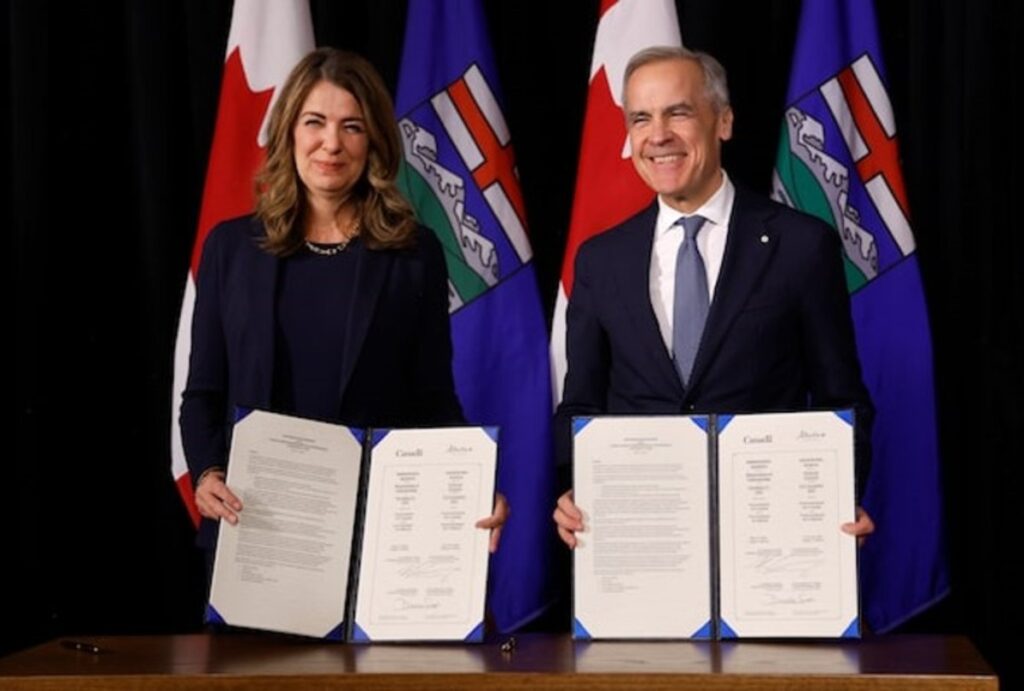
Back in November 2025, the federal government and the Alberta government struck a Memorandum of Understanding (MOU) to help resolve the multi-faceted—and increasingly fractious—impasse between the two governments over Alberta’s ability to expand oil production and reach export markets via shipping from Canada’s Pacific coast.
The two governments were starkly opposed. On one hand, Alberta has long wanted to expand production and development of its oilsands, and gain export pipeline capacity to the west coast with lucrative markets waiting in Asia. On the other hand, the Carney government inherited and assumed prior commitments to make Canada a “net-zero” greenhouse gas (GHG) emitter by 2050, along with other commitments to environmental protection and Aboriginal reconciliation—all issues critical to any hope of future Alberta-to-Pacific pipeline development.
The MOU, in theory, set the grand bargain. In broad strokes, Alberta would bend the knee to Ottawa’s net-zero agenda, impose steeper upstream (industrial) carbon taxes in lieu of direct consumer carbon taxes, and take on a huge commitment ($24 billion and counting) to a “carbon capture and storage” program known as the Pathways project. Pathways would capture GHG emissions at oilsand production sites across northern Alberta, compress it, transport it via pipelines to sites where it could be injected and “stored” deep underground. Voila, “net zero” or the magically “decarbonized” barrels of oil Prime Minister Carney is talking about for future trade.
In return for all this, Alberta would gain a bit of regulatory relief in the form of non-imposition of pending regulations made superfluous by the new tax regime (a dubious “gift” indeed). And—this is the important part—the federal government would pledge to use recently crafted (and still pending) regulatory reform legislation, First Nations participation and inclusivity, and various fast-track and “national interest” designations to eventually get a pipeline built that would carry a million barrels of oilsands oil per day to a port on the British Columbia coast for export to Asia.



In the MOU, the Smith government’s pledges were concrete and immediate, and to begin immediately. The federal government’s pledges were much less concrete, much more aspirational, and are a lot more contingent on diffuse forces and good fortune. And with the ink barely dry as the MOU enters implementation, the claw-back on those diffuse promises is already starting.
As the CBC reports, “After ‘feedback from thousands,’ Carney government slows down sweeping environmental changes.” The subhead informs that “Consultations extended from June 7 to July 22,” pushing them neatly past the current legislative session in Parliament that might have advanced the legislation. This is, by the way, the same legislation the federal government is banking on to fast-track Alberta’s potential pipeline. In other words, it’s a major part of the MOU, threatened only months after negotiation and formal adoption.
Further, the CBC observes, Carney faces pushback on environmental regulation reform from within his own caucus, and also from a newly resurgent and now politically independent Steven Guilbeault, Quebec MP and architect of many of the anti-oil regulations Carney is trying to eel his way around.
Of course, pushback on the MOU from environmental activists, Aboriginal interests, and a panoply of anti-oil, anti-development, anti-pipeline and anti-tanker actors was as predictable as snow in Canadian winters. But that Prime Minister Carney is showing signs of shakiness when Premier Danielle Smith is still rubbing ink off of the side of her MOU-signing hand does not bode well for the future of Alberta’s grand oilsands bargain.
Smith would do well to push back on Alberta’s initiation of its obligations under the MOU lest they be carved quickly in concrete, while the federal government’s pledges assume the status of vapourware.
Share This:






















On The Verge: Energy Sector Primed for New Wave of Growth – ATB Economics