


 CDN NEWS |
  US NEWS







By Steven Globerman and Jock Finlayson
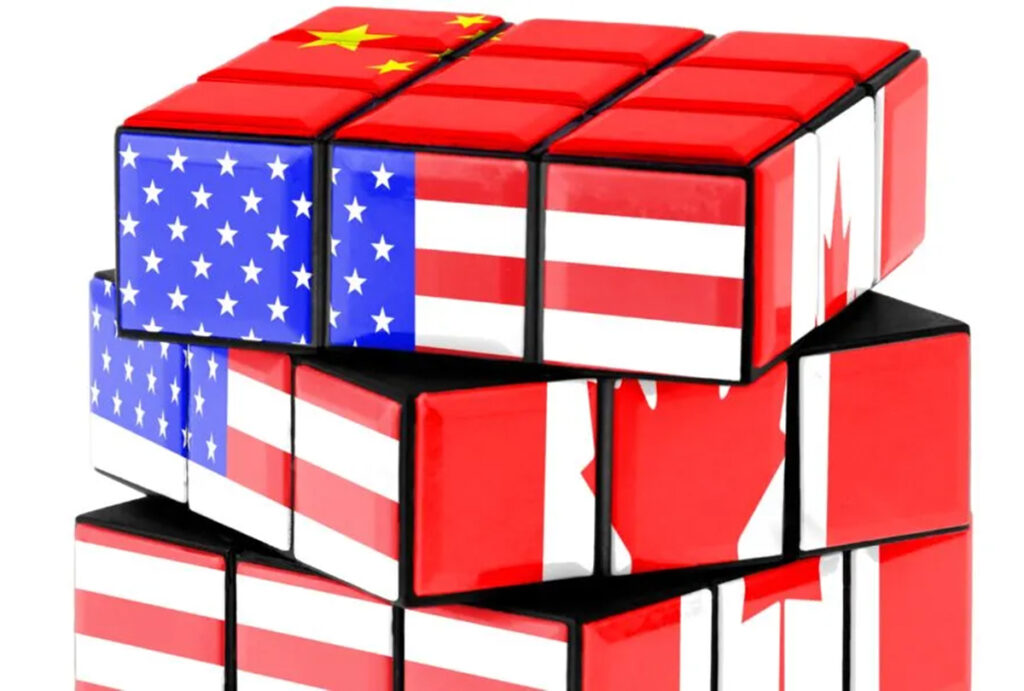
In his recent speech at the Economic Club of New York, Prime Minister Carney called for a new partnership between Canada and the United States, one that recognizes the deep economic integration between the two countries, notably in manufacturing supply chains and energy. Yet he also reiterated his position that Canada must enhance its strategic “autonomy,” which includes decreasing trade reliance on the U.S.
Despite Carney’s rhetorical emphasis on trade diversification and his goal to double non-U.S. exports by 2035, he’s not been explicit about how to deepen integration with the U.S. in select industries while simultaneously reducing Canada’s economic dependence on the U.S., which absorbs around 70 per cent of Canada’s exports. The upcoming review of the Canada-U.S.-Mexico Agreement (CUSMA)—which President Trump continues to publicly deride—officially starts on July 1, so the clock is ticking.
Clearly, it will be difficult—perhaps impossible—to achieve an outcome whereby Canada preserves the benefits of extensive trade and commercial linkages with the U.S. while expanding trade with other countries, especially China, the world’s second-largest economy, largest manufacturing country, and the principal rival of the U.S.



Of course, countries that account for a large share of the global economy are better positioned to become bigger markets for Canadian exports than smaller economies. And fast-growing economies are more attractive export diversification candidates than stagnant or slow-growing ones. In 2024, China accounted for almost 17 per cent of global GDP compared to 22 per cent for the U.S. Indeed, China’s GDP is only slightly less than the combined GDPs of Germany, Japan, India, the United Kingdom and France, and by the end of the decade, will likely be larger than these five countries combined. Over the past two decades, China’s economic growth rate has exceeded that of all large Western countries. In other words, China’s economic heft, growth track record and increasing prosperity make it a prime destination for Canadian exports.
Another important determinant of trade patterns is relative cost. Simply put, Canadian companies will be more successful exporting to countries where Canada is a relatively low-cost supplier of relevant goods and services. Due to Canada’s physical distance from China, Canadian companies incur higher freight costs when exporting goods to China compared to Asian competitors. But freight costs are a relatively small obstacle to international trade. The primary challenge for Canadian businesses hoping to sell more to China are the costs associated with managing significant differences in laws, regulations, business practices, cultural norms and language between the two countries. Canadian exporters can mitigate these costs by establishing closer supply chain linkages with Chinese commercial partners. It follows that increasing Canadian exports to China will require Canadian companies to become more integrated into China’s dominant supply chains.
However, should Canadian companies become substantially more connected to large Chinese enterprises that are either state-owned or state-directed, this almost certainly will lead to more conflict with the Trump administration (and possibly future administrations) given the ongoing economic, technological and military rivalry between the U.S. and China.
For Canada’s top export categories—including oil, natural gas, minerals and some agricultural goods—China is either a substantial importer or promising growth market. And exporting more oil, gas, minerals and foodstuffs to China would not require the same degree of supply chain integration as is the case with most manufactured goods. Still, the Chinese government is alert to the possibility that other countries will defer to U.S. political and strategic priorities. In particular, Chinese policymakers worry that other countries may support U.S. efforts to “isolate” China or otherwise reduce China’s influence in the global economy and in various supply chains for critical goods. Should Canada embark on a “Fortress North America” trade and industrial strategy, as suggested by the prime minister, China is unlikely to view Canada as a preferred supplier of energy, minerals and other commodities.
This is not to suggest that the Carney government should abandon its goal of increasing non-U.S. exports. However, to achieve this goal, Canada must establish itself as a reliable long-term exporter to China. And that’s likely to raise the ire of the current U.S. president and perhaps future presidents. With trade diversification top of mind, Prime Minister Carney and his negotiators face a complex balancing act in managing relations with our closest ally and main trading partner on the one hand, and the world’s leading manufacturing country and steadily rising global power on the other.
Share This:






















On The Verge: Energy Sector Primed for New Wave of Growth – ATB Economics