


 CDN NEWS |
  US NEWS







A $2 billion expansion to Tilbury Island LNG can finally proceed
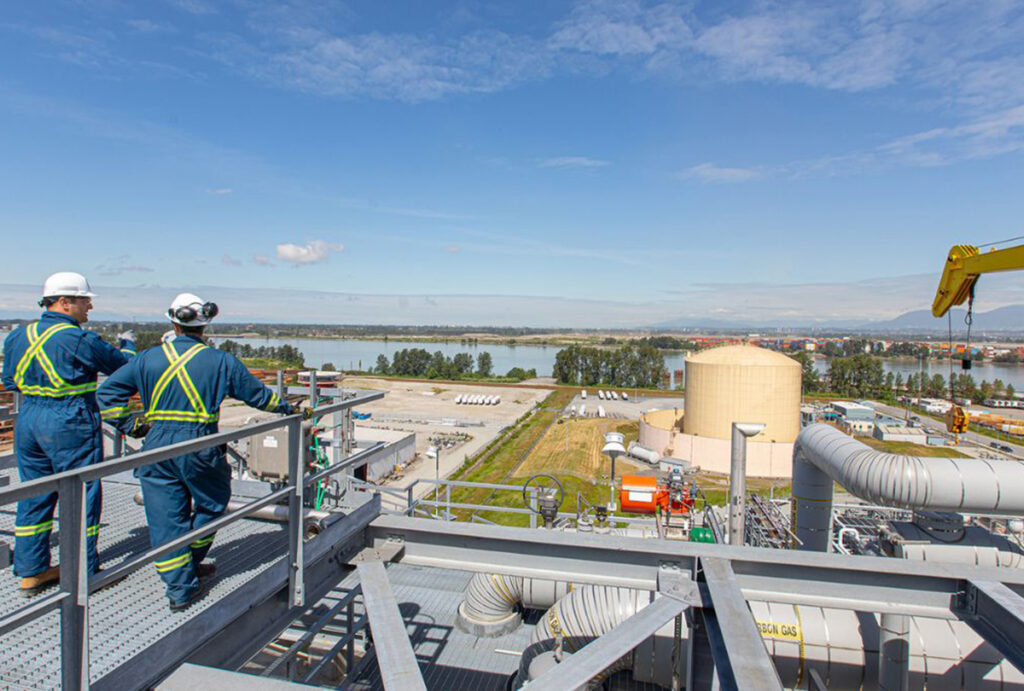
Tilbury Island LNG to undergo $2 billion expansion. | FortisBC
A $2.2 billion phased expansion of the FortisBC Tilbury Island LNG plant is, finally, getting a break from the B.C. government on the regulatory front to help move it along.
This project is important for the Port of Vancouver, because the expansion will put Vancouver on the map as the only major LNG marine-bunkering hub on the Pacific coast.
“We’re talking about an announcement that will increase the competitiveness and sustainability of the Port of Vancouver to ensure we remain the preferred port of call for cargo and for cruise ships in the transition to alternative marine fuels,” Energy Minister Adrian Dix said last week.
Decarbonizing Pacific shipping corridors
The Phase 1 expansion, which includes a new marine jetty needed for marine bunkering, will be exempted from a certificate of public convenience and necessity. That’s bureaucratese for circumventing the B.C. Utilities Commission (BCUC).
The NDP government is doing for the Tilbury Island LNG expansion project what the NDP, while in opposition, slammed the B.C. Liberal government for doing for Site C dam: skirting the BCUC.
It’s a tacit admission on the NDP government’s part that the red tape in B.C. is just too damned thick to get things built in B.C. in a timely fashion.
Navigating a decade of regulatory hurdles
This project has spent a decade moving through the regulatory maze, so please let’s have no talk about “fast-tracking” here. Nothing about getting this project’s approval has been fast.
The marine jetty proposal entered the B.C. EAO process in 2015, and only received its environmental certificate in 2024.
The expansion includes a new marine jetty for fuelling bunkering vessels, an expansion of liquefaction capacity, a new 230-kV transmission line to bring more power to the site, and piping infrastructure.
The first phase expansion will bring production up from the current 250,000 tonnes to 900,000 tonnes per annum.
A Phase 2 expansion would bring total production to 2.5 million tonnes per annum. Phase 2 has not been approved yet and is still making its way through the B.C. EAO process.
Local energy resilience and Indigenous partnerships
The expansion is said to represent a $2.2 billion investment. Of that, $800 million will be spent on construction, which is expected to create 1,100 construction jobs each year over a four-year period.
The project is receiving support from the Musqueam First Nation, which may be getting dealt in on the project with an equity option.
“It’s exciting to have an opportunity with equity building so that we can deal with the issues that we have in our community,” said Musqueam Chief Wayne Sparrow.
It should be noted that, of the half dozen LNG projects in various stages of development in B.C., FortisBC’s Tilbury Island LNG plant is the only one not designed for LNG exports.
It is designed to meet the growing demand for natural gas as a cleaner fuel alternative for ground and marine transportation.
The original Tilbury Island plant has been making and storing liquefied natural gas since the early 1970s. The stored LNG is used for backup, such as when demand for natural gas surges in the winter during extreme cold snaps, or when there is a pipeline outage somewhere.



But for about a decade now, LNG from Tilbury Island has been fuelling a growing fleet of compressed natural gas trucks and, increasingly, ferries and other vessels operating on natural gas – including some of the newer, cleaner cruise ships.
Already, FortisBC provides a number of B.C. Ferries and Seaspan ferries with LNG.
Seaspan Energy Ltd. operates three LNG fuelling vessels out of Vancouver, with the ships roaming as far as Long Beach, California.
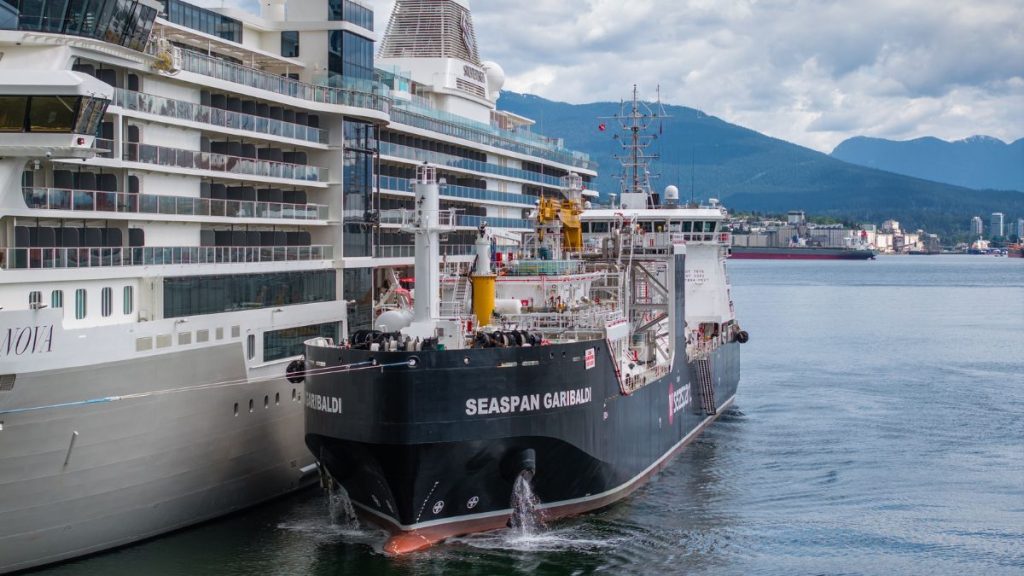
One of Seaspan’s three bunkering vessels fuels up a cruise ship with LNG. | Seaspan
Currently, those bunkering vessels are filled with LNG from the Tilbury Island plant by truck. The new marine jetty will obviate the need for LNG trucks, with the gas piped directly from the LNG plant to bunkering vessels via the marine jetty.
Meeting IMO 2020 standards on open water
As international shipping switches from more polluting fuels to cleaner-burning natural gas, FortisBC, Seaspan and the Port of Vancouver plan to position Vancouver as a reliable LNG fuelling hub.
Regulations implemented in 2020 by the International Maritime Organization (IMO) oblige the shipping industry operating in the western hemisphere to lower the sulphur content in their emissions to 0.5% from 3.5%.
“LNG is significantly cleaner than conventional marine fuels such as diesel,” Dix noted.
It is not only 25% lower in greenhouse gas emissions, he said, but 76% lower in nitrous oxide as well, and 90% lower in sulphur oxide and fine particulates.
Some shippers have been meeting the new IMO regulations by installing scrubbers and continue to burn diesel and heavy fuel oil, especially on older vessels.
But for new builds, many ship owners are switching to vessels capable of burning other, cleaner fuels, like methanol or natural gas.
Of all the alternatives available, natural gas in the form of LNG has proven the top choice for new builds.
According to classification society DNV, there are now 800 vessels globally that can burn natural gas, with 600 more vessels on order.
Those ships will need to fuel up somewhere, and the Port of Vancouver wants to make Vancouver one of the ports capable of fuelling LNG-powered ships.
“This expansion of our LNG facility will really help position Port of Vancouver as a leading global LNG marine fuelling hub on North America’s West Coast,” said FortisBC president Roger Dall’Antonia.
According to the Port of Vancouver, more than 70 vessels have fuelled up with LNG since 2024 using Seaspan’s bunkering service.
“We’ve seen cruise, cargo and container ships all embrace LNG bunkering since its introduction to the Port of Vancouver through approved provider Seaspan Energy,” said Sean Baxter, the port’s harbour master and director of marine operations.
Now that FortisBC has been exempted from obtaining a certificate of public convenience and necessity review, it plans to start construction in 2027, and is aiming for completion in 2031.
Nelson Bennett’s column appears weekly at Resource Works News. Contact him at [email protected]
Share This:






















INSIGHT: Canada’s Economy Falling Behind Despite Misleading Headlines – Fraser Insitute