


 CDN NEWS |
  US NEWS







By Dorothy Neufeld | Design Miranda Smith
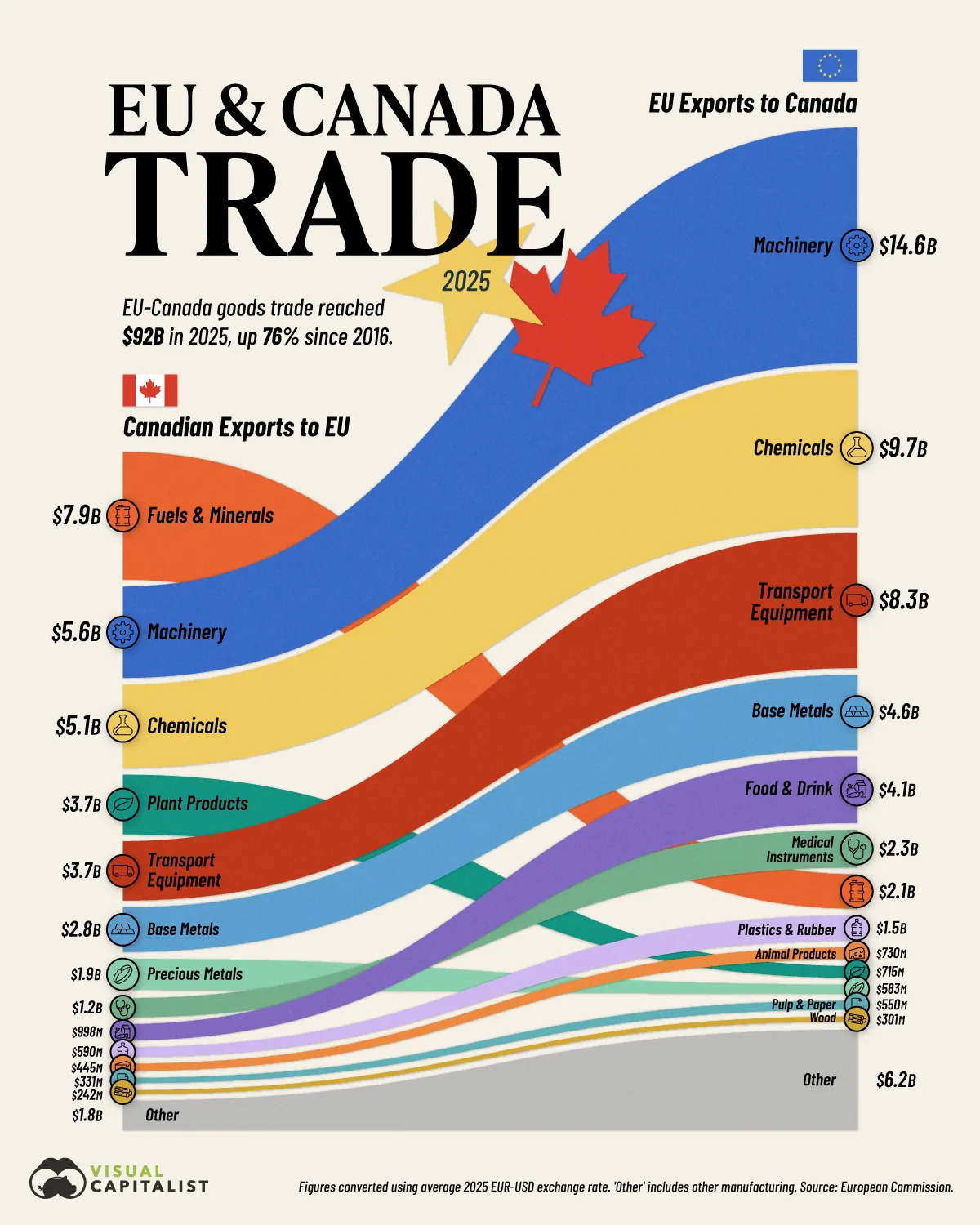
Key Takeaways
- EU-Canada goods trade reached $92 billion in 2025, up 76% since 2016.
- The EU exported nearly $15 billion in machinery to Canada, making it the largest product category moving in either direction.
- Fuels and minerals were Canada’s largest export category to the EU, at $7.9 billion.
Canada and the European Union are discussing a closer relationship after European Commission President Ursula von der Leyen proposed opening the door for Canada to become the EU’s first “associate member.” The status does not currently exist under EU treaties, and its details remain undefined.
Against that backdrop, the two economies already have a substantial goods-trade relationship with distinct export profiles.
This graphic ranks EU-Canada trade by product in 2025, based on data from the European Commission.
Breaking Down Canada-EU Trade
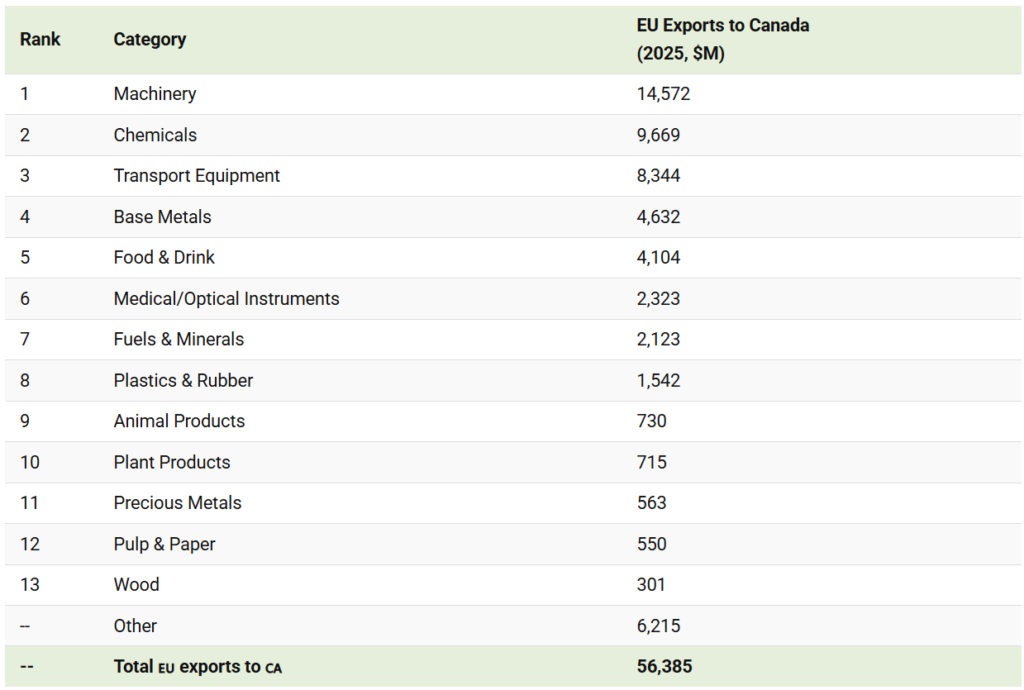
Here’s how EU exports to Canada break down by type of good:
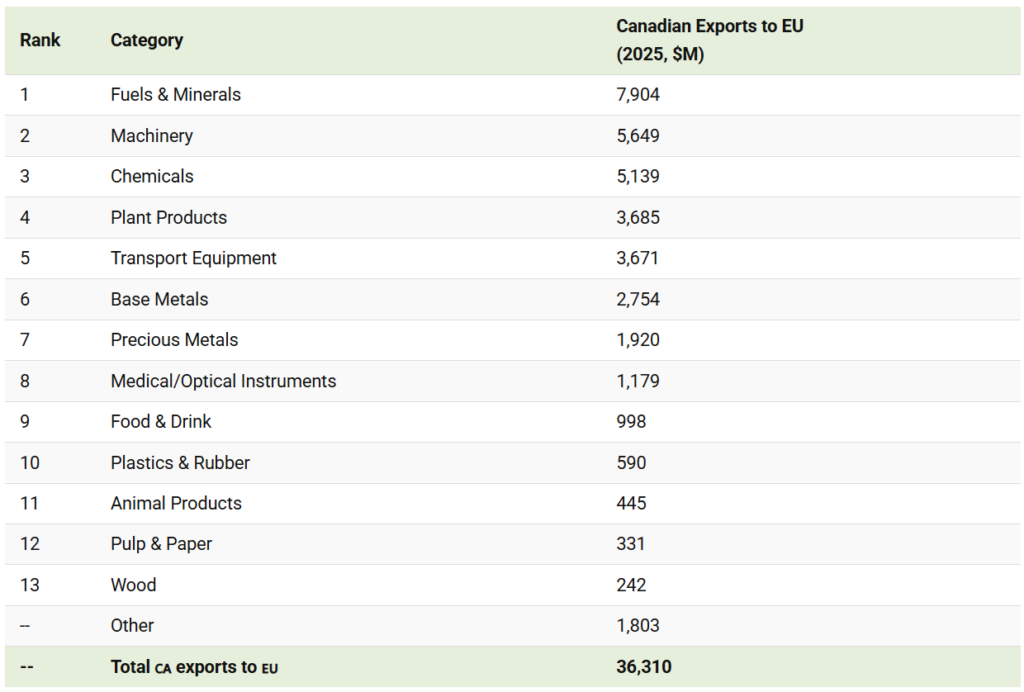
And here’s how Canadian exports to the European Union stack up:



Europe Sends Machinery, Canada Sends Resources
Machinery shows one of the clearest differences between the two trade flows. The EU exported $14.6 billion worth to Canada in 2025, compared with $5.6 billion moving in the opposite direction. Chemicals and transport equipment were also major European exports.
Canada had larger flows in several resource-oriented categories. Its exports of fuels and minerals reached $7.9 billion, while plant products and precious metals also tilted toward Canada.
Across all categories, the EU exported about $18 billion more in goods to Canada than it imported in 2025.
Canada Is Diversifying Beyond the U.S.
Canada remains heavily tied to the U.S., but that concentration declined in 2025.
The U.S. received 71.7% of Canadian goods exports in 2025, down from 75.9% a year earlier. Meanwhile, Canadian exports to countries outside the U.S. rose 17.2%.
Energy contributed to that shift. Canadian energy exports to countries outside the U.S. rose 22.3% to $28.8 billion in 2025, supported by higher shipments to markets including the Netherlands. Energy exports to Germany and Italy also increased.
Could Canada and the EU Get Even Closer?
Canada and the EU already have an extensive trade framework through the Comprehensive Economic and Trade Agreement (CETA), which has been provisionally applied since 2017 and has eliminated most tariffs between the two markets.
The relationship could now expand beyond trade. In September 2026, European Commission President Ursula von der Leyen proposed making Canada the EU’s first “associate member,” a new status whose legal and economic details have yet to be defined.
The proposed relationship would seek closer cooperation in areas including defense, energy, critical minerals, and technology. Canada and the EU are also negotiating a digital trade agreement, potentially extending their $92 billion goods-trade relationship into new areas of economic cooperation.
Share This:






















REMAKING THE LANDSCAPE FOR INVESTORS – The First-Ever Canada Investment Summit – Maureen McCall