


 CDN NEWS |
  US NEWS









By Stewart Muir
How Metro Vancouver became the head office, the trading floor and the export gateway of a resource economy it has stopped recognising—and why the city’s own crest has been telling the story all along.
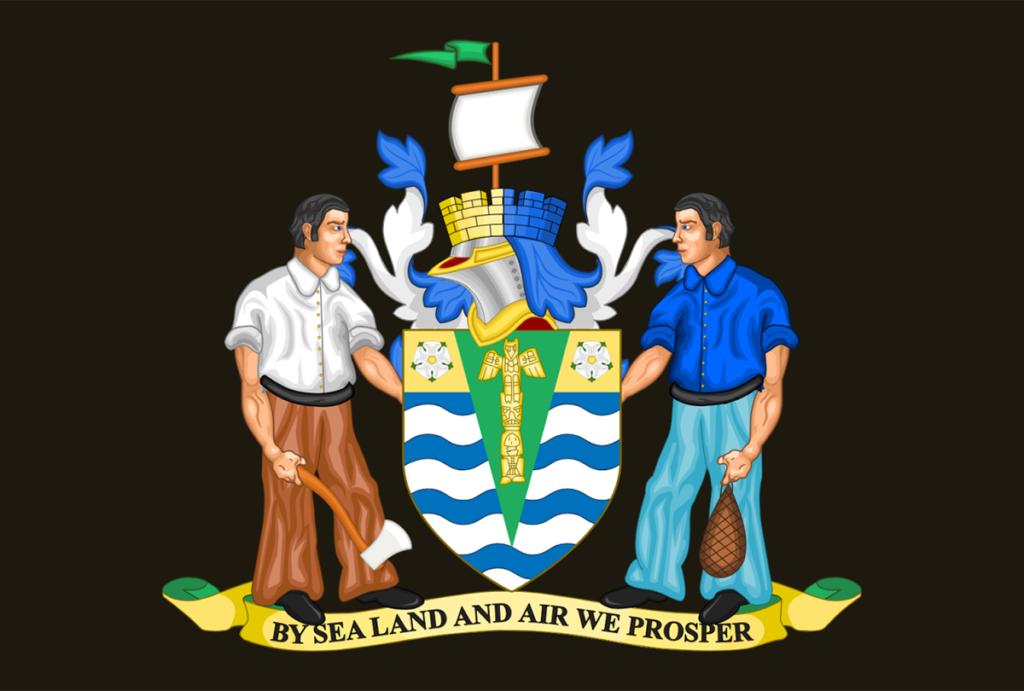
In 1969 the City of Vancouver was granted a coat of arms. A logger and a fisherman hold up the shield. A ship crowns it. The sea runs through the middle. Image by Jack Ryan Morris – Own work, CC BY-SA 4.0, https://commons.wikimedia.org/w/index.php?curid=93662558
There is not a single working mine, oil well or pulp mill inside the City of Vancouver. And yet Metro Vancouver is one of the most important places on earth for natural resources—the head office, the trading floor and the export gateway for what the rest of the province and the country digs, cuts, pumps and grows. This is the story of how a resource economy hides in plain sight, in a region that believes it has moved on—and of how much of it has been built in the last two years alone.
The argument in brief
- Metro Vancouver looks like a post-industrial economy of real estate, technology and tourism. It is also a resource economy—one that wears a suit instead of a hard hat.
- Four roles define it: the gateway (the Port of Vancouver, a national asset moving mostly resources), the build-out (new oil, gas and electricity capacity being built right now), the brain (a global cluster of mining finance) and the base (the resource revenue that helps fund the province’s public services).
- The numbers are not small. The port enables roughly $365 billion in trade a year. Crude shipped through B.C. in the first year of the Trans Mountain expansion was worth nearly $13.9 billion. BC Hydro, run from downtown, is spending nearly $36 billion to rebuild the grid. Close to 1,000 mining and exploration companies, worth about $449 billion, are run from the region. Resource industries supply roughly three-quarters of B.C.’s goods exports. And when that economy grows, most of the new jobs are created here: 55 per cent of them in Metro Vancouver and the Lower Mainland.
- None of this needs a mine within city limits. That is the point—and the reason the region so often misreads its own economy. Its own 1969 coat of arms reads it correctly: a logger, a fisherman, a ship and the sea.
The gateway
A national asset that happens to sit here Start with the most physical fact of all. Almost everything western Canada pulls out of the ground or off the land has to reach the ocean somewhere—and most of it reaches the ocean here.
The Port of Vancouver is the largest port in Canada and the largest by cargo volume on the west coast of the Americas. In 2025 it moved a record 170 million tonnes of cargo. It trades with 170 economies and enables on the order of $365 billion in goods every year—moving almost as much by volume as Canada’s next five largest ports combined. It is important to be clear about whose port this is. The Port of Vancouver is federal infrastructure, governed by a federal authority, and it exists for the benefit of the whole country and its resource industries. Most of what it ships is produced far from the Lower Mainland—the coal of the Elk Valley, the grain and potash of the Prairies, the crude of the Alberta oil sands, the forest products of the B.C. interior. Metro Vancouver is not the owner of this wealth so much as its gateway: the place where a nation’s resources meet tidewater and the world.
That role still lands heavily in the regional economy. An economic impact study prepared for the port authority by the Vancouver consultancy InterVISTAS found that port operations and their supply chains support more than 132,000 jobs across Canada, pay $9.3 billion in wages and add $16.3 billion to GDP. The terminals, railways, trucking, longshore work and marine services that do this work sit largely in Metro Vancouver. Take the resources out of the port and you do not get a smaller port—you get almost no port at all.
The build-out: The newest chapter is being poured right now
The resource economy here is not a legacy or a museum piece. It is being expanded in steel and concrete on the region’s waterfront, and the last two years have reshaped it more than the previous twenty.
Oil: two years of Trans Mountain
In May 2024, after a decade of fighting and roughly $34 billion in cost, the Trans Mountain expansion opened. It nearly tripled the capacity of the only pipeline connecting the Alberta oil sands to the West Coast, and it ends at the Westridge Marine Terminal in Burnaby—inside Metro Vancouver.
What two years did is striking. Statistics Canada found that in the first year of operation, crude movements from Alberta to B.C. rose more than fivefold, and the volume of crude exported through B.C. surged more than sixfold. The Canada Energy Regulator reports that Westridge can now load up to 630,000 barrels of crude a day, up from about 79,000 before the expansion. Where a handful of tankers once called each month, roughly one now loads every day or two.
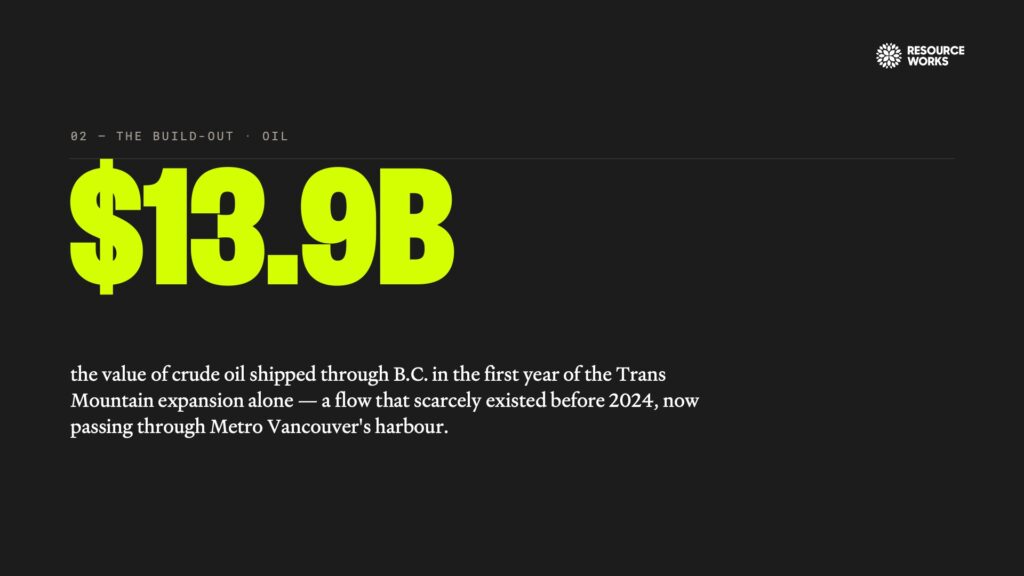
The value is real and new. Crude oil shipped through British Columbia was worth nearly $13.9 billion in that first year alone—a trade category that barely existed before. At the Port of Vancouver, liquid-bulk tonnage jumped 54 per cent in 2025, with crude exports up 95 per cent. The federally owned pipeline returned about $1.7 billion to the Government of Canada last year.
Most of that value belongs to the producers in Alberta and to the federal owner, not to Vancouver. But the region captures the marine economy the project created and concentrated in its harbour: the terminal operations at Westridge, the B.C. Coast Pilots who board every tanker, the tug-escort fleets that shepherd them through the First and Second Narrows, the spill response capacity, the Burnaby refinery, the line supplies, and the port activity itself. A multi-billion-dollar export flow now runs through the city’s inlet that did not exist two years ago—most of it bound for the U.S. West Coast and, increasingly, Asia. The Asia Pacific Foundation of Canada frames this plainly: Trans Mountain is Canada’s first real step toward diversifying its oil exports beyond the United States and into the Indo-Pacific—a national trade pivot executed through Metro Vancouver’s harbour. It is not without friction: the tolls are high and disputed, the tanker route through a crowded urban harbour is tight, and critics warned about spill risk in a dense inlet.
$13.9B the value of crude oil shipped through B.C. in the first year of the Trans Mountain expansion alone—a flow that scarcely existed before 2024, now passing through Metro Vancouver’s harbour.
Gas: the overlooked LNG story
If two years of oil is the visible build-out, liquefied natural gas is the one hiding in plain sight—arguably the most overlooked economic story on the coast. LNG is simply natural gas chilled to a liquid so it can travel the world by ship, and the region now sits at the centre of a build-out worth billions, with First Nations as governing partners rather than bystanders.
On Howe Sound near Squamish, on the region’s doorstep, Woodfibre LNG is rising on a former pulp-mill site at swiyat, in Squamish Nation territory. It is a roughly $12.3-billion export plant designed to produce 2.1 million tonnes of LNG a year, all of it contracted to BP for 15 years. As of mid 2026 it was about 70% built, with first production expected in 2027, and its developer bills it as the world’s first net-zero LNG facility. Notably, the Squamish Nation conducts its own environmental oversight of the project under 13 legally binding conditions—a landmark of Indigenous-led regulation.
Feeding it is a second project rooted in Metro Vancouver. FortisBC’s Eagle Mountain—Woodfibre gas pipeline runs roughly 47 kilometres from north of the Coquitlam watershed, inside Metro Vancouver, to the Woodfibre site—including a nine-kilometre tunnel bored beneath the Squamish estuary to limit its footprint. It is regulated under its own agreement with the Squamish Nation, and it is a substantial employer: the pipeline contractor alone reported more than 450 workers at peak, and together Woodfibre and its pipeline represent thousands of construction jobs, with a stated priority on hiring local and Indigenous workers.
Closer in, FortisBC’s Tilbury LNG facility sits squarely inside Metro Vancouver, on the Fraser River in Delta. It is expanding—additional liquefaction now, with a proposed second phase that would roughly triple its storage—and in July 2024 the Tilbury jetty project won approval to build a marine terminal on the south arm of the Fraser, opening the plant to ships. That jetty is the key to a second role: marine bunkering. Tilbury is positioning the region as a West Coast hub for supplying LNG as a lower-carbon marine fuel to vessels in the harbour, with bunkering set to scale up around 2027. The port, in other words, is starting not only to ship the country’s gas but to refuel the world’s ships with it.
Power: the electricity build-out
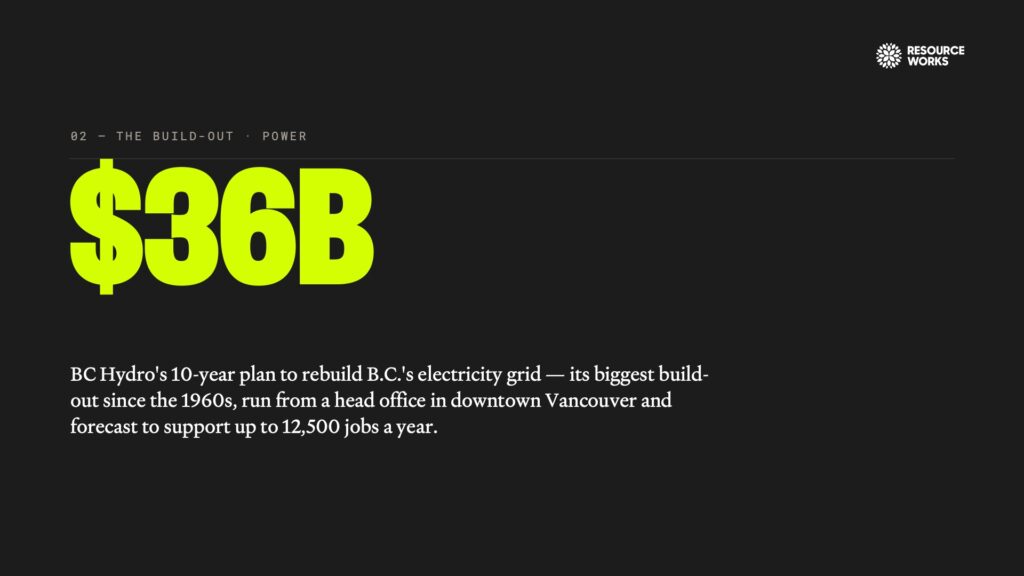
None of this—not the electrified LNG plants, not the mines, not the growing port—runs without power, and the company building that power is headquartered downtown. BC Hydro, the provincial Crown corporation run from a tower in central Vancouver, is in the middle of what it calls its biggest build-out since the 1960s: a 10-year capital plan of nearly $36 billion to rebuild and expand the province’s electricity system, a roughly 50 per cent increase over its previous plan.
The scale is easy to miss because it is spread across the province, but the command and much of the spending run from Vancouver. The plan is forecast to support 10,500 to 12,500 jobs a year, on average, over the decade. Critical in this was the completion of the Site C dam, reinforcing transmission into a growing Burnaby and South Fraser, and adding new clean generation through “calls for power” in which First Nations hold majority equity—more than $2 billion of First Nations ownership in the latest round alone. And a large part of its purpose is to electrify the resource economy itself: the mines of the north coast, the LNG plants on the water, the trucks and ships and port that move the goods. Even the clean-energy transition is being managed from Metro Vancouver—and much of it exists to power what the province digs, ships and builds.
The throughline across all three—oil, gas and power—is the tell. The region’s newest and lowest-carbon energy ambitions are resource ambitions, run from and landing in Metro Vancouver, with First Nations as partners and owners. The next chapter of the resource economy is being built on the city’s water and wired from its towers right now.
The brain
A global capital that mines nothing locally
If the port is where resources leave, the towers of downtown Vancouver are where decisions about resources are made—for projects on the other side of the world. The city has been a centre of mining money for more than a century. The Vancouver Stock Exchange, incorporated in 1906 was built on mineral speculation. After a run of scandals, it merged with the Alberta Stock Exchange in 1999 to form the Canadian Venture Exchange. The Toronto Stock Exchange acquired it in 2001, and it was renamed the TSX Venture Exchange in 2002 . What outlived the exchange was the ecosystem around it—a dense cluster of geologists, financiers, securities lawyers, promoters and engineers packed into a few blocks of downtown office buildings.
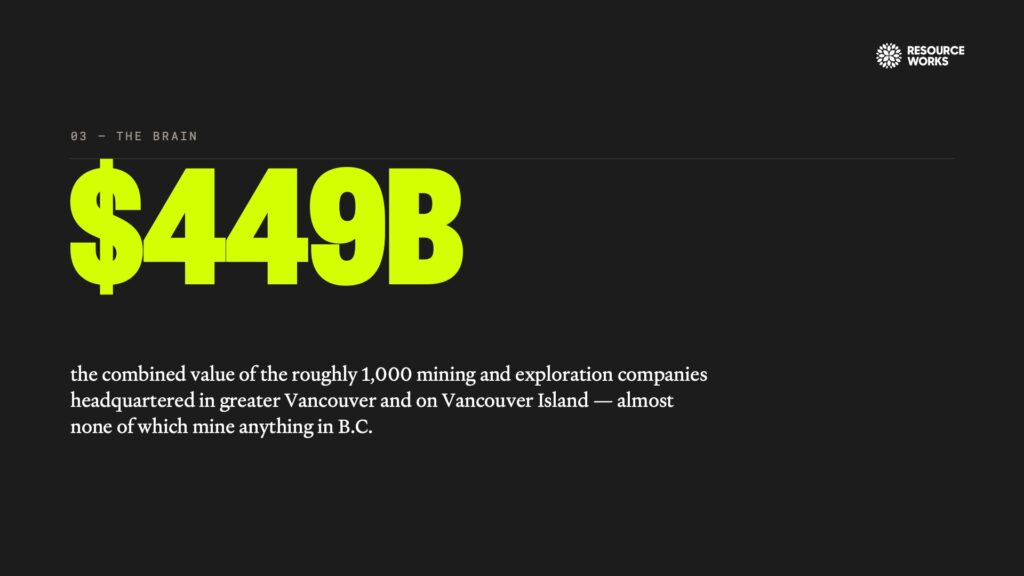
Today that cluster is, by one common measure, the largest of its kind anywhere. Industry counts put close to 1,000 mining and exploration companies in greater Vancouver–more, on that measure, than Toronto and Perth, the next two contenders, combined. The Mining Association of BC values the companies headquartered in Metro Vancouver and on Vancouver Island at a combined $449 billion. Business in Vancouver sums it up neatly: London is the capital of the world’s biggest mining companies, and Vancouver is the global capital of the “juniors”–the small exploration firms that find the deposits the giants later buy. A large share of the world’s publicly listed mining companies, by various counts 40 per cent or more, trade on Toronto’s two exchanges, and Vancouver houses the densest concentration of the exploration firms behind them.
Here is the twist that makes the point. Almost none of these companies mine anything in British Columbia. Of the ten largest by market value headquartered in the city, essentially one—Teck Resources—actually operates mines in the province. The rest run projects in Chile, Argentina, Mali, Nevada, Botswana, the Yukon. The chief executive of one Vancouverlisted explorer described the arrangement with unusual candour to a reporter for Inside Climate News.
“The money flows into Vancouver, and then we geologists spend it—in Alaska, in Mongolia, all over the world.”
Mining executive, To Inside Climate News, 2025

That is what a command centre looks like. The city’s export is not ore. It is capital, expertise and decisions—and they travel to wherever in the world the rock happens to be.
The cluster
The jobs, and the space, that never look like mining
A command centre needs people, and the resource economy employs a great many of them in Metro Vancouver—most of whom never set foot on a mine site.
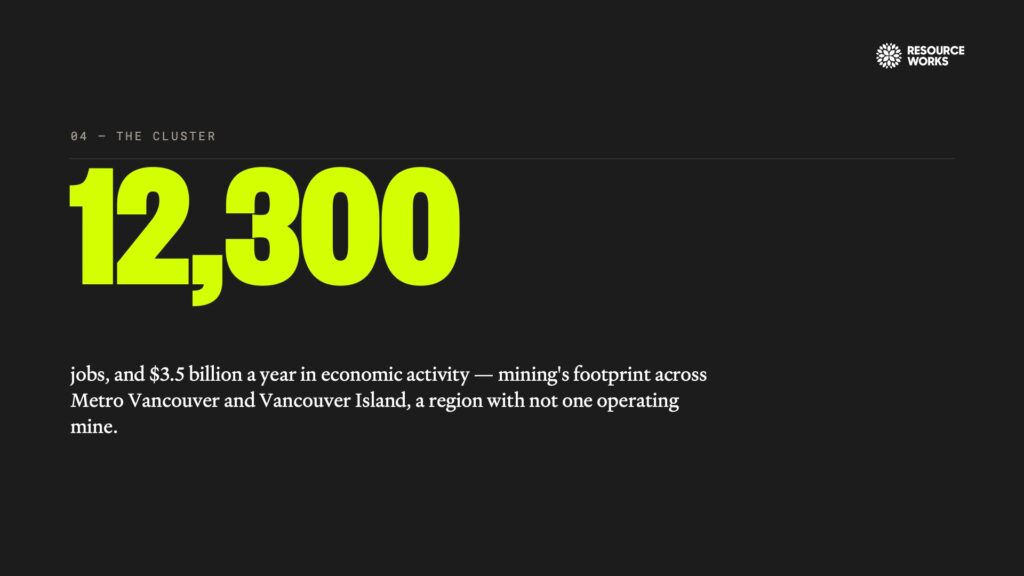
Run down the disciplines the sector draws on and it reads like a directory of the downtown core: engineering, geoscience, finance, law, accounting, environmental science, chemistry, software. The Mining Association of BC’s own regional study found that mining supports more than 12,300 jobs and over $3.5 billion in annual economic activity across Metro Vancouver and Vancouver Island–a region with no operating mines, yet one that accounts for a fifth of the entire sector’s economic footprint. Forestry tells a similar story: about a quarter of B.C.’s roughly 100,000 forest-sector jobs, some 26,000, are based in the Lower Mainland and Southwest, clustered around the head offices, suppliers and ports rather than the cutblocks. Even natural gas, produced 1,000 kilometres to the northeast, runs a supply chain through the city–Vancouver firms billed more than half a billion dollars in goods and services to gas development between 2018 and 2024.
“Increasingly, mining is to Vancouver what oil and gas is to Calgary.”
Michael Goehring, Mining Association of BC, 2026
The footprint in the city
All of this takes up physical space—though, like the economy itself, in a way that hides in plain sight. Walk the financial core and the towers along West Hastings, Howe, Burrard and Georgia house the mining houses, the securities lawyers, the engineering and geoscience firms. Yet the commercial brokers who track that market describe downtown office demand as “well diversified—business services, engineers, legal and tech,” with no single industry dominating. Mining and energy firms are folded into those professional-services categories rather than counted on their own. Many of the region’s roughly 1,000 exploration companies hold small or even shared and virtual offices—a registered address and a phone line on West Hastings while the geologists are in the field—so the cluster’s footprint is systematically under-counted in the leasing statistics even as it fills the calendars of the city’s lawyers, accountants and engineers.
The resource economy’s other footprint is industrial. The terminals, rail yards, warehouses and transload sites that serve the port consume some of the scarcest and most expensive industrial land in North America. Port and resource logistics is one of the largest claimants on that land, and the competition for it—among housing, the port and industry—is one of the region’s defining planning tensions. You cannot easily read the resource economy off a vacancy report, because it is spread across professional services tenancies, small offices and industrial logistics rather than labelled “mining” or “energy.” Its footprint, like its output, is real but camouflaged.
The base
What pays for the glass towers—and the hospitals
Behind the port, the build-out and the cluster sits a deeper and older idea—the one that explains why a city of condos should care about a copper mine 1,000 kilometres away.
The Canadian economist Harold Innis gave it a name almost a century ago: the staples thesis. His argument was that Canada grew by extracting raw materials—fur, fish, timber, minerals, grain—and shipping them to larger economies, and that this trade shaped everything else, from where cities rose to how wealth moved through them. The relationship it produced was between a “metropolis,” which organised, financed and shipped the staples, and a “hinterland,” which produced them. Vancouver is the textbook metropolis.
The economic geographers Roger Hayter, of Simon Fraser University, and Trevor Barnes, of the University of British Columbia, spent careers mapping precisely this—how British Columbia’s resource economy is run from its largest city even though the resources come from everywhere but the city.
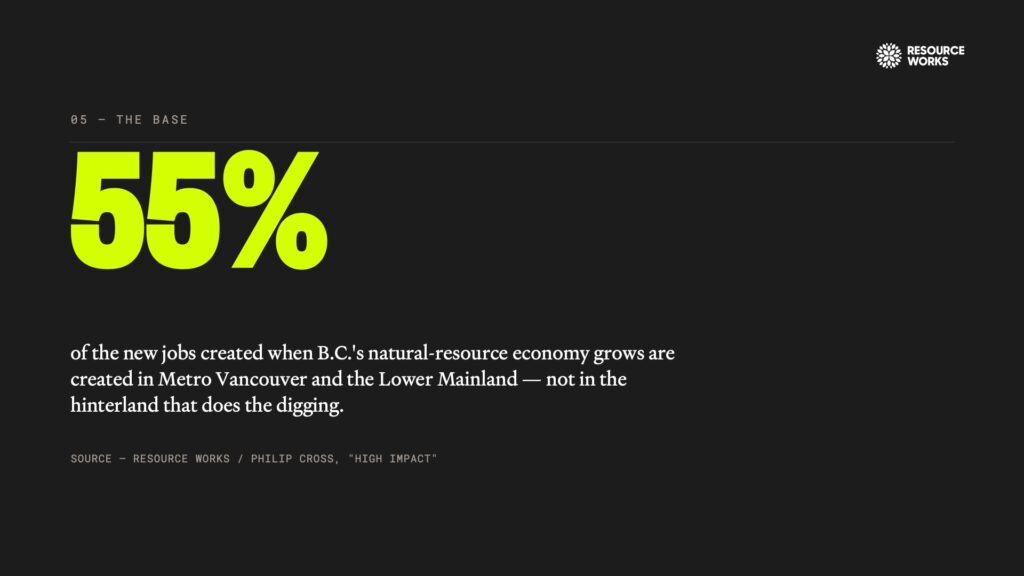
Translated into today’s numbers, the idea holds. A study by Philip Cross, a former chief economic analyst at Statistics Canada, found that natural resources and the activities directly tied to them make up about 11 per cent of B.C.’s GDP, and that resource industries supply roughly three-quarters of the province’s goods exports. An analysis commissioned by the provincial government went further, estimating that resource-related activity accounts for more than half of B.C.’s “economic base”—the export earnings that bring outside dollars into the province and then circulate through every café, clinic and condo sale that follows. The same economist made the regional point most sharply in Resource Works’ own High Impact study: a 10 per cent increase in B.C.’s natural-resource output would generate more than 39,000 new jobs across the province—and 55 per cent of them would be created in Metro Vancouver and the Lower Mainland. The resources come from the hinterland; the jobs they create, more often than not, land in the city.
Argued over, line by line
This is not an abstract claim. It is fought over every year in the province’s budget process. Under the Budget Transparency and Accountability Act, an all-party committee of the Legislature—the Select Standing Committee on Finance and Government Services—holds a public consultation and reports recommendations for the next budget. Resource industries are perennial participants. In June 2026, Resource Works itself presented to the committee, arguing that energy, mining and forestry are “the indispensable foundation for fiscal stability, job creation, and the public services,” and that without the tens of billions in resource exports and the revenue they generate, “the math on hospitals, schools, and infrastructure simply does not add up.” The province has been acting on that case: Budget 2026 put more than $40 million over three years into faster permitting, mineral-exploration permits rose nearly 35 per cent in 2025 over 2024, and timelines for major mine applications have fallen about 35 per cent since 2019.
The accountants make the same point in their own idiom. The Chartered Professional Accountants of British Columbia, in their annual BC Check-Up reports, classify forestry, fishing, mining, oil and gas together as “natural resources,” track their weight in the economy, and warn that B.C.’s exposure to U.S. tariffs on softwood lumber, metals and energy is a direct economic risk—urging the province to diversify both its trading partners and its economy.
The trade analysts extend the logic outward, casting the new tidewater access at the region’s port as Canada’s chance to swing resource exports toward Asia. The throughline is consistent across the accountants, the committee room and the think tanks: the resource economy is a major source of the public revenue that pays for the province’s hospitals and schools—including the city’s. The glass-tower economy and the services that support it are, in part, underwritten by what the province digs, cuts and pumps.
The other story
Where this account has to be fair
None of this is the whole truth, and an honest report has to say so plainly.
There is a strong, well-evidenced case that Metro Vancouver has genuinely changed. The resource sector’s share of the provincial economy has shrunk over decades—not because resources collapsed, but because real estate, finance, technology and services grew so much faster. Scholars such as Thomas Hutton and Trevor Barnes have documented Vancouver’s rise as a “new economy” city of design, film, software and creative work, layered over and partly replacing its old industrial waterfront. For most residents, the region’s defining economic story is not coal or copper. It is the price of housing.
The finance cluster has a shadow side, too. The same downtown that insiders call a “centre of excellence” has long been known, less admiringly, as Howe Street—a market whose junior-mining listings have produced as many cautionary tales as discoveries. Investigative journalists and academics, from The Narwhal to Inside Climate News to the scholar Alain Deneault, have documented how loose disclosure rules and generous tax incentives can tip exploration finance from genuine risk-taking into speculation. Critical research groups, including the Canadian Centre for Policy Alternatives and its Corporate Mapping Project, argue that the sector’s economic weight also buys it outsized political influence in the province.
So the honest synthesis is not that Vancouver is secretly a mining town. It is that the region is two economies at once—a postindustrial metropolis and a resource command centre—and that the second is consistently underweighted in how the first understands itself. The risk is not in celebrating the new economy. It is in writing policy as though the old one had vanished, when the port’s record tonnage, the new oil in the harbour and the downtown towers full of geologists say otherwise.
Why it matters
Seeing the economy you actually have.
Why press the point? Because places make decisions about things they can see, and Metro Vancouver has trained itself not to see this one.
When the region debates a pipeline, a port expansion, a mine permit or an LNG terminal, it tends to frame the question as someone else’s industry being imposed on an urban, post-resource public. The evidence points the other way. These are, in large measure, Metro Vancouver’s own industries—its jobs, its head offices, its export earnings, its tax base, the revenue behind its public services. The roughly $365 billion that crosses the port, the new $13.9 billion in crude through the harbour, the $36 billion BC Hydro is spending to power it all, the $449 billion in companies run from downtown, the three-quarters of provincial exports and the 55 per cent of resource-driven job growth that lands in the Lower Mainland do not belong to the hinterland alone. They are the quiet foundation beneath the visible city.
There is real opportunity in seeing this clearly. As the world scrambles for critical minerals, low-carbon metals, responsibly produced energy and reliable food, the very things Metro Vancouver already organises, finances and ships are in rising demand. The concentration of expertise downtown is a genuine, hard-to-replicate competitive advantage—the sort other cities would pay dearly to build from scratch. The first step to using it well is admitting that it is there. The city said as much in 1969, when it put a logger and a fisherman on its coat of arms, set a ship above them and the sea between them, and chose the motto it still carries.
Metro Vancouver is a resource city. The mines are just somewhere else.
Stewart Muir is the President and CEO of Resource Works Society.
Share This:



















COMMENTARY: Natural Gas ‘Flying Under the Radar,’ But Big Growth is Coming