


 CDN NEWS |
  US NEWS







EnergyNow Editorial Report
Artificial intelligence is creating an energy challenge unlike anything the technology industry has faced before.
Data centres are getting larger, individual campuses are increasingly measured in hundreds of megawatts or even gigawatts, and utilities across North America are struggling to build generation and transmission fast enough to keep pace.
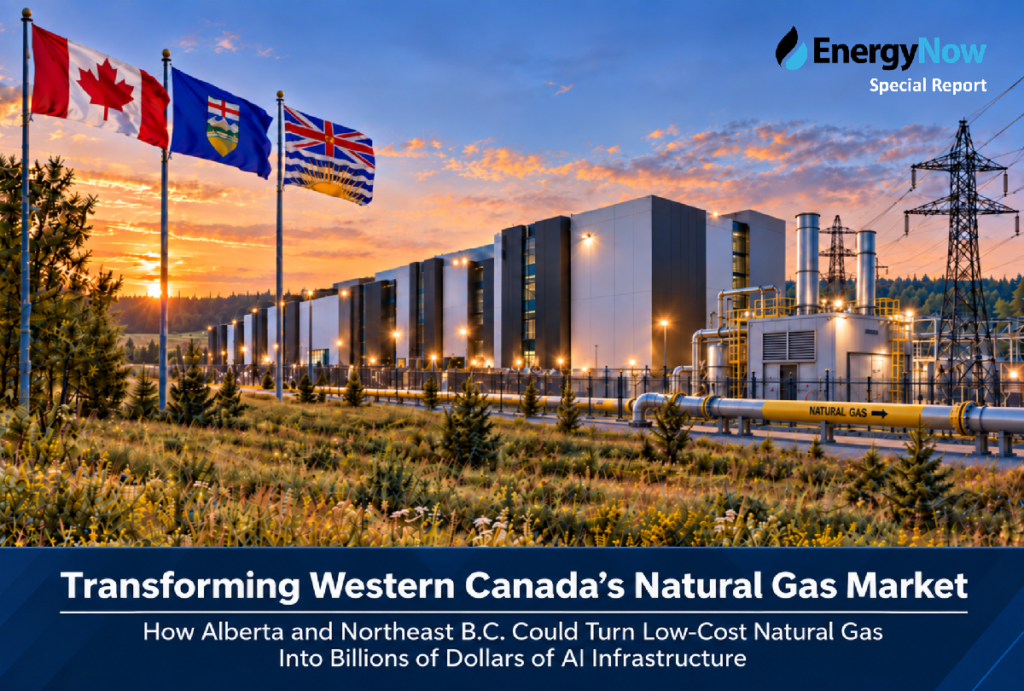
For Alberta—and potentially parts of northeast British Columbia—that challenge could become a major economic opportunity.
Western Canada has several things the AI industry urgently needs: enormous natural-gas resources, established pipelines and processing infrastructure, experienced energy companies, industrial land, a cold climate that can reduce cooling requirements and, perhaps most importantly, some of the lowest-priced natural gas in North America.
In early September, Alberta AECO gas was trading at roughly C$1.15/GJ, while B.C. Station 2 was around C$1.05/GJ. That is a problem if the only objective is to sell gas into a depressed commodity market.
But it can be a major advantage if the objective is to turn that low-cost gas into reliable electricity for one of the fastest-growing industries in the world.
The strategic question is changing.
Instead of asking only how Western Canada can move more natural gas thousands of kilometres to customers, should Alberta and B.C. also be asking how much value can be created from that gas before it leaves the producing region?
Alberta Is Already Becoming a Test Case
The level of data-centre interest in Alberta is extraordinary.
Requests for new data-centre connections have totalled roughly 19.6 GW, significantly more than Alberta’s historical peak electricity demand.
Not all of those projects will be built, and certainly not all would be powered exclusively by natural gas. But the size of the queue illustrates why Alberta has had to rethink how large new loads connect to the provincial electricity system.
The province is increasingly encouraging major projects to bring their own generation or storage rather than simply drawing enormous quantities of power from the existing grid.
That approach plays directly into Alberta’s natural-gas advantage.
Meta’s Sturgeon County data-centre development is one example. The associated 932-MW Greenlight Electricity Centre is expected to use roughly 150 million cubic feet of natural gas per day.
Tourmaline’s proposed Malachite One project near Edson takes the idea a step further by proposing to locate data-centre infrastructure and dedicated generation close to existing gas production and processing facilities.
That creates an interesting new value chain:
Produce the gas → process it → generate electricity → power the data centre → export computing services globally.
Instead of exporting only the raw commodity, Western Canada keeps more of the associated investment and economic activity at home.
How Much Gas Could Data Centres Actually Use?
The Alberta projects provide a useful benchmark.
Approximately 150 MMcf/d of natural gas per gigawatt of continuous generation is a reasonable working estimate for highly efficient gas-fired power supplying a major data centre.
Using that assumption:
| Gas-Powered Data Centres | Approx. Gas Demand |
|---|---|
| 1 GW | 0.15 Bcf/d |
| 5 GW | 0.75 Bcf/d |
| 10 GW | 1.50 Bcf/d |
| 19.6 GW | 2.94 Bcf/d |
Canada produces roughly 19 Bcf/d of natural gas, with Alberta and B.C. accounting for almost all of it.
That means 1 GW of gas-powered data centres would not materially change the Western Canadian market.
Five gigawatts would.
At 0.75 Bcf/d, a 5-GW data-centre sector would create a large new block of continuous, year-round demand.
At 10 GW, consumption would approach 1.5 Bcf/d, making AI one of Western Canada’s largest industrial gas-demand sectors.
Could AI Become an LNG-Sized Gas Market?
This may be the most important comparison.
LNG has become one of the principal growth stories for Western Canadian natural gas. LNG Canada Phase 1 is expected to require roughly 1.8 Bcf/d at full utilization.
At the 150-MMcf/d-per-GW benchmark, approximately 12 GW of gas-powered data centres could consume roughly the same amount of gas.
That does not mean Alberta will build 12 GW of gas-powered AI infrastructure.
But it shows that the potential scale is no longer trivial.
Data centres could eventually become an LNG-sized domestic market for Western Canadian natural gas.
And there is one important difference.
With LNG, the gas is transported to the coast, liquefied and exported.
With data centres, much more of the value chain remains in Western Canada through power generation, construction, pipelines, municipal taxes, engineering, technology employment and digital infrastructure.
Would Data Centres Increase Natural-Gas Prices?
Almost certainly—if enough are built. But that should not necessarily be viewed negatively.
Western Canadian producers have repeatedly dealt with periods of extremely weak AECO and Station 2 pricing because local production exceeds immediate regional demand or transportation capacity.
Large data centres would provide something producers value enormously: predictable, year-round demand located inside the producing basin.
A 1-GW data centre purchasing 150 MMcf/d every day for decades is very different from a temporary demand spike.
Five gigawatts would absorb around 750 MMcf/d. Ten gigawatts would absorb 1.5 Bcf/d.
At those levels, the likely effect would be to help establish a stronger floor underneath Western Canadian gas prices and potentially reduce some of the severe regional discounts producers periodically experience.
That does not mean data centres would automatically push AECO to C$3, C$4 or C$5/GJ. Weather, LNG exports, storage, drilling, pipeline constraints and U.S. production all influence prices.
But sustained local industrial demand should strengthen the market.
The Bigger Economic Impact Could Be on Gas the Data Centres Never Use
Consider the 5-GW scenario.
At about 289 million GJ of annual gas consumption, the direct commodity value would be approximately:



- C$578 million annually at C$2/GJ
- C$866 million at C$3/GJ
- C$1.16 billion at C$4/GJ
But that may not be the biggest benefit.
Alberta produces more than 11 Bcf/d of gas. If stronger local demand contributed to even a modest improvement in realized pricing across a much larger share of that production, the increase in gross commodity value could amount to billions of dollars annually.
A sustained C$1/GJ improvement applied across Alberta’s approximate production base represents more than C$4 billion of gross annual commodity value.
That is not a prediction that data centres will increase AECO by C$1/GJ.
It simply demonstrates the leverage created when even a modest price improvement is applied across an enormous production base.
Would Consumers Pay More for Natural Gas?
Yes, probably somewhat. If data centres strengthen the underlying Western Canadian gas market, residential and commercial customers would eventually see some of that increase in the commodity portion of their bills.
But the magnitude needs perspective.
For every C$1/GJ increase in the commodity:
- a household using 5 GJ pays about C$5 more
- at 10 GJ, about C$10 more
- at 15 GJ, about C$15 more
The commodity itself is only one part of a natural-gas bill. Distribution, transmission, administration and other charges remain significant.
The bigger consumer risk would arise if several developments occurred simultaneously: rapid AI growth, more LNG exports, increasing oilsands gas consumption, pipeline constraints and a cold winter.
The best protection against that outcome is not preventing new demand. It is ensuring new supply and infrastructure grow alongside it.
Western Canada has that ability.
The Montney and Deep Basin contain enormous low-cost resources, and producers have repeatedly demonstrated that they can increase drilling when pricing justifies additional investment.
Which Producers Could Benefit Most?
The strongest-positioned companies are those with large gas reserves, low production costs, processing infrastructure and proximity to potential data-centre locations.
Tourmaline Oil may be the most obvious beneficiary. It is Canada’s largest gas-focused producer and is already actively exploring the gas-to-data-centre model through Malachite One.
Canadian Natural Resources has enormous scale, infrastructure and financial capacity.
Ovintiv has one of the strongest Montney positions in Alberta and B.C.
Shell, following its acquisition of ARC Resources, now has a much larger Montney position along with LNG expertise and the financial capability to participate in major infrastructure projects.
Peyto Exploration could be particularly well positioned for west-central Alberta development because of its low-cost Deep Basin gas assets.
Birchcliff Energy and Advantage Energy also have strong Alberta Montney exposure.
In northeast B.C., Pacific Canbriam, PETRONAS Canada and other major Montney producers could benefit if the province creates a workable framework for dedicated gas-powered computing infrastructure.
Pipeline and midstream companies could benefit as well.
A 1-GW campus requiring 150 MMcf/d is already a significant industrial customer. A 5-GW cluster requiring 750 MMcf/d begins to resemble a major new regional market, creating opportunities for TC Energy, Pembina and other infrastructure providers.
Where Should the Data Centres Go?
The strongest locations will combine natural gas, pipelines, fibre, workforce, industrial land and suitable cooling.
Several regions stand out:
Sturgeon County and Alberta’s Industrial Heartland offer established industrial infrastructure, access to Edmonton’s workforce and strong pipeline and transmission connectivity.
Edson and the Deep Basin corridor offer the opportunity to build computing closer to prolific gas resources.
Grande Prairie and the Peace Country combine natural-gas supply with an experienced energy-services workforce.
Northeast B.C., particularly Fort St. John and Dawson Creek, has enormous Montney gas resources and very low Station 2 pricing, although B.C.’s electricity and climate policies make gas-fired development more challenging than in Alberta.
The Western Canadian climate provides another advantage.
Data centres produce enormous amounts of heat. Alberta and northern B.C.’s cooler temperatures can reduce cooling loads for significant parts of the year compared with hotter U.S. data-centre markets.
The Emissions Question Cannot Be Avoided
The biggest challenge for gas-powered AI is emissions.
One gigawatt of continuously operating natural-gas generation could produce roughly 3 million tonnes of direct CO₂ emissions annually before carbon capture.
Five gigawatts could approach 15 million tonnes.
That means gas-powered AI will eventually need more than cheap gas.
The strongest long-term Western Canadian model could combine:
- high-efficiency natural-gas generation
- carbon capture where practical
- renewable electricity
- battery storage
- low-water cooling
- eventually other forms of firm low-carbon power
Alberta’s experience with carbon capture and geological storage could ultimately become another competitive advantage.
The Bottom Line
Western Canada’s cheap natural gas is usually discussed as a problem.
AI may turn part of that problem into an opportunity. At 1 GW, the natural-gas impact is modest.
At 5 GW, approximately 750 MMcf/d becomes a meaningful new market. At 10 GW, approximately 1.5 Bcf/d becomes a major structural source of demand.
At roughly 12 GW, AI-related gas demand could approach the broad scale of LNG Canada Phase 1.
That could strengthen Western Canadian gas prices, stimulate drilling and pipeline investment, increase royalties and taxes and attract tens of billions of dollars of AI and power infrastructure.
Consumers would likely see some increase in the commodity portion of natural-gas bills. Emissions, water use and electricity-system impacts would have to be carefully managed.
But Western Canada has something many competing AI jurisdictions do not: enormous quantities of low-cost, reliable energy sitting beside an established industrial infrastructure base.
For decades, Alberta has asked how it can get more value for its natural gas. Data centres offer a different answer.
Instead of simply shipping the gas to the customer, bring the customer to the gas.
Turn natural gas into electricity. Turn electricity into computing. And export the resulting value to the world.
Share This:






















BUYER BEWARE! OPINION: Iceland and Norway Keep Saying No to Europe. Canada Should Too