


 CDN NEWS |
  US NEWS







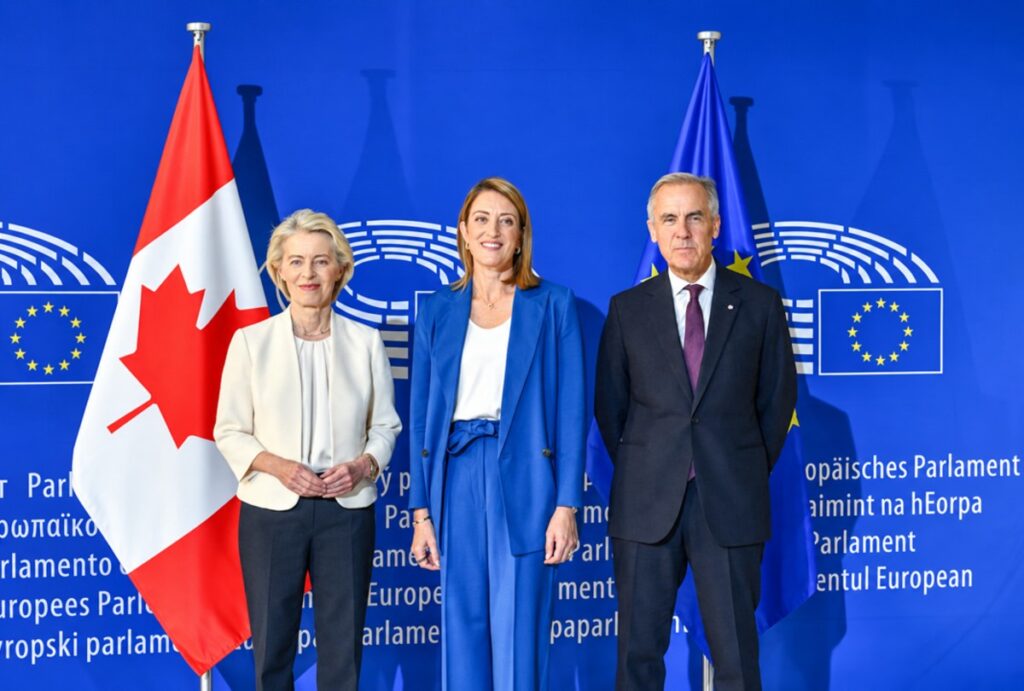
Prime Minister Mark Carney, EU Parliament President Roberta Metsola and European Commission President Ursula von der Leyen arrive for a speech during European Commission President’s annual State of the Union address at a plenary session of the European Parliament in Strasbourg, eastern France on Sept. 16, 2026.
Canada has no need for closer ties with the EU. Going beyond the access we have will ensnare us in Brussel’s growth-killing regulatory net
By Tammy Nemeth, Originally a Special to the Financial Post Here
It was smiles, applause and handshakes all around on Wednesday in Strasbourg as Mark Carney sat in on EU President Ursula von der Leyen’s “state of the union” address, in which she floated the idea of Canada becoming the EU’s first “associate member,” whatever that means. But let’s not get carried away by all the well-wishing and good fellowship. The EU is a bloc that sensible countries like Iceland and Norway keep refusing to join. They already have the market access Carney wants and live right next door to the regulators he is courting, and yet they have repeatedly rejected closer integration.
In August, Icelanders voted 52.8 per cent against restarting accession talks that were abandoned more than a decade ago. Turnout was high at 82.5 per cent and the question was not membership but simply whether to reopen negotiations. And still the voters said no.
The vote was decided by national identity and sovereignty arguments that should sound familiar to Canadians: existing arrangements with a larger hegemon already deliver market access without surrendering control of critical resources or importing even more of Brussels’ regulatory machine. Iceland is in both the European Economic Area (EEA) and the Schengen Agreement, which controls population movements. Although it must adopt certain rules and regulations, it keeps control of its own currency, trade policy and, most importantly, fisheries. Fish still account for about 40 per cent of Iceland’s merchandise exports. Voters saw the EU’s Common Fisheries Policy as a non-starter even though the EU hinted it might offer special treatment. Icelanders either didn’t believe that or preferred
Watching the results closely was Norway. Although Norway’s voters rejected EU membership twice, in 1972 and 1994, some politicians in Oslo hoped an Icelandic “Yes” would pave the way for another Norwegian referendum. Like Icelanders, however, Norwegians are less keen than their leadership on closer ties to Brussels. In 2025, a Norwegian government collapsed over three directives from the EU’s clean-energy package, which Oslo was required to adopt in return for EEA single-market access.
More recently, Norway has said it will develop new oil and gas fields in the Barents Sea whether Brussels likes it or not because energy security “serves both Norwegian and European interests.” Norway is also reconsidering its role as Europe’s hydro-electric “green battery.” Instead of delivering stability, power interconnections to Sweden, Denmark, Finland, Germany, the Netherlands and the U.K. have exposed Norwegians to Europe’s price volatility and put pressure on its reservoirs. Norway’s grid operator has been instructed by the national government in Oslo not to plan new subsea links before 2029. Norway can act boldly on its oil and gas developments precisely because it is not a full or associate member of the EU.
Canada already has a better bargain than the EEA deal Iceland and Norway have refused to expand and Norway is walking back. The Comprehensive Economic and Trade Agreement (CETA) we have with Europe removed tariffs on most goods and opened some services and procurement without our having to pay the EEA’s real price: taking Brussels’ laws and regulations with no vote or contribution in writing them.



In addition, we already have the 2025 security and defence partnership, as well as Canada’s unique non-European access to the EU’s SAFE defence instrument. Essentially, Canada already has exceptional trade access and defence co-operation.
It’s more likely that a “unique alliance” or associate membership would import what we don’t have: the EU’s oppressive rules and regulations, all 170,000 pages of them. We should keep it that way. Any closer integration with the EU boils down to accepting European regulation. That would be devastating for Canadian business and for Canadian independence, as well. We would become a rule-taker, surrendering sovereignty and policy space that actually matters, namely how we: develop oil, gas, hydro and critical minerals; manage Atlantic and Arctic fisheries; set agricultural and forestry rules; and tax and regulate our own industries.
Canada’s core industries — oil and gas, mining, fisheries, agriculture and forestry — are exactly the ones Brussels wants to classify, control, constrain or phase out through its Green Deal and Fit for 55 programs and the legal and regulatory frameworks they impose. A closer association would attach European criteria to how those resources are developed, financed and sold — think the Trudeau government on steroids — without giving Canadians any say in writing rules that have already been written. Even if we were to have a “seat at the table” we would no longer be “masters of our own house” but, rather, a far-away voice facing 27 other countries that do not necessarily share the same interests.
Carney’s dealings with European political elites are being pitched as the ultimate in political sophistication, as well as pragmatic execution of his call-to-arms for middle powers. But countries like Iceland and Norway that actually live next-door to the EU and already enjoy privileged market access keep saying their current deals are enough. Any degree of membership imports a bureaucratic superstructure designed for a different continent, resource endowment and political culture.
Canada does not need closer ties with the EU. We should reject the idea that existing arrangements aren’t enough and that private investment and national resource policy require an official European hierarchy to function. Trade as it is? Yes. Quiet conscription of Canadian energy, minerals and fisheries into Brussels’ regulatory and policy orbit? No, thank you.
Tammy Nemeth is a U.K.-based energy analyst and consultant.
Share This:





















BUYER BEWARE! OPINION: Iceland and Norway Keep Saying No to Europe. Canada Should Too