


 CDN NEWS |
  US NEWS







EnergyNow Media Editorial Staff
Kendall Dilling says faster tax write-offs could strengthen the investment case for the multibillion-dollar project, while Alberta Energy Minister Brian Jean says governments and producers are working toward a final agreement by mid-November
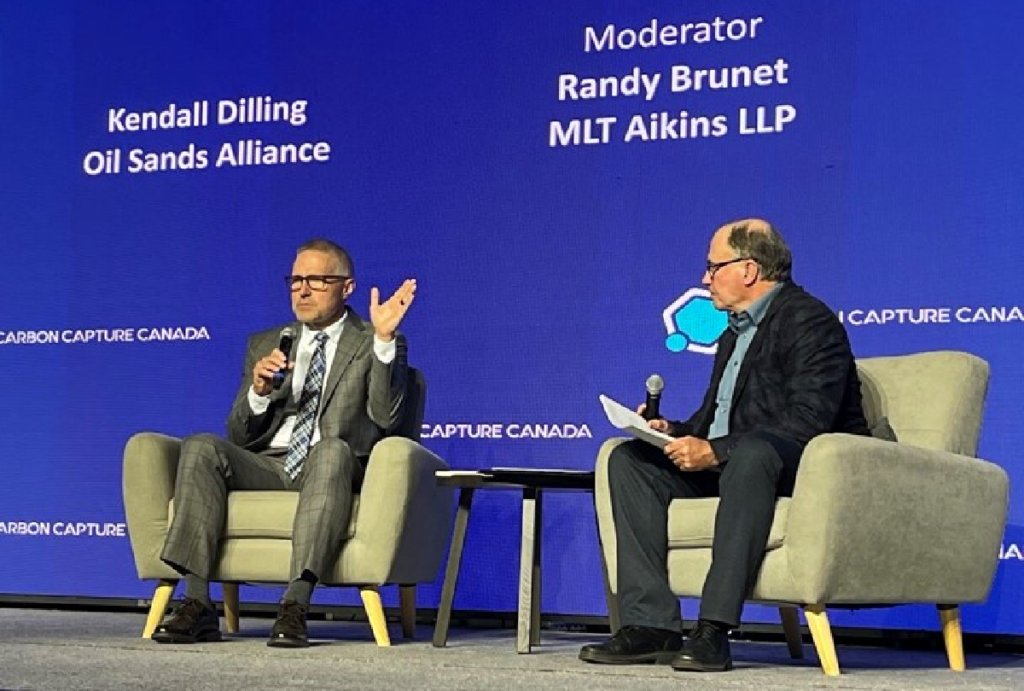
EDMONTON — Ottawa’s new capital-investment tax deduction could help overcome one of the biggest financial barriers facing the proposed Pathways carbon capture and storage project, according to Oil Sands Alliance president Kendall Dilling.
Speaking Tuesday at the Carbon Capture Canada Conference in Edmonton, Dilling said oil sands projects face a unique investment challenge: they require enormous amounts of capital upfront, while investors may wait years before seeing a return.
“The hardest investor to find is the first one,” Dilling said, explaining that once an oil sands project is operating, the resource can produce for generations.
“Once you get through that valley of death, as we call it — the oilsands are incredibly resilient resources.”
The problem is particularly acute for carbon capture and storage projects. The proposed Pathways system would include carbon-capture facilities at multiple oil sands operations, a shared CO₂ transportation pipeline and a permanent underground storage hub in the Cold Lake region.
The project could take a decade or longer to move from early investment to full operation. That lengthy development cycle makes it difficult to compete for capital against projects offering faster and more predictable returns.
“It is just a non-starter,” Dilling said of asking investors to wait that long to recover their capital. Without an attractive financial structure, he said, investors may simply collect their dividends and deploy the money elsewhere.
Carney’s ‘mega deduction’ changes the calculation
Dilling’s comments came one day after Prime Minister Mark Carney announced a permanent “Productivity Mega Deduction” at the Canada Investment Summit in Toronto.
Under the proposal, businesses would be allowed to immediately deduct the cost of most newly acquired capital equipment and other long-term assets in the first year those assets are put into use. The measure applies to qualifying investments acquired on or after Sept. 15.
“The effect is straightforward. When you invest in Canada, you can deduct substantially more of that investment immediately,” Carney told investors in Toronto.
The federal government says the measure will reduce Canada’s marginal effective tax rate on new business investment from approximately 13 per cent to 6.4 per cent — less than half the comparable U.S. rate. Ottawa is promoting the deduction as a central part of Carney’s plan to attract $1 trillion in investment over five years.
For the Pathways project, immediate expensing could allow participating companies to recover a larger share of their initial investment through the tax system much sooner than under traditional depreciation schedules.
Dilling said that addresses one of the key pillars the alliance has been seeking from government, although the deduction alone will not be enough to move the project forward.
“Our value proposition is not a standalone carbon capture and storage proposition,” he said.
Instead, Pathways forms part of what Dilling described as a “grand bargain” involving carbon capture, government support, expanded oil production, new pipeline capacity and improved access to international markets.
In other words, oil sands companies are not proposing to spend billions of dollars on emissions infrastructure in isolation. The investment case also depends on Canada creating conditions that allow the industry to grow production and reach higher-value markets.
Mid-November deadline approaching
Alberta Energy and Minerals Minister Brian Jean told the Edmonton conference that the province, Ottawa and the five Oil Sands Alliance producers are working toward final agreements by mid-November.



The alliance represents Canadian Natural Resources, Cenovus Energy, ConocoPhillips Canada, Imperial Oil and Suncor Energy.
Those companies spent approximately five years negotiating with governments before signing a memorandum of understanding with Alberta and Ottawa in July. The agreement established Nov. 15 as the target for reaching binding arrangements defining the obligations and financial contribution of each party.
Jean said Alberta’s carbon-capture incentive is being designed to complement the federal government’s carbon capture investment tax credit. He has consistently argued that CCUS is the “only viable option” for substantially reducing emissions from hard-to-abate industries such as oil and gas, petrochemicals and cement.
Under the July memorandum, Ottawa committed to advancing proposals addressing the project’s operating costs. Alberta agreed to finalize its carbon capture incentive program and extend it through 2035.
Operating support remains essential because the federal investment tax credit, Alberta’s incentive and the new productivity deduction primarily address capital costs. Once operating, Pathways would face continuing expenses for capturing, compressing, transporting and storing millions of tonnes of carbon dioxide.
Those costs would largely be offset through carbon markets rather than through a predictable U.S.-style production tax credit.
Dilling said carbon pricing itself is no longer a major point of disagreement between the parties.
“We’ve kind of moved beyond that now,” he said, although implementation details still need to be resolved.
That certainty remains important to investors. Candice Paton, vice-president of corporate affairs at Enhance Energy, told the conference that developers need to understand how Alberta’s industrial carbon market and federal clean fuel credits will operate over the full life of their projects.
“The durability of these systems is, I think, as important as incentivization,” Paton said.
Construction could begin around 2030
If binding agreements are completed and the project advances through regulatory reviews and a final investment decision, Dilling said approximately two years of preliminary construction could put the start of major pipeline work around 2030. That would position the system to begin operating near its current 2032 target, although some early work could occur sooner.
The initial project is expected to capture and store approximately six million tonnes of CO₂ annually. Dilling compared that reduction to removing roughly half of Alberta’s vehicles from the road.
The scale is significant, but the investment hurdles facing Pathways reflect a broader global problem. Frank Des Rosiers, an assistant deputy minister at Natural Resources Canada, told the conference that International Energy Agency data indicates approximately 90 per cent of announced carbon capture projects have not yet reached a final investment decision.
The question for Canada is whether the combination of investment tax credits, Alberta incentives, operating support and Carney’s productivity deduction will finally provide enough certainty to move one of the world’s largest proposed carbon-management projects into construction.
Dilling argued that carbon captured from an industrial facility delivers the same atmospheric benefit as emissions avoided through another technology.
“A molecule is a molecule,” he said.
He also positioned the project as a test of whether Canada can combine emissions reductions with expanded resource development and stronger access to global markets.
“We are going to stop getting in our way, and we are going to develop our resources, and we’re going to do it responsibly,” Dilling said.
The next major test comes Nov. 15. If governments and producers can convert the July memorandum into binding commercial agreements, the Pathways project could move closer to a final investment decision. If they cannot, the uncertainty that has held back the project — and much of Canada’s wider carbon-capture industry — will remain.
Share This:





















COMMENTARY: Here’s How to Help Secure Canada’s Energy Sovereignty – Fraser Institute