


 CDN NEWS |
  US NEWS







EnergyNow Editorial Staff
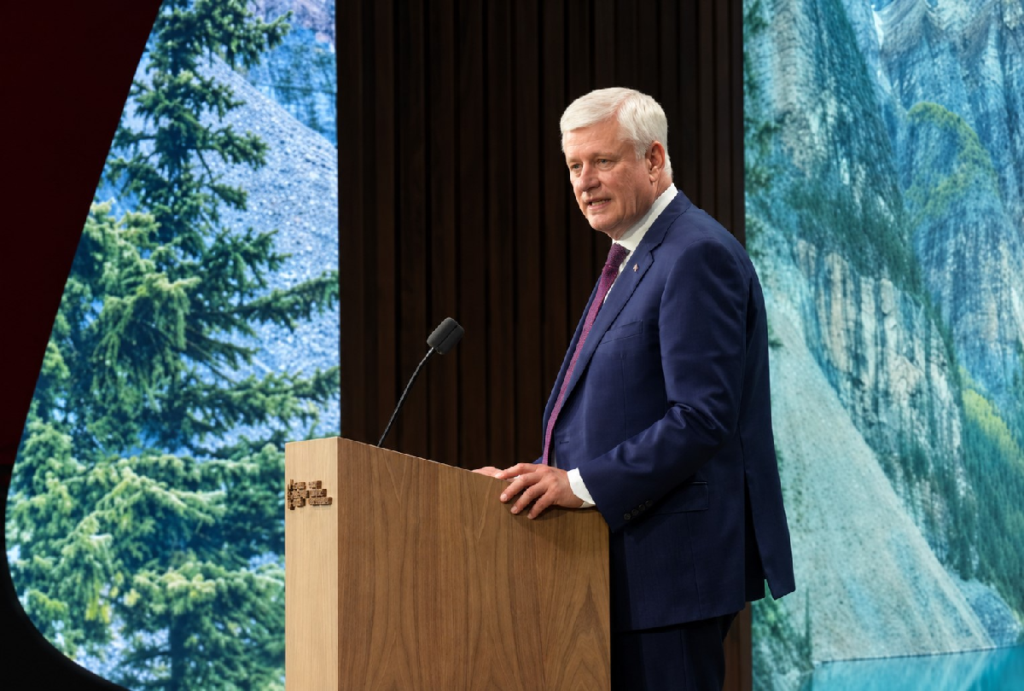
Former prime minister Stephen Harper used his closing address at the Canada Investment Summit in Toronto on September 15 to deliver a pointed message: Canada had the opportunity to become a global energy superpower more than a decade ago, but federal policy choices made after his government left office prevented the country from realizing that potential.
Harper also argued that the current breakdown in Canada–U.S. trade relations should be treated as a catalyst for Canada to develop new markets, accelerate major projects and reduce its dependence on the United States.
Canada was ready in 2015
Harper said Canada was positioned to emerge as a global energy leader when his Conservative government left office in 2015.
“In 2015, Canada was poised to become that energy superpower. Today, we are not. Why? Because of deliberate policy choices that followed over the next decade.”
Although Harper did not mention Justin Trudeau by name in that sentence, the reference was unmistakable. Trudeau’s Liberal government governed throughout almost the entire period Harper described.
Harper’s criticism appeared aimed at the regulatory burdens, lengthy approval processes and restrictions imposed on resource and infrastructure development during the Trudeau years. These included the federal impact-assessment regime, restrictions on tanker traffic along British Columbia’s northern coast and policies that contributed to uncertainty surrounding pipelines, LNG facilities and other resource projects.
However, Harper said Canada should focus on recovering the opportunity rather than dwelling on what was lost.
“There is no point bemoaning what is past, especially because the opportunity of becoming that global energy superpower is fortuitously offering itself to us once again.”
Why Harper believes Canada can be an energy superpower
Harper framed energy broadly, emphasizing that Canada’s advantage extends well beyond oil and natural gas.
He pointed to Canada’s position as:
- The world’s fourth-largest oil producer
- The fifth-largest natural gas producer
- The third-largest hydroelectricity producer
- The second-largest uranium producer
- A leader in nuclear-reactor construction, refurbishment and small modular reactor development
- A country with significant investments in biofuels, renewable energy and the critical materials needed for emerging energy technologies
“Whatever the energy mix of the future, Canada should be a major and a global supplier.”
According to Harper, Canada’s resources are particularly valuable because they are produced within a stable democracy governed by the rule of law, with comparatively high environmental and regulatory standards and far from many of the world’s geopolitical conflict zones.
That combination, he argued, gives Canada an advantage over competing suppliers and makes Canadian energy attractive to countries looking for secure, reliable and responsibly produced supplies.
Harper welcomes Carney’s change in direction
While sharply criticizing the policies of the previous decade, Harper praised Prime Minister Mark Carney’s government for moving to accelerate approvals for major projects, particularly oil sands projects.
“These changes are welcome and they are very important. However, more does need to be done.”
Harper referred to the Carney administration as “Canada’s new government,” reinforcing Carney’s attempt to distance his government from the Trudeau era.
He called for comprehensive reform of Canada’s regulatory and permitting systems so that investors can receive a predictable, science-based decision within a fixed and reasonable timeframe.



“The burdens and restrictions that do not exist elsewhere simply must be removed in Canada.”
His central argument was that Canada does not lack resources, customers or available investment capital. The obstacle has been the country’s inability—or unwillingness—to approve infrastructure and move its products to international markets.
“The world is developing an unprecedented demand for energy in all its forms, and they want it from Canada, provided we want to get it out of the ground and sell it.”
Breaking Canada’s dependence on the United States
Harper tied energy development directly to Canadian sovereignty and the country’s deteriorating trade relationship with Washington.
He supported the federal government’s recent decision to walk away from trade negotiations with the United States, saying Canada had “no choice” under the circumstances.
“It is clear that the current U.S. administration views our level of economic integration as incompatible with our separate sovereignty.”
Harper said Canada must consequently reduce its economic reliance on the United States, even if that transition carries substantial costs.
“Thus, to maintain that sovereignty, we must pursue diminished reliance upon the United States.”
Energy infrastructure would be central to that diversification. New pipelines, LNG export terminals, ports, electricity connections, uranium production and other projects would allow Canada to reach Asian and European customers instead of remaining overwhelmingly dependent on the American market.
Harper warned that failing to build those connections would leave Canada trapped in its existing relationship.
“Ironically, if we do not do these things as a country, the Americans will continue to be our sole customers, and they will not lack the urgency that we have lacked here in Canada.”
Energy development is now a national necessity
Harper said becoming an energy superpower is no longer simply an economic opportunity. In his assessment, it has become essential to Canada’s prosperity, industrial strength and national survival.
“Becoming that energy superpower is no longer just good business—not only, in my view, good politics. It is critical to our prosperity and indeed to our survival as a country.”
He said Canadian energy would support both exports and domestic reindustrialization, including new manufacturing, technology development and investment-intensive industries.
Harper concluded by praising the Carney government for organizing the summit and encouraging it to make the gathering a regular event.
“It is such a great innovation that I wish I had thought of it.”
His overall message was simultaneously critical and optimistic: Trudeau-era policies cost Canada a decade of energy development, but growing global demand, concerns about energy security and the Carney government’s apparent willingness to reform project approvals have given the country another opportunity.
This time, Harper argued, Canada must act with urgency. Full English portion of Harper’s address
Share This:





















COMMENTARY: Here’s How to Help Secure Canada’s Energy Sovereignty – Fraser Institute