


 CDN NEWS |
  US NEWS







EnergyNow Media Editorial Staff
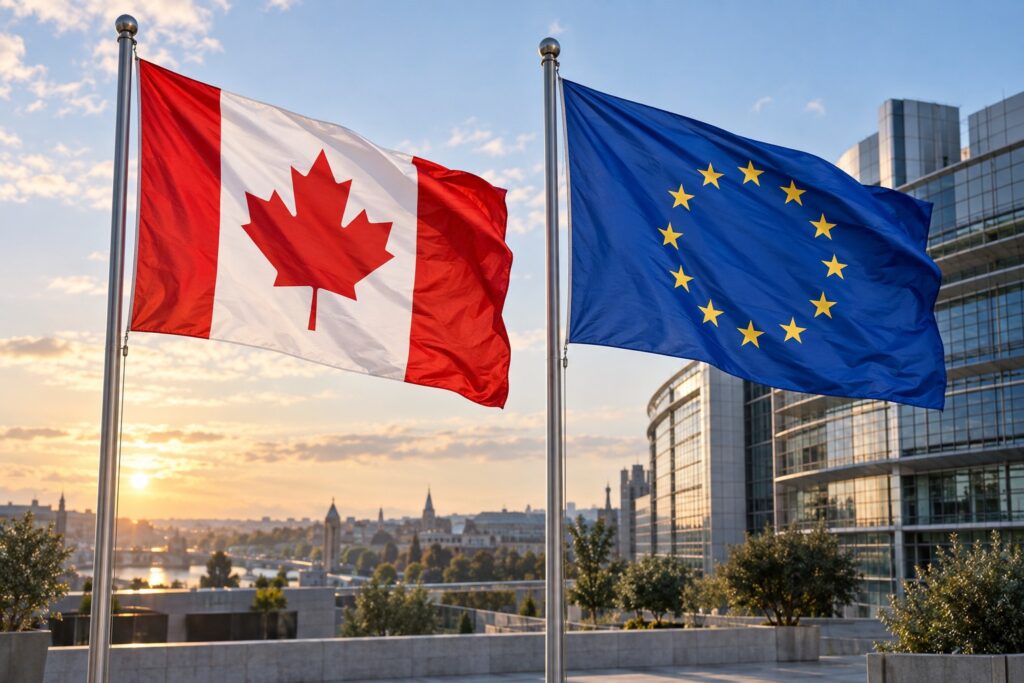
European Commission President Ursula von der Leyen used her State of the European Union address in Strasbourg this morning to propose that Canada become the European Union’s first-ever “associate member.”
Prime Minister Mark Carney was in the European Parliament for the announcement and received a standing ovation from European lawmakers. Von der Leyen then embraced Carney after making the proposal.
The announcement is potentially historic—but it remains a political invitation rather than a defined agreement. Neither Canada nor the EU has established what associate membership would include, how it would be approved or when it could take effect.
What von der Leyen said
Von der Leyen framed the proposal as a response to what she called an “openly hostile world,” in which traditional alliances, supply chains and trading relationships have become less dependable.
“I would like to work with you on opening the door for Canada to be the first associate member of the EU,” she told Carney.
She said Canada and Europe increasingly view major international issues in the same way—from artificial intelligence and climate change to the Arctic, Ukraine, defence, raw materials and global supply chains.
“Above all, dear Mark, Europe and Canada believe in democracy,” she said.
Her proposed Canada-EU “Alliance for the Future” would build on the existing Canada-European Union Comprehensive Economic and Trade Agreement, or CETA, and potentially establish what she described as a common space for prosperity and economic security.
The areas identified for deeper cooperation include:
- Advanced and intelligent manufacturing
- Artificial intelligence and quantum computing
- Cybersecurity and digital technology
- Defence production and procurement
- Energy security
- Critical minerals and batteries
- Arctic security and development
- Resilient strategic supply chains
“We will create a tech alliance. We will integrate defence industrial bases. We will make the Arctic a flagship joint project,” von der Leyen said.
She emphasized that the initiative is “not against anyone else,” although it comes as Canada and the EU both face trade and geopolitical pressure from the United States, China and Russia. Reuters
What “associate membership” actually means
At the moment, nobody can say with certainty.
The EU does not currently have a formal associate-member category. Canada would be the first country to enter such an arrangement, meaning the structure would have to be negotiated from the ground up.
Carney has also made it clear that Canada is not seeking full EU membership.
“We’re not looking to become a member of the European Union,” he said earlier this week. Instead, Canada is seeking a “unique alliance” based on common priorities and complementary economic strengths. Reuters
The distinction is important. Canada is not proposing to:
- Adopt the euro
- Join the EU’s political institutions as a full voting member
- Surrender control over Canadian taxation or monetary policy
- Automatically accept every EU law and regulation
- Transfer Canadian sovereignty to Brussels
Instead, associate membership could give Canada preferential participation in selected parts of the European economic, security, technology and mobility systems.
The substance of the relationship is expected to become clearer at the Canada-EU summit in Montreal in late October. Any far reaching arrangement would likely require approval from all 27 EU member states.
How it could benefit Canadian trade
Canada already has preferential access to Europe through CETA, which has provisionally applied since 2017 and removed tariffs from approximately 98% of product categories.
Two-way EU-Canada trade in goods and services reached approximately €130 billion in 2025, up 80% from €72.1 billion in 2016. Nevertheless, the EU recorded sizable surpluses in both goods and services, demonstrating that Canada has considerable room to increase exports to Europe. European Commission
Associate membership could go beyond lowering tariffs. Its most valuable provisions might include:
- Greater mutual recognition of Canadian and European technical standards
- Faster approval of Canadian products in Europe
- Easier participation by Canadian companies in European procurement programs
- More integrated supply chains for defence, aerospace, automobiles, batteries and technology
- Improved access to EU research, innovation and infrastructure programs
- Greater mobility for engineers, tradespeople, scientists and executives
- More European investment in Canadian manufacturing and natural-resource projects
- Coordinated protection against supply disruptions and economic coercion
This could help Canadian companies overcome one of the biggest remaining barriers under CETA: complying with different rules, certifications, product standards and national regulations across Europe.
Canada has already become the first non-European country to participate in the EU’s €150-billion SAFE defence procurement program. Associate membership could extend that approach to other strategic sectors.



There would, however, be difficult negotiations. The EU could seek greater access to Canada’s protected dairy and telecommunications markets. Canada might also have to align more closely with European environmental, data, competition and product regulations.
For exporters, the benefit would be greater access to a market of roughly 450 million people. The trade-off could be accepting more European regulatory requirements.
How travel could change
For ordinary tourism, Canadians already enjoy relatively easy access. Canadian citizens can visit the Schengen Area without a conventional visa for up to 90 days in any 180-day period. Longer stays and employment remain subject to the laws of individual countries. European Union travel guidance
The much bigger possibility would be negotiated mobility rights allowing Canadians to:
- Live in participating EU countries for longer periods
- Work without obtaining a conventional employment visa
- Transfer more easily between Canadian and European corporate offices
- Study at European institutions under simplified rules
- Have professional credentials more readily recognized
- Participate in expanded youth and working-holiday programs
- Retire or maintain a second residence in Europe under streamlined conditions
An arrangement approaching freedom of movement would be transformative for Canadians, but it should not be considered part of the deal yet. The Associated Press reported that Canada is interested in an arrangement allowing Canadians to live and work in Europe without visas, but this remains a negotiating objective not an established right.
Questions involving health coverage, taxation, social benefits, pensions and recognition of qualifications would all have to be settled. European citizens would almost certainly expect reciprocal rights in Canada.
What it could mean for Canadian energy exports
Energy may be one of the strongest arguments for a deeper relationship.
Europe wants to reduce its dependence on Russian energy and its reliance on China for critical minerals, batteries and clean-energy components. Canada can offer Europe a politically stable supply of oil, natural gas, uranium, potash, hydrogen and critical minerals.
LNG and natural gas
Closer Canada-EU integration could encourage European utilities to sign long-term LNG purchase agreements with Canadian producers. Those contracts could give investors the revenue certainty needed to finance export terminals and associated pipelines.
In the short term, however, geography remains a significant obstacle. Canada does not presently have an operating Atlantic Coast LNG export terminal capable of directly serving Europe. LNG Canada and other British Columbia projects are primarily positioned to serve Asia.
European buyers could still purchase Canadian West Coast LNG and use international cargo swaps—for example, exchanging a Canadian cargo delivered to Asia for an equivalent Atlantic Basin cargo delivered to Europe. German companies have already expressed interest in this approach. Reuters
Over the longer term, European investment and purchase commitments could strengthen the commercial case for:
- An Atlantic Canadian LNG terminal
- Additional gas pipelines connecting Western Canada with eastern export infrastructure
- Expansion of West Coast LNG capacity
- Canadian low-carbon LNG backed by carbon capture and methane controls
- Hydrogen and ammonia export facilities in Atlantic Canada
Associate membership would not build these projects by itself. Canada would still need competitive economics, Indigenous partnerships, regulatory approvals, pipelines and long-term customers.
Canadian oil
European refiners could purchase more Canadian crude as they diversify away from unstable or adversarial suppliers. Atlantic Canada can already receive and export seaborne crude, while increased pipeline access to Canadian ports would broaden Canada’s global marketing options.
A formal strategic energy partnership could produce:
- Long-term contracts between European refiners and Canadian producers
- European investment in Canadian pipelines, terminals and upgrading capacity
- Greater recognition of Canadian environmental and methane-reduction standards
- Coordinated energy-security planning and emergency supply arrangements
However, transportation costs and infrastructure limitations would continue to determine whether Canadian crude could compete against supplies from the North Sea, Middle East, Africa and the United States.
Uranium and nuclear energy
Uranium may offer Canada a more immediate opportunity. Several European countries are extending nuclear plants, building new reactors or reconsidering nuclear power as a source of reliable, low-emission electricity.
Canada is a major uranium producer with a politically stable mining industry. A strategic agreement could support longer-term uranium contracts, nuclear-fuel cooperation and Canadian participation in European reactor and small modular reactor supply chains.
Critical minerals and clean energy
Europe also wants secure supplies of lithium, nickel, cobalt, copper, graphite, rare earth elements and other materials required for batteries, renewable power, defence and advanced manufacturing.
The greatest opportunity may not be simply shipping raw minerals. European investment could help Canada develop mines, processing facilities, refineries, battery material plants and recycling operations, keeping more of the value chain and employment in Canada.
Bottom line
Von der Leyen’s proposal is significant because it offers Canada something beyond another conventional trade agreement: the possibility of becoming a preferred economic and strategic partner of the entire European Union.
For Canada, the greatest benefits could be:
- A major alternative to excessive dependence on the United States
- Increased European investment in Canadian industry and infrastructure
- Better access for Canadian companies and workers
- Deeper defence and technology cooperation
- Long-term European customers for Canadian energy and critical minerals
- Greater negotiating power in an increasingly divided global economy
But associate membership remains a concept, not a completed agreement. Its value will depend on whether Canada can negotiate practical market access, investment, labour mobility and energy commitments without surrendering control over important domestic policies.
For Canada’s energy industry, the proposal could create customers and capital. Canada must still build the pipelines, terminals, mines and processing facilities required to turn that political opening into actual exports.
Share This:






















PERSPECTIVE: Canada’s Trade Surplus Driven by Natural Resources, Not Weak Loonie