


 CDN NEWS |
  US NEWS







Oil, gas, metals and lumber earned a $27.4-billion surplus in June, more than covering the deficit in everything else Canada trades.
By Geoff Russ
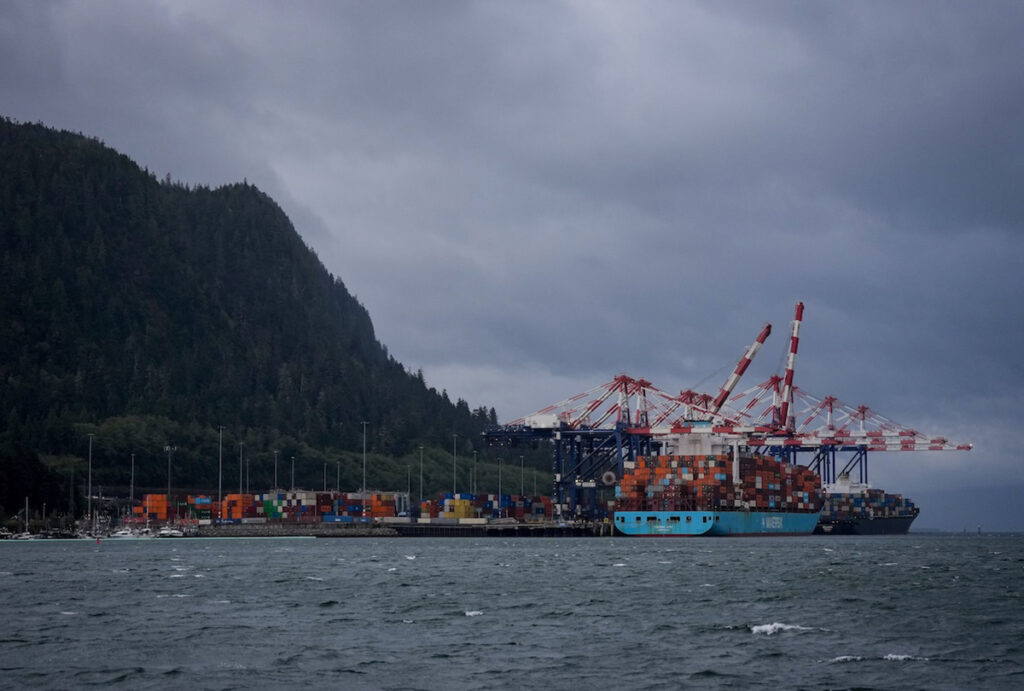
The Maersk Lima, front left, and Bellavia container ships are seen docked at port, in Prince Rupert, B.C., on Sunday, Sept. 27, 2026. THE CANADIAN PRESS/Darryl Dyck
By Resource Works
More News and Views From Resource Works Here
Time after time, week after week, there is yet another story lamenting Canada’s continued reliance on its resource economy. Wood, minerals, oil, gas and more are written or spoken of as antiquated, crumbling foundations of an economy that must supposedly grow up and embrace the world of tech and renewable energy.
In June 2026, Canadian merchandise exports reached a record $78 billion, while imports totalled $73.8 billion, producing a $4.2-billion trade surplus. Why? Because Canada’s natural resource economy has proven once again that it can generate enough export earnings to offset deficits elsewhere in merchandise trade, supporting national income and domestic production.
According to Statistics Canada’s merchandise data, five resource and resource-based product categories stand out: farm, fishing and intermediate food products; energy products; metal ores and non-metallic minerals; metal and non-metallic mineral products; and forestry products and building and packaging materials.
Combined, they accounted for $46.2 billion in exports, while accounting for just $18.9 billion in imports, for a surplus of around $27.4 billion. Compare that with every other merchandise category in Canada, which ran a combined deficit of roughly $23.2 billion.
Many countries must finance their imports through services, investment income or foreign capital, as well as merchandise exports. But in June, Canada’s resource and resource-based merchandise surplus more than offset the combined deficit across every other merchandise category, meaning that our resources were converted into real purchasing power on the global market.



Energy and minerals drive Canadian purchasing power
As always, energy was the golden goose. Even after energy exports fell sharply in June as lower prices weighed on crude oil and refined petroleum products, the energy sector still exported $18.9 billion and imported $3.9 billion. That left a monthly surplus of approximately $15 billion. Metal and non-metallic mineral products added another $8.6 billion, while farm and fishing products, forestry products, and ores and minerals together contributed about $3.7 billion.
Exports of metal and non-metallic mineral products rose 15.8 per cent, with unwrought gold the largest contributor to the increase. Copper ore and concentrate exports climbed 20 per cent to a record $934 million, mainly on the strength of shipments to Japan, China, Finland and South Korea. It is another sign that Canada can be an abundant and reliable supplier of resources to the democratic world, whether in energy, minerals or other commodities.
Volume growth proves real economic demand
It is true that a weakened Canadian dollar lifted the value of exports and imports, but it would be an egregious mistake to chalk up our trade surplus to currency illusions. Canada’s export volumes rose 1.1 per cent in June, while import volumes fell 1.5 per cent. By volume, Canada shipped more goods abroad while importing fewer.
Compared with June 2025, when those five resource and resource-based categories generated a net surplus of about $17 billion, that figure jumped to $27.4 billion in June 2026. Canada’s total merchandise balance improved by about $9.6 billion over the same period, moving from a $5.4-billion deficit to a $4.2-billion surplus. The improvement in the resource balance was therefore larger than the improvement in the national balance.
Suffice it to say, the notion that natural resources are an outdated part of the Canadian economy is what should be buried once and for all. Canada should produce more oil, more copper, more gold, more gas and more lumber, not less.
Furthermore, the expertise required to extract and develop these resources is innovative and cutting-edge, as the production and processing of them demand science, engineering, skilled trades and modern facilities. That can continue to create jobs as new technologies emerge that advance our understanding of the Earth and improve the way resources are developed.
There is a great and unfair contradiction in relying on resource exports to sustain our trade balance while treating pipelines and mines as problems to be delayed or impeded ad nauseam.
Canada rightly wants to sell more technology and advanced manufactured goods, and we certainly should. But the math does not lie. Much of our merchandise trade strength comes from resource and resource-based products, which are neither a consolation prize nor a vestigial hangover from an older Canada. They remain a foundation of our modern economy, and we should value them accordingly.
Geoff Russ is the editor-at-large of Without Diminishment. He is also a contributor to the National Post, Modern Age, and the Spectator Australia. He can be reached on X.com at @GeoffRuss3.
Share This:






















PERSPECTIVE: Canada’s Trade Surplus Driven by Natural Resources, Not Weak Loonie