


 CDN NEWS |
  US NEWS







The World just made Canadian energy more valuable. From Japanese tankers carrying Canadian crude to German utilities contracting Canadian LNG, the world is sending Canada a message. In a more dangerous energy market, geography, political stability and reliable infrastructure are becoming valuable commodities of their own.
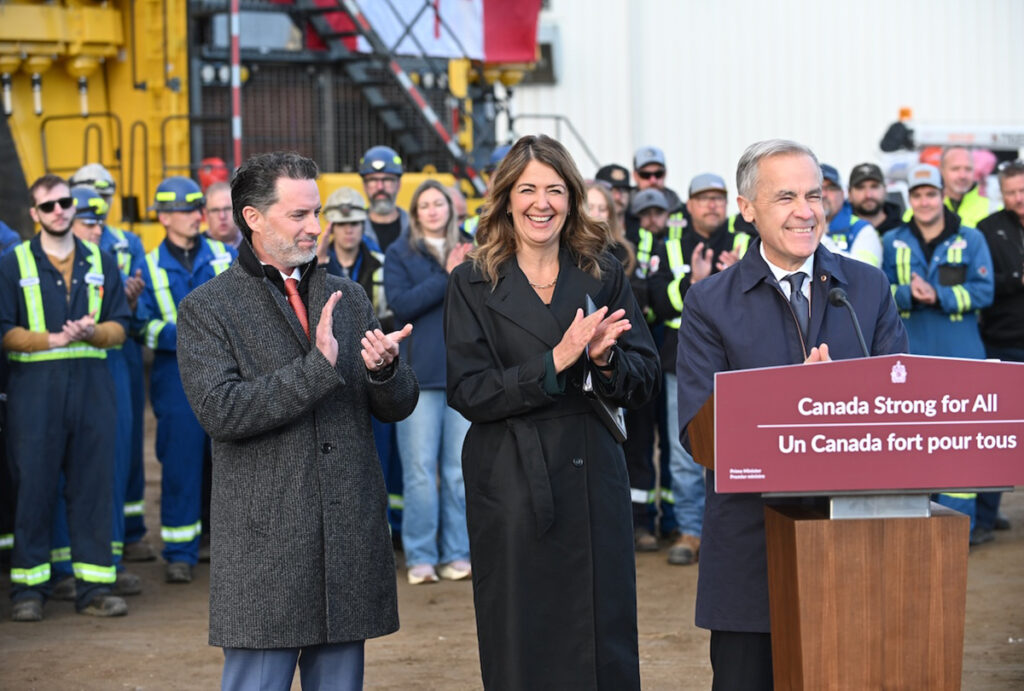
From left, Scott Burrows, CEO of the Pembina Pipeline Corp, Alberta Premier Danielle Smith and Prime Minister Mark Carney applauded after speaking in Fort McMurray on Thursday Oct 1, 2026. Prime Minister Mark Carney declared the Pacific Link pipeline project to be in the national interest. THE CANADIAN PRESS/Greg Halinda
By Resource Works
More News and Views From Resource Works Here
Something remarkable is happening in global energy markets.
In France, roughly one in five fuel stations is now reporting that it is missing either diesel or gasoline. Diesel prices have hit record highs, and the French government is preparing additional financial assistance for motorists even as it insists the country has sufficient strategic reserves.
Across Europe, diesel prices have climbed to records as supplies tighten. European gas prices have risen sharply this year, while gas storage is sitting around 70 per cent—reported as the lowest level on record for this point in the year—heading toward another winter.
In Russia, Ukrainian drones are repeatedly striking refineries, oil depots and other energy infrastructure. Half of Russia’s largest diesel-producing refineries have recently reduced or halted output after attacks, and a Sept. 20 drone strike forced the Moscow refinery to suspend crude processing.
In the Middle East, the security assumptions underpinning the global petroleum trade look increasingly fragile. Houthi forces have attacked Saudi targets and oil infrastructure while the kingdom’s critical East-West pipeline has been disrupted, forcing Saudi Aramco to improvise alternative export routes. The pipeline is particularly important because it provides Saudi Arabia with a route to the Red Sea that can bypass the Strait of Hormuz.
Meanwhile, LNG buyers are actively searching for more diverse supply as conflict disrupts Gulf exports.
Against this backdrop, a tanker carrying Canadian crude arrived in Japan in August.
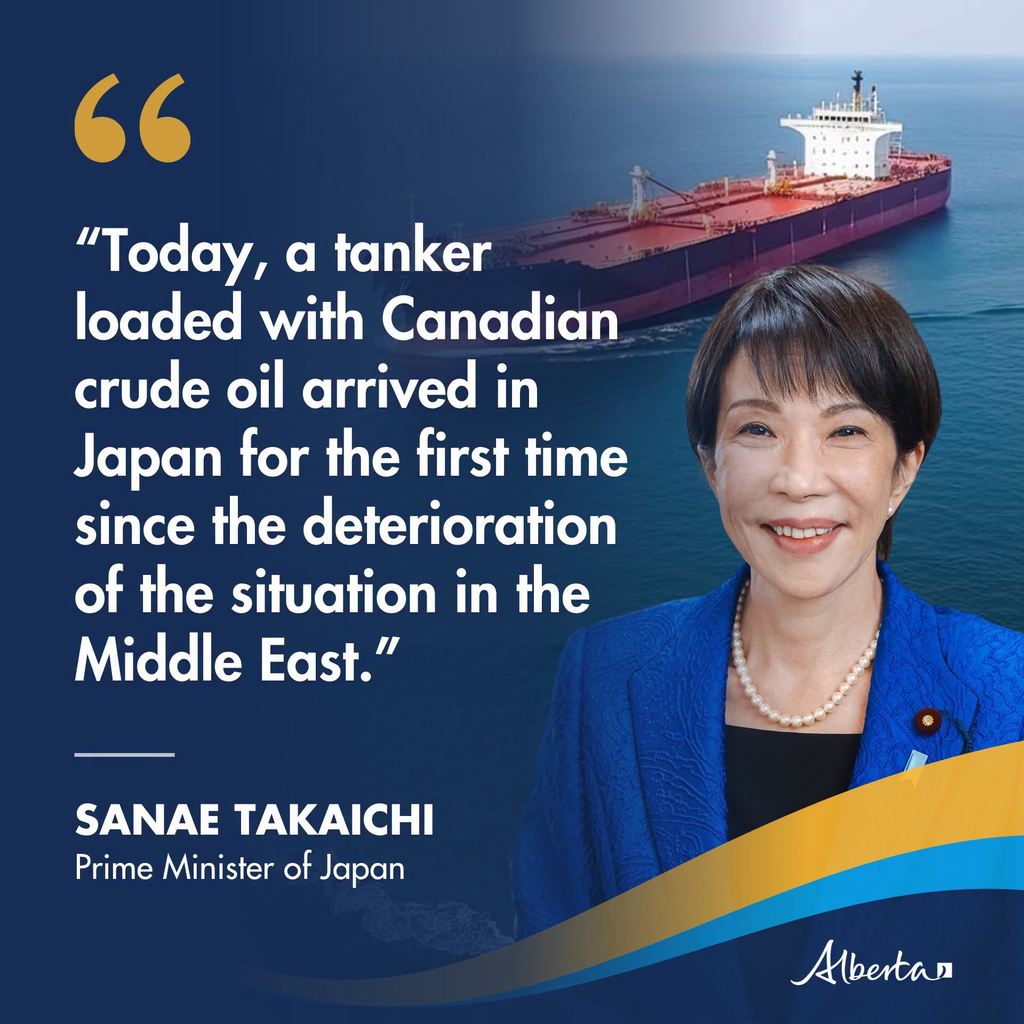
That shipment suddenly looked like much more than another commodity transaction.
Japan’s message to Canada
Japan imports almost all of the oil it consumes.
Before the current Middle East conflict, roughly 95 per cent of Japanese crude imports came from the Middle East, and almost all of those barrels depended on passage through the Strait of Hormuz. When disruptions intensified earlier this year, Japanese crude imports fell dramatically and Tokyo began drawing down strategic reserves while scrambling for alternative supplies.
Canada became part of that diversification effort.
A Canadian crude cargo departed the West Coast this summer and arrived in Japan in August, the first such shipment in more than a year. Japanese Prime Minister Sanae Takaichi publicly described Canada as an important economic-security partner and welcomed Canadian crude as part of Japan’s effort to diversify supply away from vulnerable routes.
That distinction matters.
For decades, Canadian energy was generally discussed as a commodity.
Japan is increasingly discussing it as security.
Energy insecurity has returned to Europe
Europe has learned the same lesson more painfully.
Russia’s invasion of Ukraine forced the continent to unwind an energy relationship that had taken decades to build.
Russian gas supplied to the European Union fell from roughly 152 billion cubic metres (bcm) in 2021 to about 36 bcm in 2025. Russian crude supplied to the EU fell from 114.4 million tonnes to just 9.7 million tonnes over roughly the same period.
Europe survived that shock by rapidly finding alternative suppliers.
But replacing Russia did not eliminate Europe’s energy vulnerability. It changed its shape.
Europe is now more dependent on LNG cargoes moving through global shipping networks. The United States has become enormously important. Qatar remains a major supplier. Middle Eastern instability therefore reaches European consumers quickly.
This year has made that connection painfully obvious.
Reuters reported that European gas prices have risen from around €30 to roughly €80 per megawatt hour as Middle Eastern LNG disruptions tightened supply. European gas storage is around 70 per cent, leaving less of a cushion heading toward winter than policymakers would normally want.
Refined products are even tighter.
Wars in Ukraine and the Middle East have disrupted production from Russia, Saudi Arabia and the UAE at the same time. European diesel prices have reached record levels, while jet-fuel inventories in the major Amsterdam-Rotterdam-Antwerp trading hub have fallen to their lowest level in seven years.
France offers a glimpse of what this means on the ground.
On Sept. 21, its economy minister reported that 17 per cent of French filling stations were missing at least one fuel, with subsequent reporting putting the figure close to 20 per cent. The French government stresses that national strategic stocks remain healthy and that this does not amount to a generalized national shortage.
But a country with some of Europe’s strongest energy infrastructure is nevertheless debating emergency assistance while motorists confront record diesel prices.
That is what deteriorating energy security looks like before the lights actually go out.
And on the very same day, Canada’s foreign minister was publicly discussing the potential for a deeper Canada-France LNG partnership.
The contrast is difficult to ignore.
The world’s energy infrastructure is becoming a battlefield
There is another reason stable Canadian supply is becoming more valuable.
Energy infrastructure itself is increasingly part of modern warfare.
Ukraine has demonstrated how relatively inexpensive drones can damage refineries hundreds of kilometres behind the front lines. Reuters reported in September that attacks had forced six of Russia’s largest diesel-producing refineries to reduce or suspend operations. Russia subsequently restricted refined-product exports in an effort to protect its domestic market.
On Sept. 20, drones struck the Moscow oil refinery. Its major crude-processing units went offline, removing additional gasoline and diesel production from an already tight market.
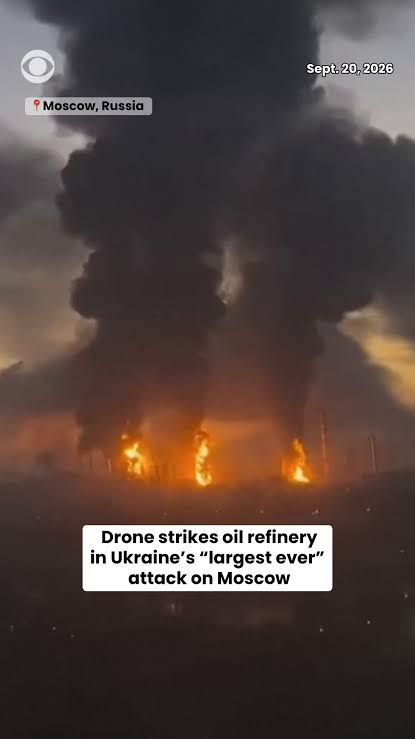
https://www.pravda.com.ua/eng/news/2026/09/20/8054274
The same vulnerability is emerging in the Gulf.
Saudi Arabia built its East-West pipeline partly to reduce dependence on the Strait of Hormuz. It carries oil across the Arabian Peninsula to Yanbu on the Red Sea.
But the alternative route itself has now become vulnerable.
Drone attacks forced Saudi Arabia to shut the pipeline in September, threatening a route that had recently carried several million barrels per day. Houthi forces have simultaneously attacked Saudi targets and energy facilities, while instability around the Bab el-Mandeb threatens Red Sea shipping as well.
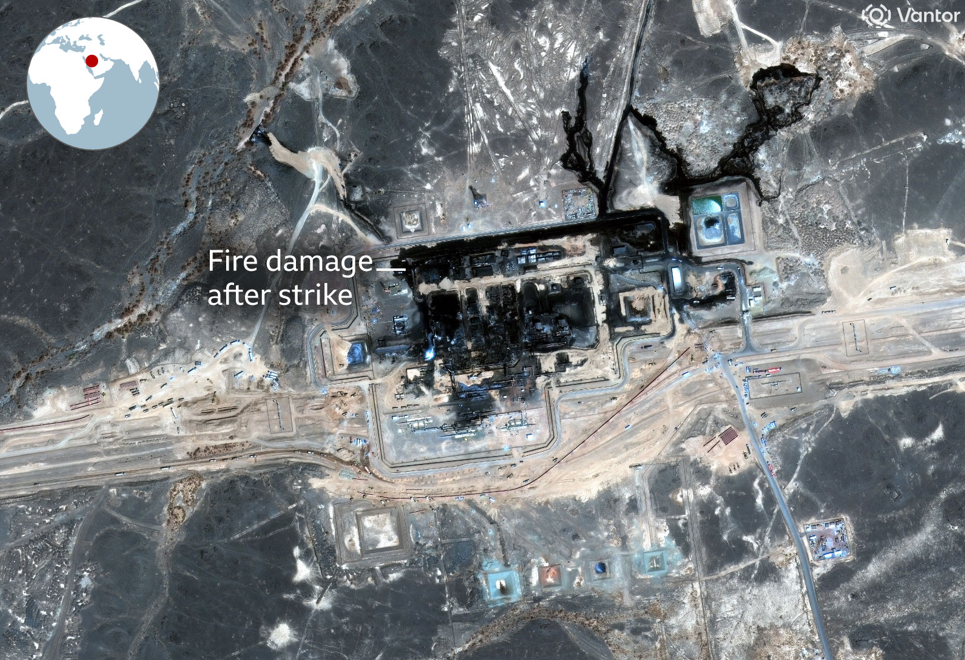
https://www.bbc.com/news/articles/c65yw2gq2nrno
The remarkable thing about today’s oil market is therefore not simply that individual producing countries are unstable.
It is that pipelines, refineries, export terminals and maritime chokepoints are increasingly exposed at the same time.
Hormuz can be disrupted.
The Red Sea can be disrupted.
Russian refineries can be struck.
Saudi pipelines can be attacked.
LNG terminals can go offline.
Europe can lose major sources of refined products within weeks.
Energy security is no longer an abstract concept buried in government white papers.
It is becoming visible at the pump.
And then there is Canada
Canada looks unusual against that backdrop.
It possesses one of the world’s largest petroleum resource bases. It has enormous natural-gas resources. Its producers operate within a mature legal system. Its infrastructure is located thousands of kilometres from most of the world’s major military conflicts. Its western coast provides direct access to Asia. And its geography gives Canadian exporters something increasingly valuable: the ability to reach major consuming markets without passing through some of the world’s most dangerous energy chokepoints. That was always true geologically. What changed was the infrastructure.
B.C. changed Canada’s energy geography
The Trans Mountain expansion transformed Canada’s ability to participate in Pacific energy markets.
The system can currently move roughly 890,000 barrels per day from Alberta to British Columbia. Trans Mountain’s optimization program could increase that to as much as 1.19 million barrels per day, adding roughly one-third to existing capacity.
Canada and Alberta have also advanced plans for another potential one-million-barrel-per-day West Coast pipeline, although the project still faces regulatory, financing and construction hurdles. Then there is LNG. LNG Canada has finally connected one of the world’s largest natural-gas basins to the Pacific Ocean.



Between June 2025 and August 2026, Canada exported approximately 130 LNG cargoes to Asia, representing about 9.7 million tonnes. Canada is now shipping roughly one million tonnes of LNG to Asia each month. West Coast LNG developments collectively represent more than $100 billion in potential capital investment.
These are not theoretical export routes anymore.
Ships are sailing.
Global capital has noticed
The investment community is beginning to respond.
For much of the past decade, the dominant story surrounding international oil companies in Canada was retreat.
Assets were sold. Capital moved elsewhere. Limited export infrastructure and political uncertainty reduced Canada’s attractiveness.
That trend is beginning to reverse.
Reuters reported in April that global energy majors were again examining Canadian assets amid the Middle East upheaval. Shell’s $16.4-billion acquisition of ARC Resources placed the Montney back near the centre of international attention, while TotalEnergies, ConocoPhillips, Equinor and BP were among the companies reported to be reassessing opportunities in Canada.
Nothing happened to the rocks beneath northeast British Columbia in April.
The molecules did not suddenly become better.
The world around them became riskier.
Political stability now carries a premium.
Secure shipping routes carry a premium.
Reliable infrastructure carries a premium.
Allied suppliers carry a premium.
Canada possesses all four.
Europe is already signing contracts
Perhaps the strongest evidence comes from buyers themselves.
Germany’s SEFE agreed this year to purchase one million tonnes of LNG annually for up to 20 years from the proposed Ksi Lisims LNG project in British Columbia.
Then Germany’s Uniper signed a binding agreement for another two million tonnes annually for up to 20 years, beginning in 2032.
Another one-million-tonne international agreement was announced in September.
Ksi Lisims alone now has multiple international buyers committing to long-term Canadian LNG supply before the facility has even entered production.
Markets are doing what markets do.
They are pricing risk before politicians finish debating it.
The opportunity is larger than a few tankers
Europe and Japan together constitute an enormous imported-energy market. Their combined crude-oil and LNG import market is roughly USD $395 billion annually.
Canada will not replace Russia in Europe.
It will not replace the Middle East in Japan.
Nor does it need to.
The opportunity is considerably larger than a few tanker shipments. A serious Canadian buildout through the 2030s could put 1-2 million barrels of crude per day into European and Indo-Pacific markets while supporting 35 to 45 million tonnes of LNG exports annually. And that need not be the ceiling.
At that scale, Canada would not simply be picking up occasional cargoes created by geopolitical disruption. It would be establishing itself as one of the democratic world’s major strategic energy suppliers. A major energy player that would increasingly eclipse the Persian Gulf suppliers and even Russia.
That matters because the potential market is enormous. Europe and Japan alone currently import roughly 11 million barrels of crude per day, while their combined seaborne LNG market is around 162 million tonnes annually. Canada does not need to replace Russia, Saudi Arabia or Qatar. It only needs to capture a meaningful share of markets already measured in the hundreds of billions of dollars.
And unlike many competing suppliers, Canada offers something increasingly scarce: large-scale energy production located thousands of kilometres from the world’s major conflict zones, connected directly to the Pacific, inside a stable allied democracy.
The Montney molecule has changed
For most of its history, a molecule of natural gas in northeast British Columbia was valued primarily according to how efficiently it could enter the North American pipeline network.
Today that same molecule can be liquefied on the B.C. coast, placed aboard a ship and sold to Japan, Korea or potentially Europe.
Its chemistry has not changed.
Its strategic value has.
The same transformation has occurred with Alberta crude.
A barrel trapped within the continental North American market is one economic proposition.
A barrel that can reach Yokohama when Gulf shipping is disrupted is another.
Infrastructure creates that difference.
The world is sending Canada a signal
The global energy system Canadians grew accustomed to over the past generation was built on an assumption of relative stability. Russian pipelines supplied Europe. Middle Eastern tankers passed through Hormuz. Saudi infrastructure kept enormous spare capacity available. Refineries processed crude safely far behind national borders. Commercial shipping moved through the Red Sea. That system is under increasing strain.
Russian refineries are being hit by drones.
Saudi energy infrastructure is under attack.
Middle Eastern LNG flows have been disrupted.
Europe is paying record prices for diesel.
French filling stations are struggling to maintain inventories.
Japan is actively diversifying away from a region that once supplied almost all of its crude.
None of this means Canadian energy can solve every global supply problem.
It means something simpler.
The attributes Canada possesses namely enormous reserves, sophisticated producers, rule of law, political stability, Pacific and Atlantic geography and allied-country status become more valuable as the world becomes less stable. That is the central geopolitical investment thesis behind Canada’s emerging opportunity.
The world is already beginning to price that reality.
Japan is receiving Canadian oil.
Asia is receiving Canadian LNG.
Germany is signing 20-year Canadian LNG contracts.
France is discussing greater Canadian energy cooperation.
Global oil majors are looking at Canada again.
For decades, Canada’s problem was having world-class resources without enough ways to reach the world.
Now the infrastructure is beginning to exist at exactly the moment the world is rediscovering why secure energy supply matters. The signal the world is sending got received on September 29th when LNG Canada approved of the phase 2 expansion, a $33 Billion investment in expanding BC’s energy export infrastructure.
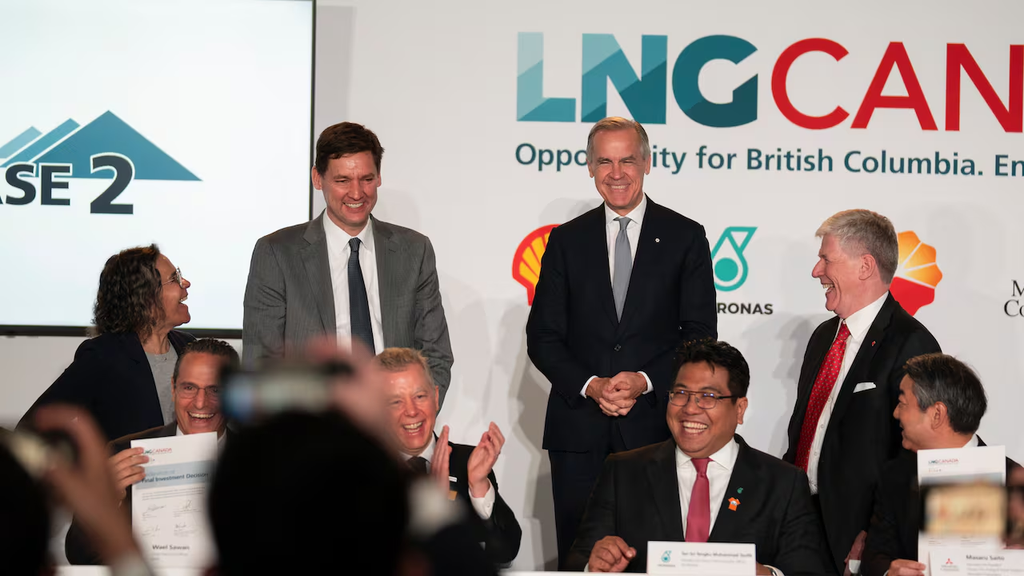
Prime Minister Mark Carney and B.C. NDP Leader David Eby are seen at an announcement regarding the Phase 2 expansion of the LNG Canada project on Tuesday. The project would more than double the LNG export facility’s capacity. (Nav Rahi/CBC)
The Montney molecule is no longer just a B.C. commodity.
The Canadian barrel is no longer just another North American barrel.
In a world where pipelines can be attacked, refineries can be bombed and strategic waterways can become conflict zones almost overnight, reliable Canadian energy increasingly carries something else inside it:
Security.
Siavash Tahan can be reached at [email protected].
Share This:






















PERSPECTIVE: Canada’s Trade Surplus Driven by Natural Resources, Not Weak Loonie