CDN NEWS |
  US NEWS







By Julio Mejía and Elmira Aliakbari
Canadians have heard a great deal about proposed oil pipelines—one that would carry Alberta crude to a British Columbia port for export, and another one linking Alberta to Ontario to strengthen east-west energy ties. While these projects could address longstanding gaps in Canada’s energy infrastructure, they’ve also drawn strong opposition from environmental groups and politicians who have embraced a “no pipelines, not here or anywhere” position. But those objections often overlook the benefits of these projects and a key fact about pipelines—their safety record continues to improve.
Pipelines remain central to Canada’s energy system, moving large volumes of oil and gas to domestic and export markets. Admittedly, building new capacity comes with risks—but so does failing to build it. Without infrastructure providing greater access to the Pacific and other markets, for instance, Canada remains heavily dependent on an increasingly protectionist United States, which in 2025 received nearly 91 per cent of Canadian crude exports. A West Coast pipeline could reduce that dependence by giving Canada’s largest export product greater access to markets in Asia and elsewhere.
An Alberta-to-Ontario route, meanwhile, could reduce reliance on Line 5, the cross-border pipeline that runs through Michigan’s Straits of Mackinac that supplies more than half of Ontario’s crude oil and about two-thirds of Quebec’s. Enbridge, the Calgary-based operator, has faced longstanding efforts by the Michigan government to shut down Line 5’s Straits crossing—efforts that gained ground in July when the state’s Supreme Court overturned a key approval for Enbridge’s plan to move the pipeline into a protective tunnel beneath the lakebed, reviving uncertainty over the pipeline’s long-term future. Without added east-west capacity, Canada’s two most populous provinces remain exposed to a major energy supply disruption affecting gasoline, diesel and jet fuel used across Toronto, Montreal and Quebec City’s airports.
Given these stakes, the question of whether pipelines can be operated safely deserves real scrutiny. Again, the evidence suggests they increasingly can.
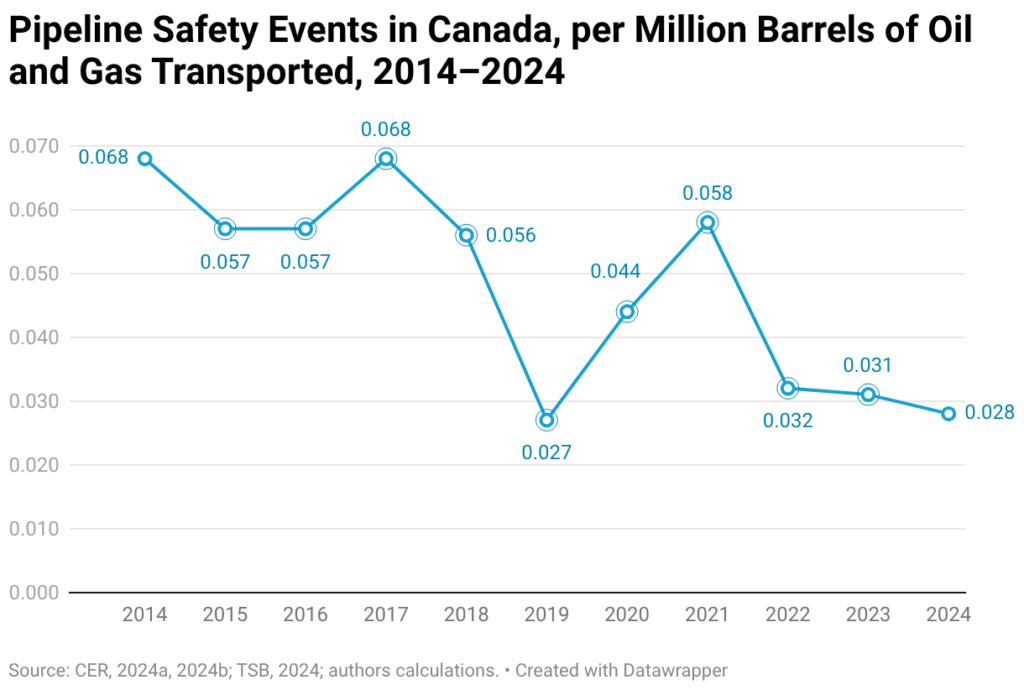
According to the Transportation Safety Board (TSB), as reported in our recent study, pipeline safety events—reportable incidents such as releases, ruptures, fires, damage or other threats to safe operation—declined over the past decade, falling from 113 in 2014 to 63 in 2024, a decrease of 42 per cent, even as the volume of oil and gas transported by pipeline increased by 37 per cent during the same period.



To better understand how pipeline safety has improved, it’s useful to compare the number of safety events with the amount of oil and gas transported. As shown in the chart below, there were 0.068 pipeline safety events per million barrels of oil and natural gas transported annually in 2014. By 2024, that rate had fallen to 0.028 events per million barrels transported—a decrease of roughly 59.3 per cent. In other words, pipelines are moving more of the energy on which Canadians and people around the world rely on, while doing so increasingly safely.
A common concern regarding energy pipelines is safety events involving product releases because such incidents can pose significant environmental and public safety risks. Here, too, the data show significant improvement. In 2014, 83.2 per cent of all pipeline safety events involved a release. By 2024, that share had fallen to 20.6 per cent.
This should matter to Canadians, both because the energy they rely on every day is being transported with a better safety record and because that infrastructure supports a sector of major economic importance to the country. In 2025, Canada’s oil and gas sector generated $218.1 billion in economic activity, directly employed nearly 200,000 Canadians and supported another 322,000 jobs indirectly, for a total footprint of more than 520,000 jobs.
Of course, neither the improving safety record nor the economic case makes pipelines free of any environmental impacts—virtually no economic activity is risk-free. But the existence of environmental risk does not, by itself, make pipelines an unacceptable hazard. The value of this infrastructure should not be judged against a standard of zero risk, but against the economic opportunities it creates for Canadians and whether its environmental performance is improving over time. On that measure, pipeline transportation has become demonstrably safer.
Share This: