


 CDN NEWS |
  US NEWS







EnergyNow Media
Allison Minor says attacks on Saudi energy infrastructure, disrupted shipping routes and the Trump administration’s reluctance to intervene are creating continued upside risk for oil prices.
Global oil prices are unlikely to decline significantly in the coming months as escalating Houthi attacks threaten Saudi Arabia’s energy infrastructure and critical Red Sea export routes, Middle East expert Allison Minor said during an appearance on CNN’s Fareed Zakaria GPS.
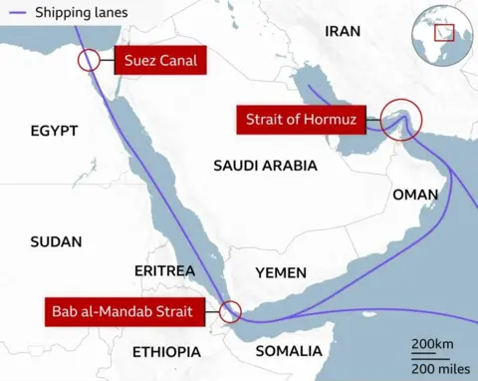
Minor, director of the Atlantic Council’s Project for Middle East Integration and a former U.S. deputy special envoy for Yemen, said the Iran-backed Houthi movement is exploiting Saudi Arabia’s increased dependence on the Red Sea following disruptions to tanker traffic through the Strait of Hormuz.
“Saudi Arabia has become increasingly dependent on the Red Sea to continue its oil exports, around four million barrels a day in July, because the Strait of Hormuz has been so disrupted as a result of this Iran conflict,” Minor told Zakaria.
Saudi Arabia and the Houthis reportedly exchanged heavy attacks this week after the Yemeni rebel movement intensified its offensive against Saudi-backed government forces.
Houthi forces have captured additional territory along Yemen’s Red Sea coast and strategic islands near the Bab el-Mandeb Strait. That narrow waterway connects the Red Sea with the Gulf of Aden and Arabian Sea, making it one of the world’s most important energy-shipping chokepoints.
Its strategic importance has increased further because Saudi Arabia and other exporters have been relying more heavily on Red Sea routes to avoid disruptions around the Strait of Hormuz.
Houthis “Seizing an Opportunity”
Minor said the Houthis appear to have concluded that the regional conflict has created an opportunity to increase their territorial control and place additional pressure on Saudi Arabia.
“The Houthis are seizing an opportunity here,” she said.
Although Minor does not consider the Houthis a complete Iranian proxy in the same way as some other Iranian-backed organizations, she said Tehran remains highly influential over the group.
“They’re not a full Iranian proxy in the way that some other Iranian-backed groups are, but Iran is incredibly influential,” Minor said.
She accused Iran of encouraging greater Houthi involvement and “stoking the flames” of the Yemen conflict. An Iranian Mahan Air flight sent into Yemen in July, she said, was intended in part to test the Yemeni government’s control of the country’s airspace.
That episode helped trigger a series of retaliatory actions that culminated in the latest Houthi advance along Yemen’s western coast and intensified attacks on Saudi ships and infrastructure inside the kingdom.
Saudi Arabia Faces Limited Options
Minor said Saudi Arabia is in a difficult strategic position because its previous military campaign in Yemen failed to defeat the Houthis, while the internationally recognized Yemeni government remains divided and comparatively weak.
“One of the Houthis’ greatest sources of strength has been the weakness of their foes inside Yemen,” she said.
The anti-Houthi coalition includes the Yemeni government and regional backers such as Saudi Arabia and the United Arab Emirates. However, divisions within that coalition have made it difficult to mount an effective and sustained response.
The war that began in 2015 and continued until a truce was reached in 2022 ultimately strengthened the Houthis, according to Minor. The group used the prolonged conflict to improve its organization and expand its military capabilities.
With Iranian weapons, technical expertise and operational assistance, the Houthis evolved from a local militia into a military organization whose arsenal now rivals that of some states in the Middle East.
“This kind of open-ended conflict just favoured the group, which is extremely adaptable,” Minor said.
Trump’s Reluctance to Intervene Adds to Uncertainty
Minor also pointed to the Trump administration’s response as an important part of the developing energy story.



Despite Saudi Arabia’s close relationship with President Donald Trump and its expectation of American security support, Washington has been reluctant to become directly involved in another military campaign against the Houthis.
According to Minor, that reluctance is contributing to growing frustration between Trump and Saudi Crown Prince Mohammed bin Salman. It is also raising questions about the strength of the longstanding U.S. security commitment to Saudi Arabia and other Gulf states.
“There’s definitely growing frustration between MBS and Donald Trump,” Minor said. “This idea of the U.S. providing a security guarantee for Saudi Arabia and other members of the Gulf is just starting to ring hollow.”
Minor said the conflict with Iran has exposed limits on what American military power can accomplish in the region. Trump appears unwilling to open another front in Yemen after years of unsuccessful efforts by Saudi Arabia and its allies to defeat the Houthis.
“Donald Trump really has been hesitant to get involved in Yemen,” she said. “I just don’t think he sees a path towards success there.”
Domestic political considerations are also influencing the administration’s position. Minor said Trump faces political pressure in the United States over the Iran conflict and may be concerned that direct military action against the Houthis would deepen American involvement ahead of the midterm elections.
Trump has attempted to distance the United States from the latest Saudi-Houthi confrontation, arguing that the Houthis do not want a direct conflict with Washington. Minor cautioned, however, that the administration cannot fully control how the fighting develops.
“Unfortunately, he doesn’t have full say over that,” she said.
The administration’s reluctance to intervene may reduce the immediate risk of a wider American military campaign, but it could also leave Saudi Arabia more exposed to attacks on its oil infrastructure.
Saudi Export System Under Pressure
That vulnerability became particularly clear after drone attacks forced the shutdown of Saudi Arabia’s East-West Pipeline, the kingdom’s most important route for bypassing the Strait of Hormuz.
The 1,200-kilometre pipeline carries crude from Saudi Arabia’s eastern producing region to the Red Sea port of Yanbu. Before the attack, it was reportedly transporting between four million and five million barrels per day—equivalent to roughly four to five per cent of global oil supply.
Three pumping stations were damaged, and industry sources have indicated that full repairs could take several weeks. Reuters
Saudi Arabia has attempted to compensate by moving more crude through the Strait of Hormuz, including tankers operating with limited tracking information and through ship-to-ship transfers designed to reduce security risks.
Saudi exports through Hormuz reportedly recovered to more than four million barrels per day in September after falling to approximately 2.4 million barrels per day in August. However, overall vessel traffic through the strategic waterway remains far below normal levels. Reuters
Saudi Arabia is therefore being squeezed from both directions. Shipping through Hormuz remains disrupted, while its Red Sea alternative is being threatened by the Houthis and attacks on the pipeline supplying the Yanbu export terminal.
More Upside Risk for Oil
Zakaria asked Minor whether the combination of supply disruptions and attacks on Saudi infrastructure made it difficult to imagine oil prices falling significantly, while making a substantial increase over the next two or three months considerably easier to envision.
“I think so,” Minor replied.
“The Gulf countries have demonstrated an ability to adapt,” she said. “But still, we’re definitely going to see a dip in supply as a result of both the Houthi actions in the Red Sea and Houthi and Iranian-backed militia attacks on Saudi energy infrastructure inside the country.”
Middle East producers have so far maintained much of their oil flow through alternative shipping arrangements. However, the security threats surrounding the Strait of Hormuz and Bab el-Mandeb have increased transportation, insurance and security costs while leaving the global market vulnerable to further disruption.
Minor warned that the Trump administration’s effort to contain or downplay the Yemen conflict will not address its underlying causes.
“This Yemen conflict is yet another example of how an unresolved conflict just continues to ripple across the region,” she said. “Trying to low-key it, as Donald Trump has been trying to do since early August, is not an effective strategy in this kind of environment.”
Without diplomatic progress or a credible regional security strategy, Saudi oil infrastructure could remain vulnerable. That means prices may retreat temporarily on hopes of peace talks, but the risk of lost supply and further attacks is likely to keep a geopolitical premium embedded in global oil markets.
Share This:






















INSIGHT: Canada’s Economy Falling Behind Despite Misleading Headlines – Fraser Insitute