


 CDN NEWS |
  US NEWS







EnergyNow Special Report
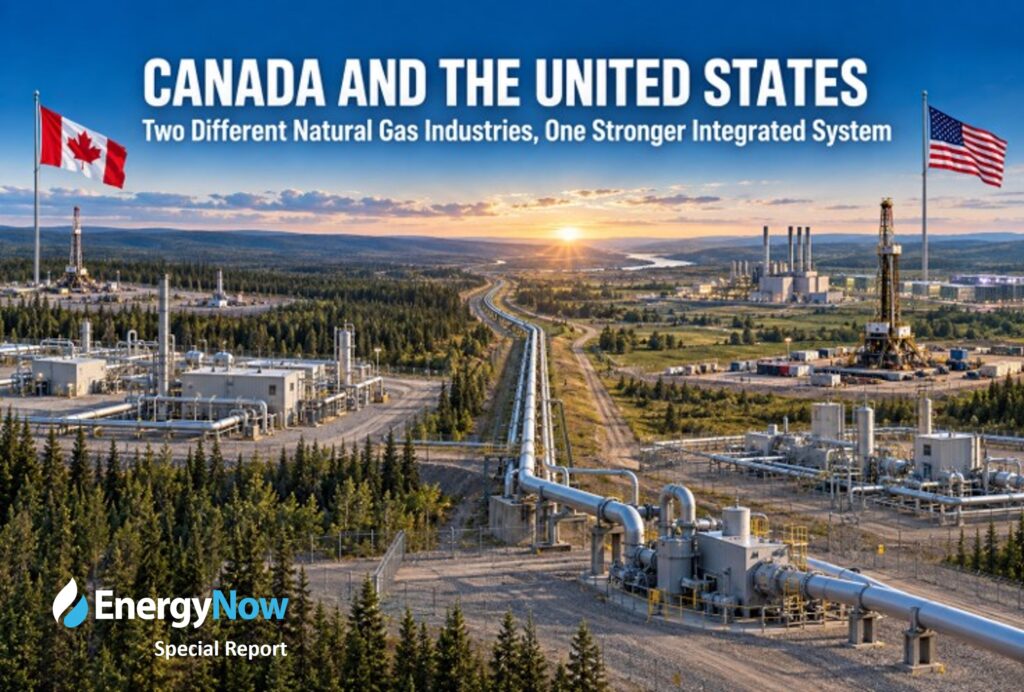
Canada brings an enormous low-cost resource base, while the United States provides market scale, infrastructure and access to growing demand.
Canada and the United States operate two of the world’s largest and most technologically advanced natural gas industries. They compete for investment and customers, but they also function as parts of a highly integrated continental production, pipeline and consumption system.
The United States is the world’s largest natural gas producer and consumer. Canada produces considerably less, but has an enormous resource base particularly in the Montney formation of Alberta and British Columbia and exports a substantial share of its production to the United States.
In 2025, U.S. dry natural gas production averaged approximately 107.6 billion cubic feet per day, compared with 103.1 Bcf/d in 2024. The U.S. Energy Information Administration forecasts production of about 111.7 Bcf/d in 2026. EIA outlook
Canadian production reached a record 18.3 Bcf/d in 2024 and continued growing in 2025, led primarily by the Montney. The Canada Energy Regulator projects that production could reach 27 Bcf/d by 2050 under its Current Measures scenario and as much as 32 Bcf/d under a higher-growth scenario. CER outlook
The two countries produce gas from similar geological formations using similar technologies, but their market positions are very different.
How the Two Industries are Similar
Both industries have been transformed by horizontal drilling, multistage hydraulic fracturing and advances in subsurface analysis.
Production is increasingly concentrated in large, highly productive formations:
United States
- Permian Basin in Texas and New Mexico
- Marcellus and Utica formations in Appalachia
- Haynesville in Louisiana and East Texas
- Eagle Ford in South Texas
- Bakken in North Dakota
- Conventional and offshore production in several other regions
Canada
- Montney formation in northeastern British Columbia and northwestern Alberta
- Deep Basin in Alberta
- Duvernay formation in Alberta
- Conventional production across Alberta and Saskatchewan
- Smaller volumes from other provinces and territories
Both countries have experienced consolidation as larger producers acquire companies with attractive drilling inventories. Producers on both sides of the border are also using longer horizontal wells, larger fracture treatments, automated facilities and data analytics to increase output while reducing costs per unit.
In both countries, natural gas prices can fall sharply when production grows faster than pipeline or market capacity.
The Fundamental Differences
The clearest difference is scale. The United States produces almost six times as much natural gas as Canada and has a much larger domestic market.
American gas is consumed by:
- Power generators
- Industrial facilities
- Petrochemical and fertilizer producers
- Residential and commercial heating customers
- Oil and gas operations
- Pipeline exports to Canada and Mexico
- LNG export terminals
Canada uses natural gas for many of the same purposes, but its population, industrial base and electricity market are smaller. Canadian production is heavily concentrated in Western Canada, while major population and industrial centres are thousands of kilometres away in Ontario and Quebec.
The United States also has more geographically diverse producing regions. Appalachia is close to northeastern population centres, the Permian is near markets in Texas and Mexico, and the Haynesville is close to Gulf Coast industrial and export demand.
Canada’s growth is increasingly concentrated in the Montney. In 2023, British Columbia alone produced 6.7 Bcf/d, approximately 36% of Canadian output with almost all of it coming from that formation. CER British Columbia profile
That concentration produces exceptional operating efficiencies, but it also makes Canada more dependent upon sufficient pipeline capacity and new sources of demand in Western Canada.
The Markets for Canadian and American Gas
The United States enjoys the stronger market position because it has a large domestic economy, extensive power demand, major industrial consumers and access to Mexico and international LNG markets.
Canada’s traditional export market is the United States. In 2024, Canada exported approximately 8.64 Bcf/d by pipeline, with nearly all those volumes moving south. CER Energy Future 2026
Canadian gas serves several important American regions:
- The Pacific Northwest and California receive gas from Western Canada.
- The U.S. Midwest draws Canadian supply through several pipeline systems.
- Northern states use Canadian gas to help meet winter heating demand.
- Canadian storage and production provide additional flexibility during extreme weather.
Trade also moves in the opposite direction. Ontario, Quebec and the Maritimes import American gas, particularly from the prolific Marcellus and Utica formations.
Several pipelines in southern Ontario were converted to bi-directional service as low-cost Appalachian gas displaced some western Canadian supply. As a result, Western Canada can export gas to western and midwestern states while Eastern Canada imports gas from the northeastern United States.
That is evidence of integration, not necessarily dependence or inefficiency. Gas generally moves from the closest competitive producing basin to the nearest market with available pipeline capacity.



Why the Integrated System Works
The Canada–U.S. natural gas system crosses the international border at numerous locations, but commercially it often operates as a single continental market.
Canadian AECO prices are influenced by conditions in Alberta, while Henry Hub in Louisiana is the leading continental benchmark. Regional prices then reflect transportation costs, weather, storage levels, pipeline constraints and local supply and demand.
The integrated system works because:
- Pipelines connect major Canadian and American producing basins with population centres.
- Gas can move in both directions in parts of the network.
- Storage facilities balance seasonal production and consumption.
- Canadian supply supports U.S. winter reliability.
- American gas provides competitive supply to Eastern Canada.
- Producers, pipelines and utilities operate under established commercial agreements.
- Common technology, equipment and service companies operate across the border.
Unlike oil, natural gas remains highly dependent on pipelines. It cannot be redirected easily if a region has insufficient transportation capacity. Cross-border connections therefore provide both countries with more customers, greater flexibility and better supply security.
Canada’s Principal Advantages
Canada has one of the largest and lowest-cost undeveloped natural gas resources in the world. The Montney is particularly important because it contains large quantities of gas and valuable natural gas liquids.
Canada’s advantages include:
- An enormous long-term resource base.
- Highly productive Montney wells.
- Established pipeline connections to U.S. markets.
- A stable political and legal system.
- An experienced workforce and service sector.
- Significant underground storage capacity.
- Low-cost gas that can support industrial development.
- Proximity to growing power demand in Western Canada and the U.S. Pacific Northwest.
Canada also has the potential to develop new domestic markets around petrochemicals, fertilizer, hydrogen, oil sands operations and gas-fired electricity. LNG provides an additional opportunity, but its larger implications will be examined separately.
The United States’ Principal Advantages
The American industry benefits from scale and market diversity.
Its advantages include:
- The world’s largest domestic natural gas market.
- Multiple major producing basins.
- An extensive pipeline and storage network.
- A large gas-fired electricity fleet.
- Major petrochemical and industrial consumers.
- Pipeline access to Canada and Mexico.
- Rapidly expanding LNG demand.
- Deep capital markets and a highly competitive service sector.
The United States can also respond quickly to demand growth. The EIA expects the Permian and Haynesville together to account for more than 70% of U.S. production growth through 2027.
Advantages Over Other Producing Nations
Canada and the United States offer several advantages over Russia, Iran, Qatar and other major gas-resource holders.
Together, they provide:
- Political stability and enforceable contracts.
- Private-sector investment and transparent markets.
- Extensive existing infrastructure.
- No dependence on a national monopoly producer.
- Advanced environmental and safety standards.
- A large internal market capable of supporting production.
- Geographic proximity between supply and customers.
- Lower exposure to geopolitical conflict and international sanctions.
North American gas is produced within a competitive market rather than allocated primarily through state-owned companies or geopolitical agreements. That encourages innovation and provides customers with multiple suppliers.
Weaknesses in Both Industries
Canada’s greatest weakness is that production can grow faster than market access. When pipelines are constrained or maintenance reduces takeaway capacity, AECO prices can trade at a substantial discount to Henry Hub.
Other Canadian weaknesses include:
- Heavy dependence on U.S. export markets.
- Limited domestic demand relative to production.
- Long distances between Western Canadian supply and Eastern Canadian consumers.
- Regulatory uncertainty around pipelines and emissions.
- A smaller capital market and service sector than the United States.
- Growing production concentrated largely in one formation.
The United States faces different challenges:
- Pipeline opposition restricts Appalachian production growth.
- Permian associated gas can overwhelm takeaway capacity and drive regional prices below zero.
- Production requires continuous drilling because shale wells decline quickly.
- Hurricanes threaten Gulf Coast infrastructure.
- Rising exports and electricity consumption can expose consumers to higher prices.
- Local opposition is growing around pipelines, drilling and large power projects.
- Production associated with oil drilling may continue even when gas prices are weak.
The Data-Centre Demand Opportunity and Price Risk
Data centres could become an important new source of natural gas demand in both countries. Artificial intelligence facilities require large volumes of reliable, around-the-clock electricity, and gas-fired generation can be built more quickly than many nuclear, hydroelectric or transmission projects.
In the United States, the EIA expects electricity demand to experience its strongest four-year growth since 2000, driven partly by data centres. Natural gas currently supplies roughly 40% of American electricity and is likely to provide part of the additional generation required.
Alberta and northeastern British Columbia could also attract data centres by combining inexpensive gas, available land and proximity to production. This could:
- Create a large new market for Western Canadian producers.
- Reduce extreme AECO discounts.
- Support additional pipelines and gas-processing facilities.
- Encourage investment in combined-cycle generation and on-site power.
- Increase royalty revenue and strengthen local gas prices.
The effect on consumer prices would depend on scale and timing. A gradual increase in demand accompanied by new production and pipeline capacity may produce only modest price increases. If data-centre development moves faster than supply and infrastructure, regional gas and electricity prices could rise more sharply.
One Continental Production System
The United States has the advantage in scale, market diversity, infrastructure and access to customers. Canada has the advantage of an enormous, relatively low-cost resource base with considerable room for growth.
Canada benefits from access to American consumers, storage and trading hubs. The United States benefits from dependable Canadian supply, particularly in northern and western markets during periods of peak demand.
The two industries compete, but they are stronger together. Their combination of resources, technology, infrastructure, market transparency and political stability makes the Canada–U.S. natural gas system one of the most secure and economically important energy networks in the world.
Share This:






















INSIGHT: Canada’s Economy Falling Behind Despite Misleading Headlines – Fraser Insitute