


 CDN NEWS |
  US NEWS







By Emily Chow
- Analysts estimate Asian LNG demand will fall 3% to 10% from 2025 levels in 2026
- Kpler sees China’s LNG demand falling by 6.1 million tons year-on-year
- Asian spot LNG prices have more than doubled to $26 per mmBtu since conflict began
BANGKOK, Sept 17 (Reuters) – Asian demand for liquefied natural gas is set to decline for a second consecutive year as the US-Israeli war on Iran curtails supplies from the Gulf, tightening market availability and lifting prices to multi-year highs that slash consumption.
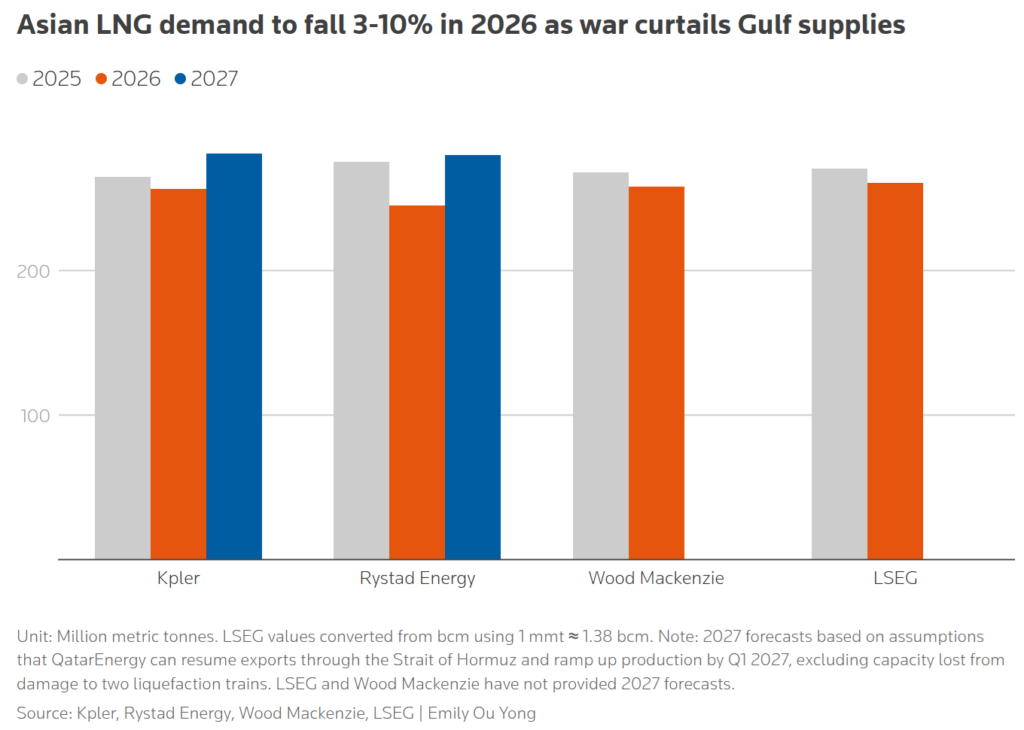
Analysts estimate Asian LNG demand to fall 3-10% from 2025 levels, with Northeast Asia bearing most of the demand destruction, before rebounding again in 2027.
“A lot of that demand destruction has been absorbed by Northeast Asia … they have coal, they have some nuclear availability. Depending on the country’s power mix, they were able to bring down their LNG demand,” said Rystad Energy analyst Lu Ming Pang.
Average temperatures in several months this year were also lower than last year, reducing the need for power generation, he said, noting that power demand and generation in South Korea and Japan were both down year-on-year.
In Northeast Asia, China accounts for a key portion of the demand decline, seen falling by 6.1 million tons year-on-year as high prices weigh on industrial gas consumption, according to Kpler.
Energy-intensive sectors such as ceramics, methanol and glass have had to cut output or shut plants because fuel costs have become uneconomical, while rapid inventory drawdowns, growing domestic gas output and higher pipeline imports have further reduced China’s need for LNG imports, analyst Nelson Xiong said.
“Under current high prices, discretionary stocking is also going to be delayed for Chinese buyers. We think the major discretionary stocking is going to come in late December or Q1 2027 onwards,” he added.
Asia’s LNG demand, which already fell in 2025, was expected to recover by 4-7% this year on lower prices fuelled by rising U.S. and Qatari supplies.



But the conflict that began on February 28 disrupted Gulf supplies, forcing top exporter QatarEnergy to declare force majeure and suspend exports after Iranian attacks knocked out 17% of its LNG export capacity.
Asia spot LNG prices have since more than doubled to $26 per million British thermal units (mmBtu), their highest since December 2022.
Despite high prices and constrained supply, India and Bangladesh continued to actively secure spot cargoes, demonstrating resilient demand, said LSEG analyst Shruti Shah.
“In India, LNG demand is expected to remain predominantly supported by the city gas distribution and fertilizer sectors, which collectively account for approximately 70% of the country’s total LNG imports,” she said, while baseload power generation requirements will underpin Bangladesh’s spot LNG procurement activity.
HIGH PRICES IN 2027
Based on assumptions that QatarEnergy can resume exports through the Strait of Hormuz and ramp up production by Q1 2027, excluding capacity lost from damage to two liquefaction trains, Rystad Energy and Kpler see Asian LNG demand rebounding to around 280 million tonnes next year.
Prices, however, are expected to remain well above pre-conflict levels. Kpler forecasts Asian spot LNG prices to average $19.30/mmBtu this year and $14.90/mmBtu in 2027, while Rystad Energy sees average prices above $19/mmBtu in 2026 and around $17/mmBtu next year.
Wood Mackenzie expects prices to remain elevated even if shipments through the Strait of Hormuz resumes by year-end, driven by Europe’s need to replenish depleted gas inventories ahead of the following winter.
“A lot of the upside next year will come from Europe’s requirement to get gas into storage,” said Massimo Di Odoardo, vice president of gas and LNG research, adding that he expects LNG prices to remain at $15-20/mmBtu in 2027 and above $20/mmBtu if the Strait of Hormuz stays closed.
Reporting by Emily Chow; editing by Lincoln Feast.
Share This:






















BUYER BEWARE! OPINION: Iceland and Norway Keep Saying No to Europe. Canada Should Too – Tammy Nemeth