


 CDN NEWS |
  US NEWS







By EnergyNow Media
Ontario premier tells Calgary energy crowd the proposed Alberta-to-Sarnia pipeline is central to Canada’s energy sovereignty and says governments may need to provide the “patient capital” required to get major infrastructure built.
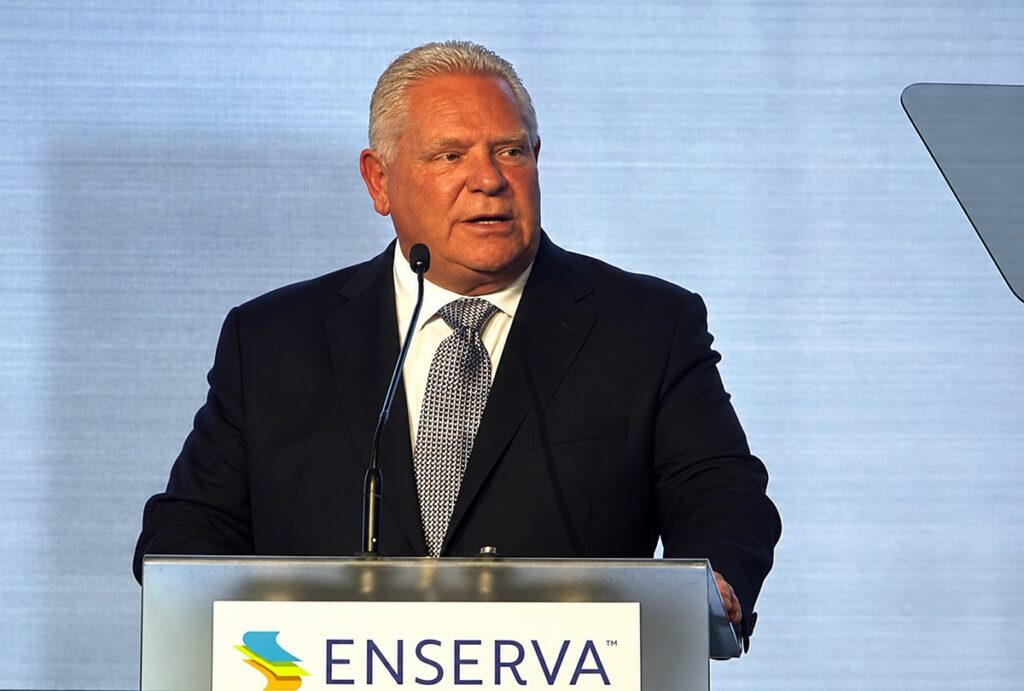
Ontario Premier Doug Ford used a major Calgary energy speech Monday to make one point unmistakably clear: Ontario intends to push ahead with the proposed Northern Shield Energy Corridor and is prepared to consider putting government capital behind the project to make it happen.
Speaking September 28 at the Enserva Speaker Series — Build Canada Stronger at Calgary’s TELUS Convention Centre, Ford repeatedly framed the proposed Alberta-to-Ontario pipeline as more than an economic development project. He described it as part of a broader strategy to strengthen Canada’s energy security, domestic supply chains and control over critical infrastructure.
“Canadian sovereignty starts with energy sovereignty,” Ford told the audience. “Canadian sovereignty starts with realizing our ambitions as a global energy superpower.”
That theme ran through virtually every part of his address.
Ontario Wants Alberta Oil Moving East – Entirely Through Canada
The Northern Shield Energy Corridor was unveiled in July by Ford and Alberta Premier Danielle Smith. The proposed route would run roughly 3,300 kilometres from Hardisty, Alberta, to Sarnia, Ontario, connecting Western Canadian crude production with Ontario’s refining and petrochemical complex.
Ontario says the pipeline could initially move about 500,000 barrels per day, with the potential to expand to 800,000 barrels per day. The province is also examining extensions to tidewater and a strategic petroleum reserve as part of the broader corridor concept. Ontario
Ford told the Calgary audience that the project would be distinctly Canadian.
“Back in July, I was proud to stand with Premier Smith to unveil the route for the Northern Shield Energy Corridor, which will bring Alberta oil 3,300 kilometres east to a refinery hub in Sarnia, Ontario,” Ford said.
“A new Canadian pipeline made with Canadian steel by Canadian workers exclusively within Canada’s borders.”
The all-Canadian route is a central part of Ontario’s argument for the project. Ford said Canada has become too vulnerable to decisions made in the United States, including disputes over cross-border energy infrastructure.
“No matter who’s in charge south of the border, the security and prosperity of Canada’s economy must always be controlled by Canadians,” he said.
Ontario’s official Northern Shield plan similarly describes the corridor as a way to reduce reliance on foreign markets, add redundancy to existing infrastructure and give Canadian crude additional domestic and export options. Ontario Newsroom
Ford Signals Government Money Could Be Needed
Perhaps the most significant part of Ford’s speech for the energy industry was his willingness to discuss direct government financial participation.
Ford acknowledged one of the biggest challenges facing major Canadian infrastructure projects: the private sector may not be willing to absorb all of the political, regulatory and construction risks.
“The risk of building in Canada often outweighs the reward,” Ford said. “That needs to change.”
He argued that government’s first responsibility is to streamline approvals and create regulatory certainty. But Ford went further.
“Our government is ready to step up with the capital necessary to build the Northern Shield pipeline,” he said.
“I want to be clear. What I’m talking about is government providing the patient capital needed to invest in our future.”
Ford argued that public investment in strategic infrastructure can produce wider benefits through jobs, energy security and long-term economic activity while potentially giving taxpayers a return on their investment.
That is an important shift from the conventional model in which governments approve pipeline projects but expect private companies to finance and build them.



At this stage, however, Northern Shield remains a proposal. Ontario has not published a final construction cost, ownership structure or financing model. A feasibility study is underway and is expected to be completed by the end of 2026. Ontario’s latest fiscal update included $14 million to continue that feasibility work. Ontario
Alberta’s major-projects database likewise describes Northern Shield as being in its early stages, with no estimated total project cost or construction timeline yet established. Alberta Major Projects
Tidewater and a Strategic Petroleum Reserve
Ford also emphasized that Sarnia would not necessarily be the end of the vision.
“As part of this plan, Ontario will determine a port option to bring Alberta oil to new tidewater,” he said.
Ontario is examining potential connections to new or existing ports, while the proposed route also provides Manitoba with an opportunity to examine an extension toward the Port of Churchill. Ontario Newsroom
Ford also reiterated Ontario’s interest in establishing a strategic petroleum reserve containing fuels such as diesel, gasoline and jet fuel.
Ontario says the concept is being studied as part of the Northern Shield feasibility work, potentially using existing refining, storage and distribution infrastructure around Sarnia.
For Ford, the pipeline, tidewater access and fuel reserve all fit under the same objective.
“As Canadians, we need to be in full control of our economic future,” he said.
Alberta Oil and Ontario Nuclear
Ford also used his address to position Northern Shield within a much larger interprovincial energy strategy.
He contrasted Alberta’s strength in oil and gas with Ontario’s large nuclear sector, arguing that the two provinces can complement one another.
“Just like Alberta is a world leader in oil and gas, Ontario is a nuclear energy superpower,” Ford said.
Ontario recently announced the start of construction on the Pickering Nuclear Generating Station refurbishment. The province says the project will support about 30,500 jobs annually during construction and extend the operating life of four reactors by as much as 38 years.
Ontario is also advancing small modular reactors at Darlington and evaluating major new nuclear capacity at Bruce and Wesleyville. The province’s 2026 budget says its broader nuclear expansion strategy could support 150,000 job opportunities and more than $800 billion in additional economic activity over time.
Ford offered Ontario’s nuclear expertise to Alberta, Saskatchewan and the Northwest Territories as those jurisdictions explore their own nuclear opportunities.
From Pipeline Proposal to Construction?
The central question for Northern Shield is no longer whether Ontario’s premier supports it. Ford’s Calgary speech made his position unusually explicit.
Ontario is backing the concept politically, funding feasibility work, examining public financing and arguing that the project should be treated as strategic national infrastructure.
But major questions remain: What will it cost? Who will own it? How much capital will governments provide? What role will private-sector pipeline companies play? Which route will receive regulatory approval? And where, ultimately, would the tidewater connection be located?
Those questions will become more concrete as Ontario’s feasibility work progresses.
For Ford, however, the argument for moving ahead is already settled.
“Alberta oil, Ontario nuclear energy, and generational projects like the Northern Shield Energy Corridor will transform our country,” he said.
His message to Alberta’s energy industry was direct: Ontario does not see Northern Shield as somebody else’s pipeline. It sees the project as part of its own energy and economic strategy and Ford says his government is prepared to help finance it.
Share This:






















INSIGHT: Newfoundland Government Should Use Hydroelectric Deal to Help Repair its Finances