


 CDN NEWS |
  US NEWS







EnergyNow Media
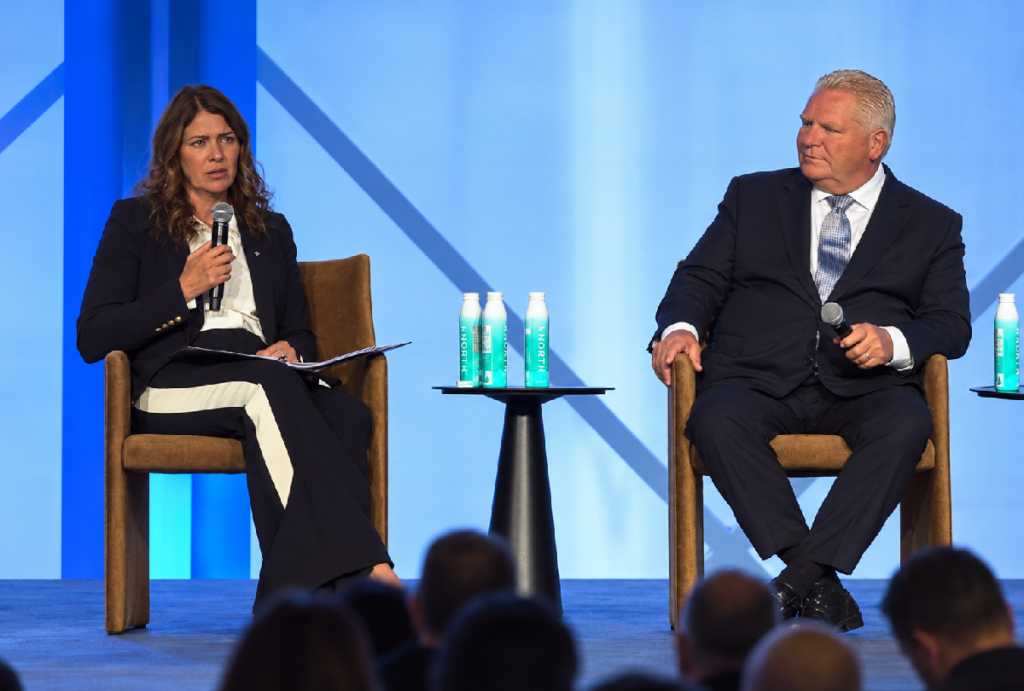
The two premiers appeared September 28 at the Enserva Speaker Series — Build Canada Stronger: Powering Canada’s Economic Future at the Calgary TELUS Convention Centre. The event brought together energy and business leaders to discuss energy security, infrastructure, trade and Canada’s ability to compete in global markets. It was moderated by Enserva President and CEO Gurpreet Lail. Enserva
The discussion highlighted both areas of agreement and differences between Smith and Ford, particularly on Canada’s evolving relationship with the United States.
Smith said Alberta’s exposure to U.S. tariffs differs significantly from Ontario’s because most Alberta exports entering the United States are energy products that remain largely tariff-free.
“If you’re looking at a bit of a difference in tone between Premier Ford and I, that’s what it comes down to,” Smith said, pointing to Alberta’s large existing trade relationship with the United States and the role played by cross-border energy companies including Cenovus, TC Energy and Enbridge.
Smith argued that Canada could potentially use energy as the foundation for a broader economic agreement with Washington, suggesting significantly larger volumes of Canadian oil could ultimately move south if a comprehensive Canada-U.S. arrangement were reached.
Ford struck a somewhat different tone but emphasized that he remains strongly supportive of the broader Canada-U.S. relationship.
“I truly love Americans,” Ford said, noting Ontario’s deep economic integration with U.S. manufacturing and trade. He argued for what he called a “Fortress North America” approach in which Canada and the United States strengthen their economic and security relationships while Canada simultaneously expands trade with other countries.
Ford said the current trade friction could ultimately push Canada to become economically stronger.
“He woke us up that we needed to be woken up, and he’s united the country like I’ve never seen before,” Ford said of U.S. President Donald Trump. “We’re going to diversify our trade, but continue building a strong relationship with our closest friends and allies, and that’s the Americans.”
Pipelines Move to Centre Stage
The conversation quickly turned to pipelines and major infrastructure projects — a central theme of the Enserva event, which was promoted around the question of how Canada can build, move and sell more energy to global markets. Enserva
Smith said she has become increasingly confident about the prospects for a proposed new West Coast oil pipeline.
“I’m feeling more and more confident every day that the West Coast oil pipeline is going to potentially even be the first of the projects that go ahead,” she said.
Smith argued that global concerns about supply security have strengthened Canada’s position as a potential long-term supplier to Asian countries seeking greater diversification.
She also pointed to additional export possibilities through the United States and to the proposed Northern Shield corridor, which Alberta and Ontario have been advancing as a potential east-west energy and infrastructure route.
Ford was emphatic that Canada should not be forced to choose between individual pipeline routes.
“We need the West, we need the North, we need the South, and we need to go east,” he said. “Why can’t we do it simultaneously?”
Ford also signalled Ontario’s willingness to participate financially in the Northern Shield concept, saying he evaluates major infrastructure according to its potential return to taxpayers.
“You show me the numbers, and if you can clip those coupons after we get it built every single year, that’s a great investment for our province,” Ford said.
Skilled Labour Could Become the Next Constraint
Both premiers warned that even if governments approve more infrastructure, Canada will need enough skilled workers to actually build it.



Smith pointed to Alberta’s expansion of apprenticeship programs, dual-credit education and partnerships with unions and employers. She said Alberta now has 81,000 apprenticeship positions and argued provinces need greater ability to align immigration with labour-market shortages.
“We need some office jobs, but we sure need a heck of a lot more factory floor jobs and field jobs,” Smith said. Pasted markdown
Ford said Ontario has invested more than $2 billion through its Skills Development Fund and said more than 750,000 people have received training through various programs.
“Number one issue: supply chain and labour. Who is going to fill these jobs?” Ford said, arguing that provinces should have greater influence over immigration programs so workers who have developed needed skills can remain in Canada. Pasted markdown
Alberta Energy Meets Ontario Manufacturing
Perhaps the strongest area of agreement came around creating deeper economic links between Alberta’s energy sector and Ontario’s manufacturing base.
Ford argued governments need to reduce regulatory barriers and create conditions that encourage companies to invest.
“The biggest problem, biggest hurdle is government,” Ford said, pointing to regulation, taxation and permitting as obstacles governments can address. Pasted markdown
Smith then outlined several areas where the provinces could work together directly.
One is natural gas-fired power generation. Alberta wants to substantially expand electricity generation to support industrial growth and data centres, but Smith said global demand for natural gas turbines has created long equipment lead times.
“We’ve got the cheapest natural gas probably anywhere in the world, sitting on an ocean of it,” she said.
Smith suggested Ontario’s manufacturing expertise could help develop a Canadian supply chain for natural gas turbines and related electricity infrastructure.
Another opportunity is steel.
With pipelines, energy projects and other infrastructure requiring enormous volumes of steel pipe and fabricated components, Smith said Alberta should identify the equipment its energy industry will need and work with Ontario manufacturers to produce more of it domestically.
“Let’s figure out how we can identify the steel fabricated items that we need, and let’s work with our friends in Ontario,” Smith said.
She also suggested Canada needs stronger east-west supply chains, rather than relying predominantly on north-south trade with the United States or imported products arriving through West Coast ports. Pasted markdown
The message fit closely with the theme Enserva established for the event. Using Canadian energy, infrastructure and industrial partnerships to improve the country’s economic competitiveness and energy security. Enserva said the discussion was intended to examine how Canada could “look beyond provincial boundaries” to unlock its energy potential.
For Canada’s energy services sector, the discussion underscored a potentially significant shift: major energy development is increasingly being presented not simply as a Western Canadian issue, but as an opportunity to connect Alberta resources, Ontario manufacturing, Canadian workers and new international markets.
And on that central point, Smith and Ford were clearly aligned.
“We’re stronger together,” Ford said.
Share This:






















Cash-Rich Oil Majors Face Post-Iran Strategy Rethink: Bousso