CDN NEWS |
  US NEWS







Canada’s West Coast could house a major transpacific liquefied natural gas bunkering hub if government policy consistently promotes audacious private sector ambitions
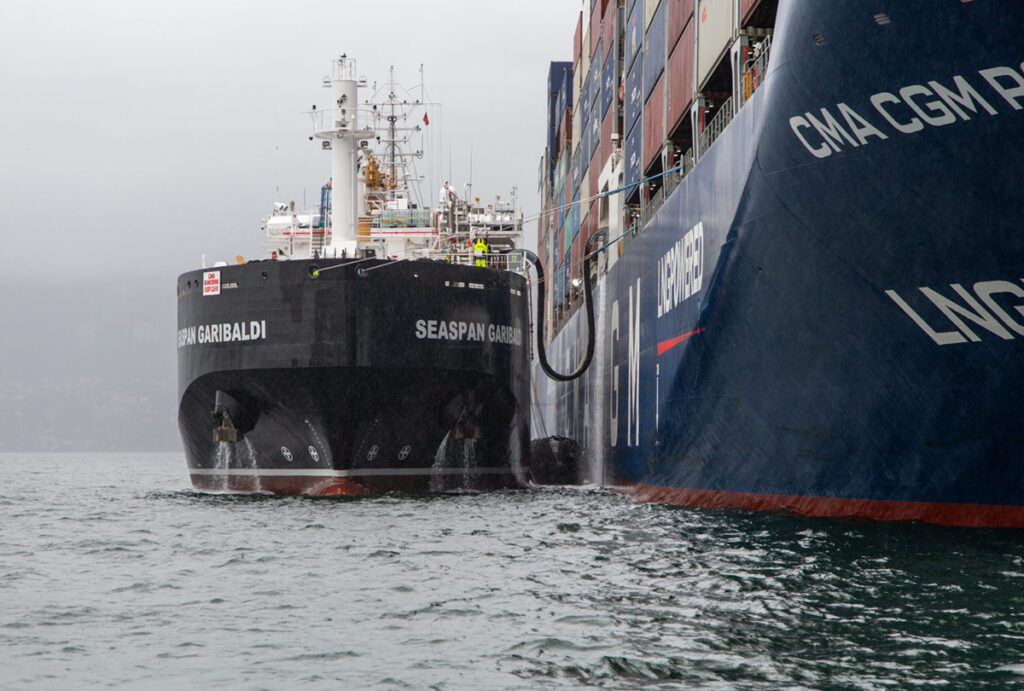
The Seaspan Garibaldi refueling a dual-fuel container ship with liquefied natural gas. | Photo from Seaspan
B.C. as an alternative energy fuelling hub for transpacific maritime shipping?
Another flight of fantasy, you say, in David Eby’s NDP land of pipeline opposition escalation, private property rights erosion, and government debt accumulation acceleration?
Maybe not.
Maybe we have more facts than fantasy to consider on that file.
Here is one: Seaspan Energy (SE).
The North Vancouver-based member of the Seaspan Marine group of companies recently announced that it had completed its 150th ship-to-ship liquefied natural gas bunkering. That would be 150 in under two years since SE launched its operations; that would also be enough to nail down seventh overall in Lansdowne Moritz’s LNG bunkering volume rankings.
Granted, not top five; however, not bad.
Even better when you consider that when SE’s Seaspan Lions refuelled a tanker with LNG in the Port of Vancouver on Jan. 30, 2025, it was Canada’s first ship-to-ship LNG bunkering operation.
That entrepreneurial spirit is typical of companies aligned with the Washington Group, which has launched such major maritime business success stories as Seaspan Corp., the world’s largest independent lessor of container ships.
Seaspan Corp., as avid Substack Shipping News (SSN) readers might recall, acquired APR Energy Ltd. in an all-stock transaction valued at US$750 million in 2020 as part of Seaspan’s plan to diversify into the energy sector.
At the time, APR was the world’s largest lessor of mobile gas turbines. Seaspan, which had undergone a major corporate retooling that included launching Atlas Corp. as its corporate parent, was later taken private and acquired by the Poseidon Acquisition Corp. in an all-cash US$11 billion deal.
Seaspan’s container ship fleet today numbers 227 – 890 per cent more than it started with in the early 21st century. The company’s overall capacity is now around 2.4 million 20-foot equivalent units (TEU).
All of which is to illustrate the global ambitions of Seaspan companies.
So, a seventh overall ship-to-ship LNG bunkering rank today will not remain seventh for long.
Bet on SE’s fleet of three LNG bunkering ships expanding with the demand for dual-fuel ships as maritime shipping’s pollution restrictions tighten and carbon emissions penalties erode earnings.
Still, today’s dual-fuel ship market remains marginally buoyant.
As noted in a previous SSN report, orders for alternative-fuel ships in 2026’s first half dropped to 137 compared with 155 in 2025’s first six months and were down 45 per cent in 2025 compared with 2024.



Concerns over fuel availability, regulatory uncertainty, and comparative cost have dampened demand for dual-fuel ships.
However, A.P. Moller-Maersk (CPH:MAERSK-B) and other top ocean carrier lines remain committed to increasing their fleets’ energy efficiency and reducing their carbon footprints.
And LNG remains the odds-on favourite lower-carbon emission bridge fuel to a greener maritime shipping future.
As the World Bank Group (WBG) points out in its recently released “Ports, Ships, and Fuels” report, “LNG is currently the most widely deployed alternative marine fuel, with approximately 470 LNG-fueled ships in service globally and more than 400 on order – well ahead of other alternatives.”
Well ahead by a wide margin.
Yang Chen, the managing director and chief editor of Xinde Marine News, points out in a recent analysis that 173 LNG-capable ships were ordered in 2026’s first half compared with only four methanol ships.
Bets on which bridge fuel will drive ocean carriers to the industry’s green destination are multibillion-dollar gambles.
Bunker fuel typically represents 40 per cent to 60 per cent of a ship’s operating budget, and a 10,000 TEU container ship costs approximately US$100 million and has a working life of around 25 years.
The supporting infrastructure for that fuel bridge is critical to its commercial viability.
So, whoever is pushing chips into the middle of the table needs to be confident that he is making an informed bet.
Again, LNG has the inside track.
The WBG report estimates “that by 2040, supporting global maritime fuel supply could require about US$310 billion for green ammonia, US$81 billion for green methanol, and US$42 billion for renewable LNG.”
It focuses on the Pacific region and notes that China is leading the push to dominate green shipping initiatives.
The report says, for example, that the shipbuilding action plan for China’s Ministry of Industry and Information Technology has an international market share target of more than 50 per cent for green-powered vessels.
“Complementary measures include large-scale LNG bunkering infrastructure at ports such as Yangshan and Yantian and coordinated institutional support through state-owned enterprises.”
B.C. cannot hope to win any head-to-head industrial competition with China; however, its natural resource and geographic advantages could establish it as a player in the transpacific shipping theatre.
It just needs the private-sector mettle and government commitment to leverage those advantages.
Seaspan provides evidence that the West Coast still has that mettle; British Columbians await any sign that their government has the required commitment.
This article originally appeared in The Substack Shipping News. Timothy Renshaw can be reached at [email protected].
Share This: