CDN NEWS |
  US NEWS







Manitoba Hydro’s $3-billion turbine proposal is under scrutiny today as BC Hydro seeks to retain nearly 400 megawatts of existing gas generation
By Ian Biana
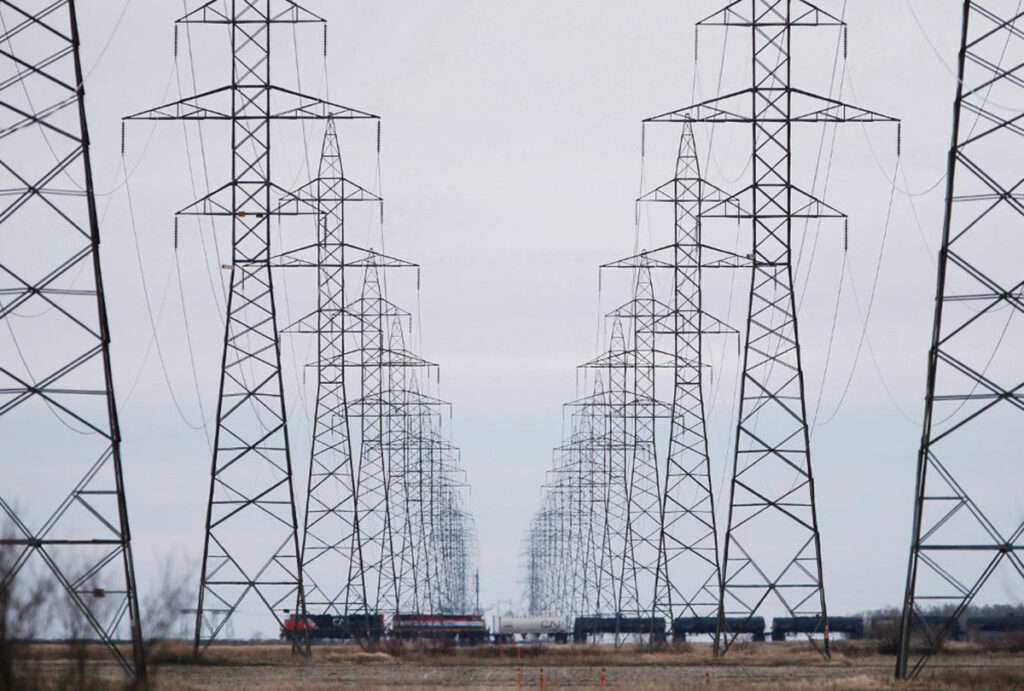
Severe drought in Western Canada is putting pressure on hydroelectricity generation, forcing two hydro-rich provinces to import power from other jurisdictions due to low reservoir levels. Manitoba Hydro power lines are photographed just outside Winnipeg, Monday, May 1, 2018. THE CANADIAN PRESS/John Woods
A tale of two hydro-dependent provinces
Manitoba Hydro was back before the Public Utilities Board on Tuesday as hearings resumed in a case scheduled to run through Sept. 4. At issue is one of the province’s biggest power decisions in years: whether a grid that generated 96.3 per cent of its electricity from water in 2024 should spend about $3 billion on three new natural gas turbines.
The proposal, first unveiled last November, would add about 750 megawatts at Brandon by 2030. It is not approved. The board will test the need, alternatives and rate impact before advising cabinet.
Manitoba Hydro projects that the new turbines would operate less than five per cent of the time in an average year, functioning primarily as drought protection and capacity insurance rather than replacement for hydroelectricity.
The politics make today’s story more striking. Within one month this spring, two NDP governments in two of Canada’s most hydro-dependent provinces formally moved natural gas back toward the centre of their reliability plans.
Manitoba Premier Wab Kinew, who leads the province’s NDP government, framed the project as energy security when it was unveiled: “We’re Trump-proofing our economy by having power sovereignty.” B.C. is led by another NDP premier, David Eby. The decisions are separate, but they respond to the same physical problem on almost the same timetable.
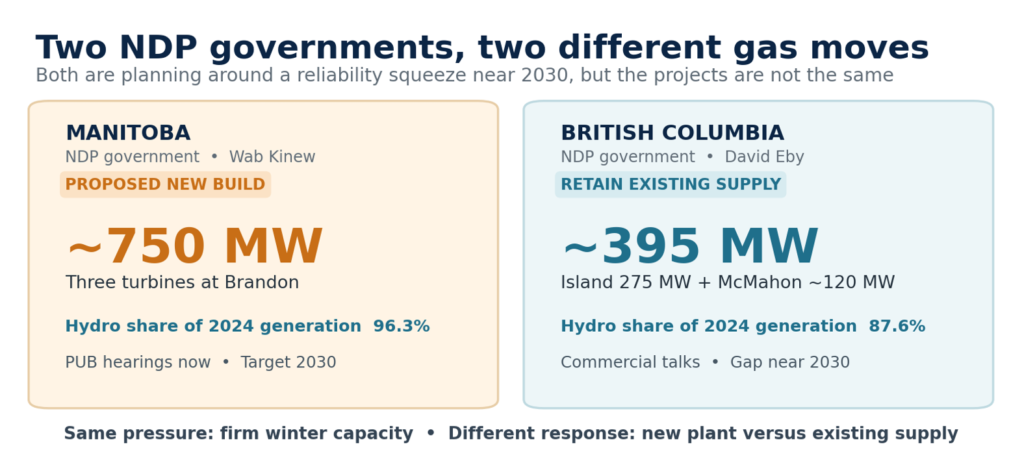
Source note: Figures synthesize the Manitoba hearing record, BC Hydro’s May 28 filing and Statistics Canada’s preliminary 2024 generation data. The projects remain under review or negotiation.
B.C.’s quieter strategy: Retaining existing assets
Manitoba is proposing a new plant. B.C.’s move is quieter but still significant.
In a May 28 regulatory filing posted June 4, BC Hydro said it was in commercial talks to continue supply from the 275-megawatt Island Generation plant in Campbell River and the roughly 120-megawatt McMahon cogeneration facility at Taylor. Together, they could cover about 400 megawatts of an early capacity gap approaching 500 megawatts around 2030. This represents an extension of existing thermal assets, not an announced new build.
British Columbia also sits on a large natural gas endowment, with the BC Energy Regulator estimating about 91.8 Tcf of remaining raw gas reserves as of Dec. 31, 2023, most of it in the Montney basin.
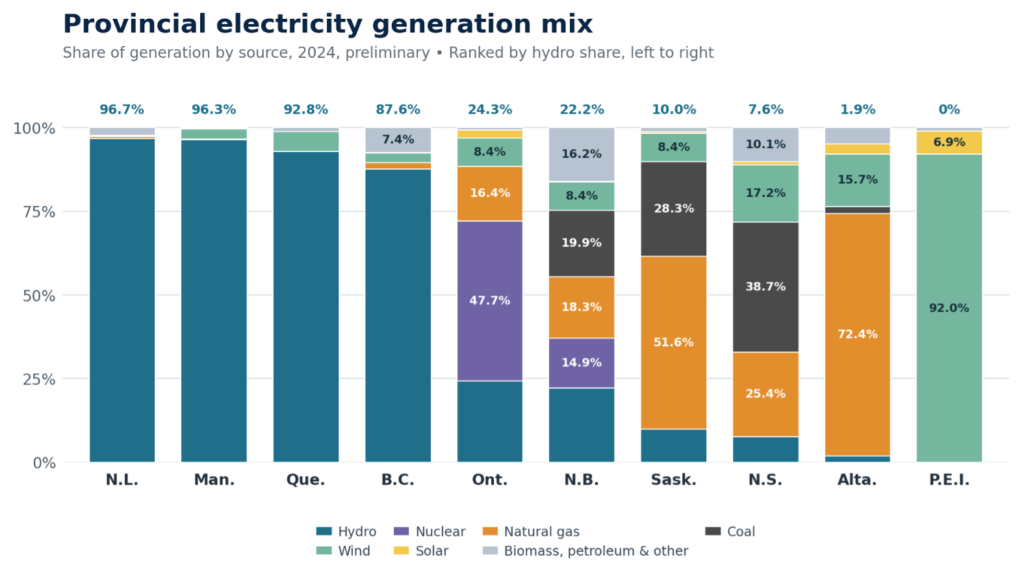

Sources: Statistics Canada table 25-10-0020-01 and table 25-10-0084-02. Shares are of provincial generation, not installed capacity or consumption; imports and exports are excluded. Thermal fuel shares are reconciled across the two surveys. Data are preliminary; territories are excluded.
Energy vs. capacity: Why winter peaks demand gas
The apparent policy contradiction disappears when energy is separated from reliability:
- Energy (megawatt-hours): The total volume of electricity produced over time.
- Capacity (megawatts):The maximum electrical output available at any single moment.
- Firm (Dependable) capacity: The reliable output planners can guarantee during a freezing winter peak, severe weather or unexpected equipment failure.
Reservoir hydro is one of the best balancing resources because operators can raise output quickly. But a dam has two limits: turbine capacity and water behind it. Drought can leave plenty of machinery with too little stored energy. Wind and solar add low-cost annual energy but cannot guarantee full output during a still, dark winter peak. Batteries shift power across hours; most cannot cover a cold spell lasting days.
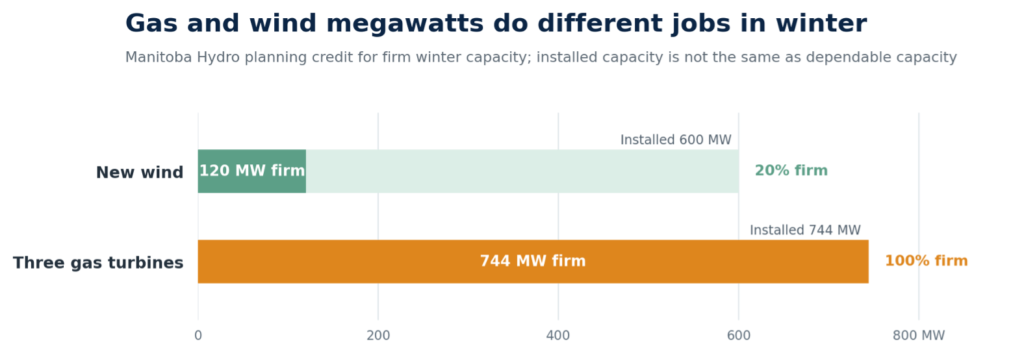
Source note: Manitoba Hydro 2025 Integrated Resource Plan modelling results. Capacity accreditation is a planning assumption, not annual energy production. Gas dependability also requires firm fuel, pipeline and equipment availability.
Imports help, but they are not a sovereign reserve. CBC reported from the hearing that Manitoba Hydro CEO Allan Danroth said the province imported electricity equal to Keeyask’s output every hour during January 2026. At a continent-wide winter peak, neighbouring systems may need their own generation.
Gas turbines fill that narrow gap. They can start quickly, run on command and sit idle most of the year.
Risks, trade-offs, and the reliability imperative
Natural gas generation is not without vulnerabilities. Turbines need assured fuel, pipeline capacity and maintenance through the same extreme cold that drives demand. They also expose customers to fuel prices, carbon costs and the risk that a short bridge becomes long-lived infrastructure.
Manitoba assumes direct turbine emissions will be mitigated with renewable natural gas credits or offsets by 2035. That is an accounting strategy, not physically emissions-free generation at Brandon.
Barry Penner, the former B.C. environment minister who chairs the Energy Futures Institute, has argued that reliability should be written into B.C.’s energy objectives alongside affordability, rate stability and environmental sustainability. His analysis makes the case for retaining existing dispatchable plants until replacements can do the same job. It is a perspective, but the NDP parallel makes his central question concrete.
The broader tension is that B.C. is trying to electrify more of the economy while still needing firm dispatchable power when winter demand spikes.
That question is now surfacing in the province’s own energy politics. As B.C. Energy Minister Adrian Dix said, “You would think that those who comply with regulations and engage with the federal government should be taken seriously.”
The bottom line
Today’s news does not mean that two NDP governments have abandoned climate policy—or that renewable energy has failed. It is a reminder that a clean grid is judged by its toughest hour, not its average year. If a lower-cost, lower-emission portfolio can provide the same dependable power by 2030, the case for it will be hard to resist. If it cannot, reliability will keep natural gas in the plan.
Ian Biana writes for the Resource Works Accelerate team and can be reached at [email protected].
Share This: