


 CDN NEWS |
  US NEWS







By Yogi Schulz
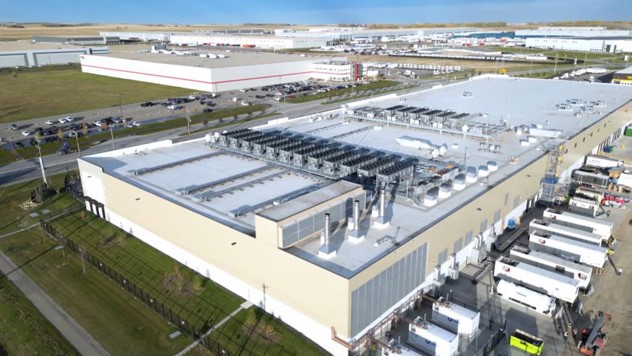
The incredible demand for AI-related computing capacity is driving rapid growth in AI data centres worldwide. The Alberta government is keen to ensure that some of that investment occurs in Alberta and has set a goal of attracting $100 billion in investment by 2030.
Recently, Pembina Pipeline Corp. and its partners announced plans to build the $4.6 billion Greenlight Electricity Centre, a 932-megawatt natural gas-fired plant in Sturgeon County, north of Edmonton. It’s designed to supply dedicated power to a massive Meta AI data centre costing at least $13 billion.
Alberta offers many advantages for AI data center developers. The advantages include:
- A pro-business culture.
- Abundant natural gas with a significant pipeline distribution system.
- Streamlined regulatory approvals, using Alberta’s well-defined Bring Your Own Generation (BYOG) permitting framework.
- Competitive electricity costs.
- A government focused on attracting investment.
- A cooler climate that reduces cooling costs by 20 to 30% compared to Texas.
- An extensive fibre optic telecommunications network.
- A skilled workforce for construction and operation.
- Lots of available office space at low occupancy rates.
- Significant amounts of land available at an attractive price.
- Excellent airline connections to many parts of the world.
- A time zone that works well for US companies.
However, these Alberta advantages for AI data centres are being overshadowed by supply chain bottlenecks in the computing equipment that will fill them. Let’s examine these bottlenecks. They will affect the timeline until Alberta AI centres come online for routine use.
AI data centre costs
The chart below estimates capital and operating costs for a 1 GW data centre. It shows that such an AI data centre requires US$38 billion in upfront capital expenditure (CapEx) and US$0.9 billion in annual operating expenses (OpEx).
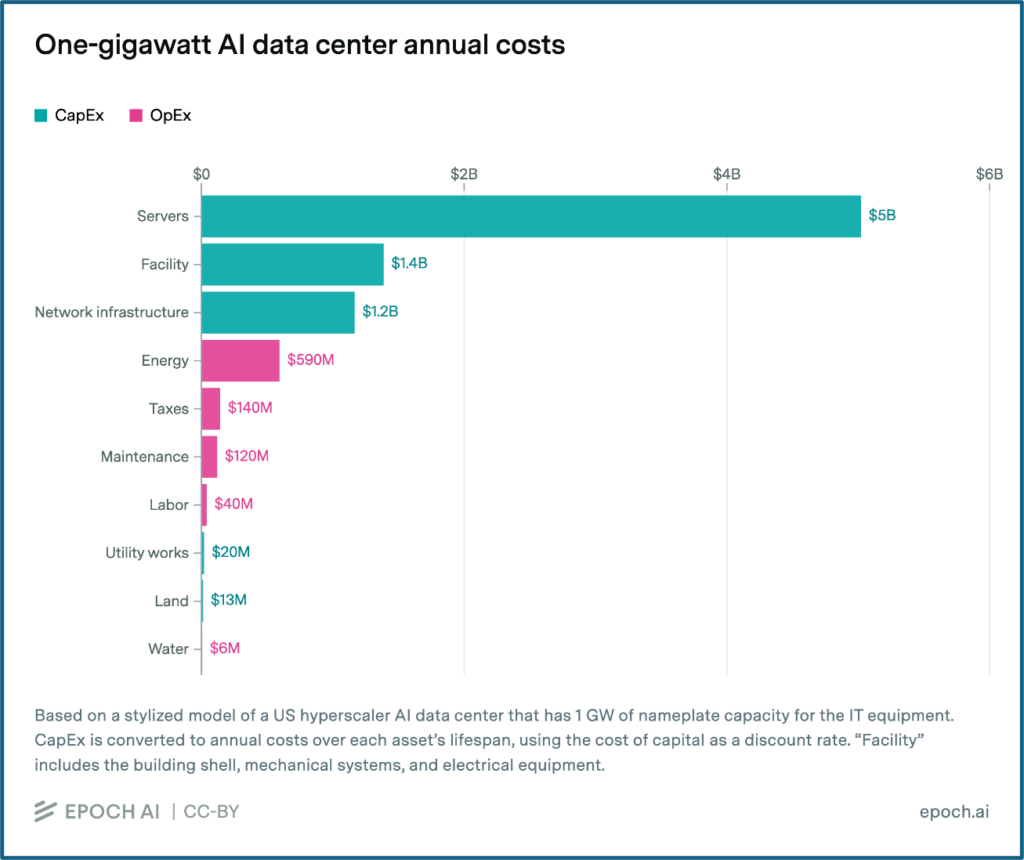
Source: Servers account for 60% of the total cost of ownership of a one-gigawatt AI data center, Epoch AI, May 14, 2026
Let’s examine each cost category for supply chain bottlenecks that will lengthen the time to completion and likely increase costs. Data centre proponents want to take actions, where possible, to minimize the impact of supply chain issues on their project completion dates.
Servers
AI data centres contain an enormous number of computing servers. The server racks themselves are not problematic. However, the following components will delay data centre projects.
GPU chips
The explosive growth in demand for graphics processing unit (GPU) chips, which are especially well-suited for AI applications, has led to 9- to 12-month lead times before delivery. This delay may affect data centre startup dates. The chart below illustrates the trend.
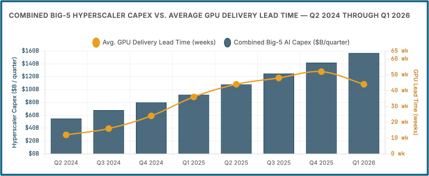
Source: The AI Compute Backlog Is Deeper Than Anyone Will Tell You, LongYield, May 06, 2026
While Nvidia is the dominant GPU supplier, other companies like AMD and Intel are jumping into the market.
Hyperscalers are designing and ordering their own AI processing chips to improve performance, circumvent Nvidia lead times and control costs. Here’s a summary:
- Amazon – Graviton processor, the Trainium AI chip, and the Nitro networking chip.
- Google – Tensor processing units.
- Microsoft – Maia accelerator chips.
CPU chips
Rapidly increasing demand for enterprise server central processing unit (CPU) chips is mostly driven by AI data center projects. Top manufacturers like AMD and Intel have announced 3- to 6-month lead times, along with price increases of more than 10%.
AMD has notified its customers that some of its CPUs will have delivery lead times of eight to 10 weeks, while Intel is warning of much longer delays of up to six months.
The manufacturers are implementing steep price increases and rationing key materials needed to etch and cool chips during manufacturing, such as helium, copper, and bromine.
Memory chips
Rapidly increasing demand for Dynamic random-access memory (DRAM) and High-Bandwidth Memory (HBM) from AI-related projects is inflating costs.



Severe constraints in global manufacturing capacity are increasing lead times to 10- to 13-month. Only three companies, Samsung Electronics, SK Hynix and Micron, collectively account for nearly 90% of global memory output. The increasing demand has led to significant price increases, as illustrated in the chart below.
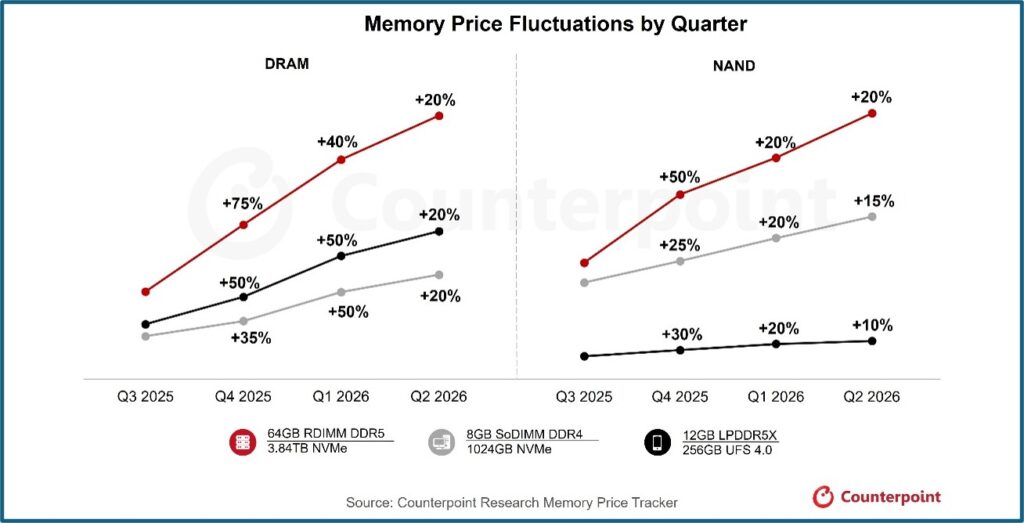
Source: Memory Prices Soar by 50% in Q4, Rally to Continue in 2026, Counterpoint, January 6, 2026
Facility
AI data centers house the computing servers in a sophisticated facility. Because multiple experienced contractors can build AI data centers, construction is unlikely to be the critical path to starting the data centers.
Network infrastructure
Because AI data centers contain an enormous number of computing servers, they also require an extensive internal network infrastructure. The increasing demand for these components has led to significant increases in lead times, as illustrated in the chart below.
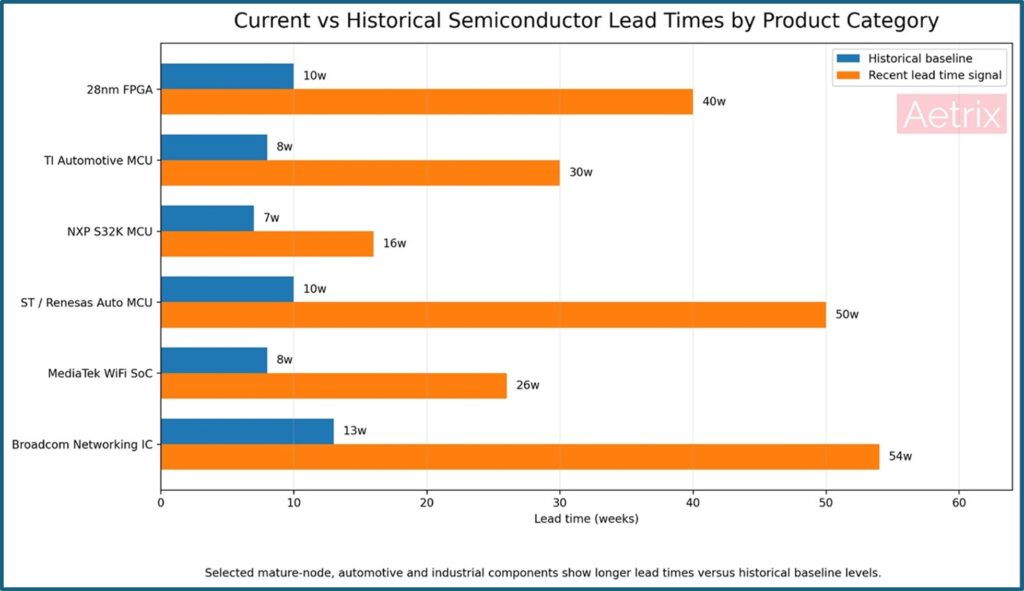
Source: Semiconductor Lead Times 2026: Why AI Demand Is Stretching Chip Supply Chains, Aetrix, June 22, 2026
Energy
Most large data centers in Alberta want to use natural-gas-fired turbines to generate electricity due to Alberta’s abundant natural gas. However, turbine demand has intensified to the point that most manufacturers are now sold out until 2031 for deliveries.
This reality will prompt data centre developers to consider alternatives to minimize startup delays seriously. Credible alternatives include wind and solar electricity generation with industrial-scale batteries.
Cooling equipment
Closed-loop and evaporative systems are widely used in data centers for their water efficiency. This technology addresses concerns about high water consumption in some locations. However, water cooling technologies face several challenges, including:
- High energy consumption.
- High maintenance costs.
- Risk of downtime.
Newer and larger data centers are being built with liquid cooling technologies such as direct-to-chip and immersion cooling because they perform better at removing heat from high server density and handling large-scale cooling requirements.
The diagram below summarizes where various cooling technologies are most effective relative to the data centre size, measured in kW of power consumption.
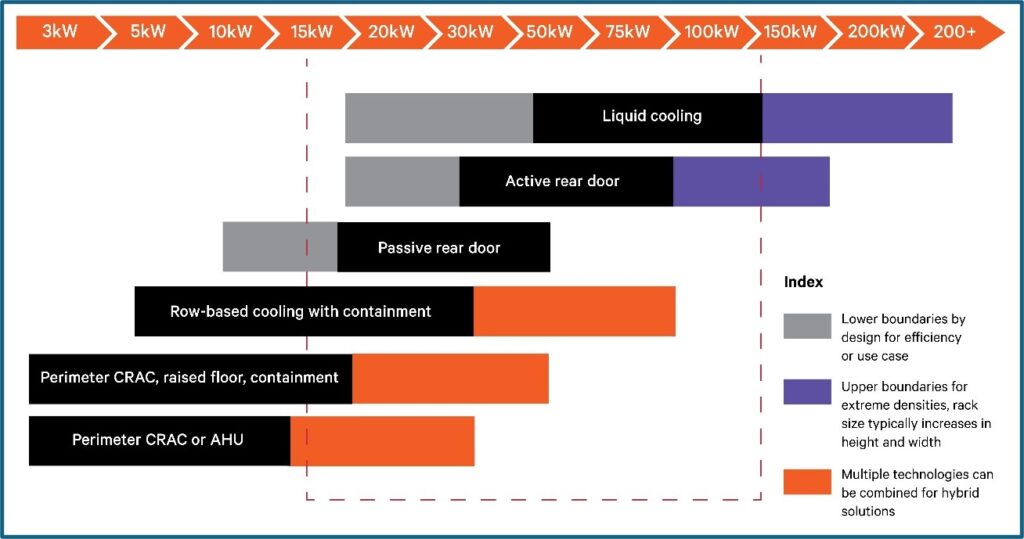
Source: Liquid cooling versus air cooling: How thermal management systems are evolving, Vertiv
Cooling equipment availability is not expected to be the critical path to starting new data centres.
Taxes
Municipal and provincial taxes add to data centre operating costs but do not affect the schedule to achieve startup.
Maintenance
Maintenance costs are a material component of overall data centre operating costs but do not occur until after startup. The following factors control this cost:
- The increasing reliability of the electronic components, which are the highest capital cost component of the data centre.
- Alberta’s competitive labour market.
- Advances in cooling technology that are decreasing cooling costs.
Labour
The skills and depth of Alberta’s labour market are an advantage that attracts data centre developers.
Utility works
Most Alberta data centres will connect to the electricity distribution grid for added reliability, even though they will build sufficient electricity generation capacity to meet their own needs.
Related permitting and construction work is unlikely to become the critical path to data centre start-up.
Land
Alberta offers significant available land at attractive prices compared to other possible jurisdictions. Data centre developers will consider the following factors in selecting their location:
- Sufficiently remote from urban areas.
- Distance from the electricity distribution grid.
- Distance from the natural gas pipeline network.
- Ability to rezone the land and receive an industrial development permit.
- Access to highways.
- Access to the fibre optic telecommunications network.
Water
Data centres require significant volumes of water to cool servers. To control overall data centre operating costs, owners recycle most of their water.
Alberta offers significant water resources for industrial development. However, water availability varies significantly within the province. Generally, water is in short supply south of Calgary. Conversely, significant water surpluses exist north of Edmonton.
Conclusion
The elapsed time to deliver natural-gas-fired turbines is likely to be the critical path to the data centre startup date. Data centre owners will likely pursue the following strategies to achieve an earlier startup date:
- Build the facility in phases and buy electricity on the open market for an initial phase.
- Build wind and solar electricity generation with industrial-scale batteries for some phases.
Share This:






















INSIGHT: Canada’s Economy Falling Behind Despite Misleading Headlines – Fraser Insitute