


 CDN NEWS |
  US NEWS







If You Liked The Pandemic, You’ll Love Decarbonization
By David Yager
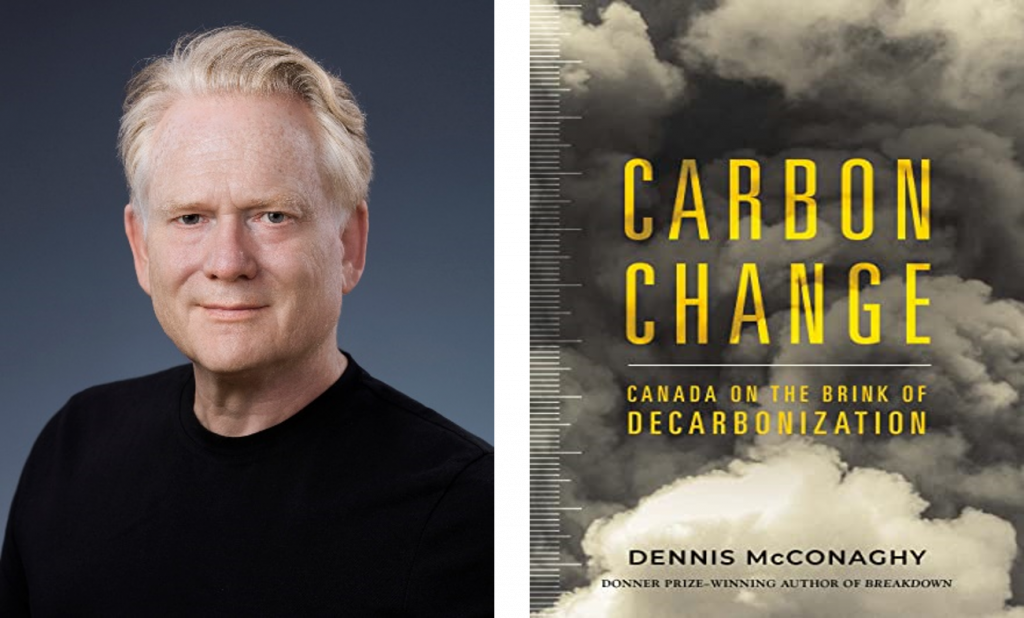
Dennis McConaghy is an engineer and former pipeline executive on a mission to knock some sense into the public and policy makers about their collective determination to restrict and ultimately replace fossil fuels without a workable plan or commercially viable alternatives.
Because that’s what engineers do. Once they have their heads around “what” and “why,” they are classically trained to meticulously map out “when” and “how.”
Dramatic changes are the history of civilization. But as current events are proving, changing the way the world uses energy by political, not scientific, means, isn’t working very well.
This is the fundamental premise of Carbon Change – Canada on the Brink of Decarbonization, to be released this fall.
This will be McConaghy’s third book in five years about hydrocarbons and Canada’s energy future. His first in 2017 was Dysfunction – Canada after Keystone XL. This was the inside story of KXL from the perspective of a senior executive at TransCanada Pipelines (now TC Energy). The second was Breakdown – The Pipeline Debate and the Threat to Canada’s Future in 2019.
Never a climate change denier and a consistent proponent of carbon taxes as foundational to a successful, market-driven transition away from carbon-based energy, McConaghy is making this third attempt to explain the perils of allowing emotion to overwhelm physics and science.
This time, McConaghy analyses the world’s recent experience with the COVID-19 pandemic and the dramatic actions world governments took to protect people from this existential threat to their health and future.
McConaghy figures that decarbonizing the global energy complex in the target time frame in absence of truly workable replacement energy sources will also require major government intervention.
Because the pandemic response is still fresh in everyone’s minds, this may be his most successful argument yet for politicians, pundits and public to think through the whole Net Zero by 2050 (NZE50) crusade and get them to fully understand what decarbonization means and how to get there.
What makes Carbon Change most valuable is that it is very current. It includes the two major events that have changed the world in the past 2.5 years, the pandemic which began in March of 2020 and the invasion of Ukraine by Russia in February 2022.
And they make the timing of McConaghy’s book a thoughtful and relevant contribution to the climate change discussion.
The author works from three main points.
First, the latest 2021 IPCC report confirms climate change is a real and significant challenge, and that emissions must be reduced to meet agreed upon maximum temperature increase targets.
Second, with emissions growing rapidly in Asia and other developing regions, global cooperation in emission reduction is essential, something rarely mentioned in Canadian climate policy. A workable plan must include India, China and the rest of the developing world.
The last is that a globally adopted and enforced carbon prices is the only workable tool for achieving real and sustainable decarbonization.
Early in the book McConaghy writes, “A cost/benefit analysis approach would create a more economically optimal outcome for managing the climate change risk than unconditional adherence to decarbonization…”
Which is something you’d think the restructuring of the entire global energy complex would deserve.
Then McConaghy loops in existential threat. While long associated with climate change, the term also emerged during the pandemic as a justification for drastic action against COVID-19 which included lockdowns.
When the IPCC 2021 report was released, UN Secretary-General António Guterres ignored much of the technical data and called it “a code red for humanity.” That’s what got the headlines, not hundreds of pages of technical data and research, all of which did not support this alarmist pronouncement.
McConaghy writes, “The official and loudest voices in the climate-policy world have limited the conversation by moralizing, and by considering only the potential damages that climate change might cause. This is an inadequate substitute for dispassionate cost/benefit analysis.”
The linkage between the response to the pandemic and what could be a similar response to arrest climate change is the most compelling element of McConaghy’s book.
Hence the title of this review. If you liked the pandemic, you’ll love decarbonization. Because McConaghy figures that without a global, market-based plan and the development of viable and economically competitive energy alternatives, the only means to meet the agreed emission reduction targets is the introduction and enforcement of lifestyle changes and legislated behavior modification, this time surrounding energy consumption.
Which, at many levels in many countries, is already underway.
McConaghy’s writing reflects his personality. He is straightforward and economical with words which leads directly to the point. Therefore, he is able to provide background, analysis, and his solutions to this complex subject in only 178 pages.
With the stage set, the author makes his key point early. “…the developed world urgently needs to reconsider its commitment to decarbonizing. Here I must note the distinction between a decarbonized world and one with ‘net-zero emissions,’ a term that is often invoked by those who wish to make the enormity and extreme implications of decarbonization appear more palatable and feasible.”
It starts with the origins of the NZE50 phenomenon and what it means. But since the first IPCC report in 1990, the process has largely left the economics to others. “Since the inception of the UNFCCC (United Nations Framework Convention on Climate Change), it has not relied on conventional cost/benefit analysis, integrating economic and physical considerations, to provide guidance for policy makers.”
Put another way, it tells world leaders what, when and why, but not how.
As for the consensus regarding NZE50, McConaghy writes, “Indeed, the word consensus doesn’t quite convey how this — still eminently debatable — response to dealing with climate change risk has become the politically correct orthodoxy, such that any skepticism is deemed by most political elites in the developed world as either immoral, politically blighted, or just plain stupid.”
McConaghy defines decarbonization. “Since technologies that might sequester or remove GHGs are not currently viable, economically or at sufficient scale, the UN process demands, de facto, that humanity cease combusting hydrocarbons. This extreme position is what I mean, then, by ‘decarbonization’.”



The book visits emissions caps. While the total required is well understood, who will contribute what and when remains undefined. “Of course, the premise of a global carbon budget immediately raises intractable questions. Who gets what share? Can shares be bought and sold? What are the consequences of noncompliance? Such are the core questions that need addressing if the current UN process is to offer meaningful policy options, though to date the IPCC has hardly confronted them directly.”
Then there’s cost of compliance versus adaptation. “The UNFCCC process emphasizes potential catastrophic impacts and existing regional and intergenerational inequities that might otherwise be undervalued by accepted cost/benefit methodology…analysis amounts to a netting out of the costs of climate change mostly represented as damage, versus the costs of abating those damages. What is the net cost or benefit? How is the net benefit optimized? At what level of temperature containment?”
There are massive obstacles and cost challenges not anticipated in the master plan. Like Maine rejecting a new power line from Quebec for hydroelectricity (a decision later overturned by the courts). This is happening all over the world as citizens obstruct wind and solar farms nearby and increasingly, all manner of industrial development and infrastructure.
How do you save a world that refuses to participate in its own salvation?
Huge numbers, even before the Russia/Ukraine war. “In January 2022, McKinsey Consulting estimated that the project (NZE50) will cost $9.2 trillion annually until 2050. That is $3.5 trillion more per year than the world is currently laying out for both low-carbon and fossil fuel infrastructure.”
McConaghy insists on periodic reality checks and comparisons of the incumbent versus the replacement. “…achieving decarbonization is expensive, perhaps infinitely expensive, based on the status of technologies currently available…and intractably, replicating the ‘gift’ that hydrocarbons represent is immensely difficult. Hydrocarbons offer massive energy stored via fundamental chemical properties, available when needed at minimal cost. The substitutes are intermittent and inherently more costly, due to the complexity of their production. Moreover, they often rely on mineral components that are themselves costly and energy intensive to produce.”
But where this book blazes new trail is when McConaghy compares decarbonization to the pandemic.
In terms of solutions, the pandemic had an advantage because of the quick development of effective vaccines from multiple suppliers. This enabled the relatively quick reversal of the lockdowns and restrictions introduced to control the spread of the virus.
For climate change, no immediate silver bullet energy technology breakthrough exists.
“The economic contraction we experienced throughout 2020, due to the pandemic, illustrates the kind of sacrifice required to affect even the modest emissions reductions that occurred that year. To sustain and exceed that level of emissions reductions would require massive intervention, not only to decarbonize energy systems, but to constrain basic human activity throughout the transition and likely beyond…Notably, 2020 was the only year since the UN climate process began in 1992 that global emissions actually fell in absolute terms. The cost of achieving it was a mandated contraction in human activity.”
McConaghy explores ESG investing, two Canadian elections in 2019 and 2021 with climate change a key issue, the trucker convoy of early 2022, reopening of the economy after the pandemic lockdowns, the COP 26 climate meeting in Glasgow in November of 2021, the US election with Trump versus the Green New Deal, the consequences of intentionally suppressing oil and gas development, and the beginning of the energy challenges that have emerged as renewables have failed to live up to expectations when the weather doesn’t cooperate.
Then every problem the world had got worse in February when Russia invaded Ukraine. This exposed the vulnerability of countries like Germany which politically had been a leader in replacing carbon-based energy with renewables.
McConaghy wrote, “The way forward will also require abandoning long-standing delusions that we can run modern economies on windmills and batteries, and this is true for North America as much as it is for Germany.”
The rest of the book, titled “Reconsidering Climate Policy,” contains McConaghy’s ideas on what the world should be thinking and doing if it really wants to decarbonize the economy and atmosphere. Here are a few key points.
- While the western democracies generally accept the pandemic lockdown as justified, will they also accept similar measures for decarbonization, which is what may be required?
- The pandemic created another public debate over science as many questioned the government responses. He applies this to both the pandemic and climate change writing, “When we start condemning dissent as disinformation and stifling debate over what constitutes optimal policy, we have begun our descent down a slippery slope to frightening and unacceptable constraints on free speech.”
- The economic cost of COVID-19 lockdowns was huge, estimated in 2020 in the US at $16 trillion. Climate change doesn’t even come close. “For context, extreme weather events in the United States in 2021 were valued at US$145 billion, according to the NOAA (National Oceanic and Atmospheric Organization.”
- In the early stages before the vaccine, people accepted the lockdowns and a quest for zero COVID seemed achievable. But nearly two years later, “The governments of most developed countries in the world had accepted de facto, by the end of 2021, that zero COVID-19 was not a realistic or even responsible goal, in part because the economic and political costs would be too great to sustain.”
- The IPCC has never stated that exceeding 1.50C would lead to human extinction, “…yet alarmism animates the UN process. Decarbonization advocates seemingly hold that no cost and no sacrifice is too great to contain…” McConaghy believes that “…the extreme intervention of trying to achieve decarbonization will do more harm than good.”
- McConaghy specifically mentions rich and famous climate change alarmists Al Gore, John Kerry, Bill Gates and Mark Carney “…who genuinely believe that technological breakthrough will soon bring an affordable, reliable, and green transition…however, I suspect they are deluded.”
- “How can a country (Canada) that already derives over 50 percent of its GDP from the public sector dismiss one of its few internationally competitive private-sector industries? So glibly, so fatuously? So ignorantly? So spitefully?”
Since the book is about Canada, McConaghy concludes with the following.
- The current plan for NZE50 is unworkable and impossible. “The world will approach a 3°C increase in average global temperature regardless of whether developed economies of the G7 attempt to effect decarbonization.”
- The US, our largest trading partner, will never participate as required. “The United States, at the federal level, cannot enact climate legislation that would begin their process of mandated decarbonization.”
- Canada should change course and move towards a global carbon tax. “Canada should not attempt to progress decarbonization in the face of these realities, but rather to become an advocate of uniform, properly conditioned carbon pricing across the G7…”
- The current plan is a disaster. “If Canada persists with decarbonization domestically, a policy that will have no impact on global hydrocarbon demand or emissions, it will only impose on itself massive economic costs, most of which will be imposed on western Canada and especially Alberta.”
Carbon Change is a timely and thoughtful book that, regrettably, the right people will probably never read.
But as the first serious major and academic work in publication following the tumultuous events of the past 2.5 years, everyone should.
The book will be out shortly. To reserve your copy to go Amazon.com: Carbon Change: Canada on the Brink of Decarbonization: 9781459750517: McConaghy, Dennis: Books
David Yager is an oil service executive, oil and gas writer, energy policy analyst, and author of From Miracle to Menace – Alberta, A Carbon Story. Find the book to www.miracletomenace.ca. He is President and CEO of Winterhawk Well Abandonment Ltd. which has commercialized a new casing expansion technology for improving annular wellbore integrity.
Share This:






















INSIGHT: The Northern Shield Energy Corridor Provides Energy Security for All Canadians – Yogi Schulz