


 CDN NEWS |
  US NEWS








Wellbore remediation operations that require changing the behavior and characteristics of the annulus of the production casing are, by nature complex, expensive, and too often yield unsatisfactory outcomes.
The basic function of all wellbores is that the production casing is the conduit to the zone of interest. Whether it is production, injection or monitoring, the zone of interest is in most cases accessed by perforating the casing to provide communication between the zone and the inside of the casing.
To ensure the movement of gas or fluids is restricted to the zone and the wellbore, the production casing is cemented to seal the casing annulus. The cement is intended to prevent gas or fluid movement or migration outside the production casing. This includes water, oil, gas and injected solvents or other materials.
However, the reality is that achieving a secure cement seal across all zones from surface to the depth of operations it not always achieved. For many older wells, cementing the production casing to surface was not even required.
The result is that from time-to-time operators seek to change the characteristics and/or behavior of the production casing annulus. Historically, the toolbox to do this after the production casing has been cemented is very limited. The main tool is perforating the casing and injecting cement or some other material. Not only does this permanently compromise the integrity of the casing, but pumping fluid from surface and having it go where you want it to go in the annulus through the perforations works materially better in concept than in fact.
The Winterhawk Casing Expansion Tool (CET) provides operators with a new tool to better control annular remediation procedures.
After dozens of set and release procedures the CET is a proven, reliable and permanent method of increasing the outside diameter of the casing and in doing so, reducing the cross-sectional area of the annulus at that interval.
The system is reliably performing four or more expansions in each trip in the well. The time on bottom for multiple expansions at about the same depth is under one hour. As many as eight expansions have been done in a single trip.
Depending upon the size of the expansion, the CET can have the same effect as an External Casing Packer (ECP). But casing expansion can be done after the well is drilled and cemented. The ECP must be installed when the production casing is run.
The following diagram illustrates the mathematics of casing expansion.
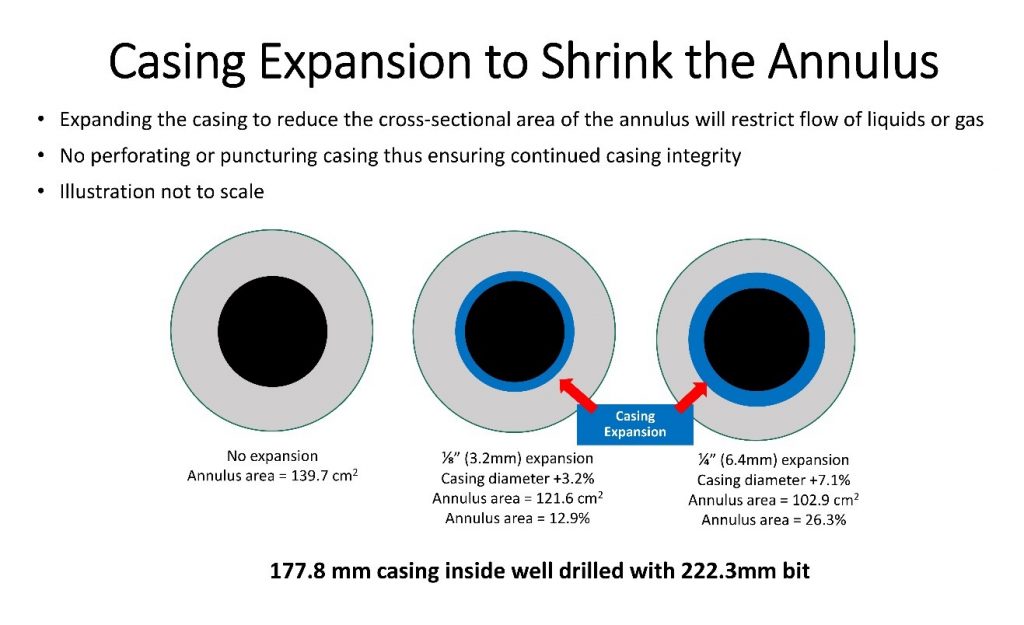
This is an illustration of 7” casing inside a well drilled with an 8 ¾” bit. If the casing diameter is increased to 7 ⅛”, the cross-sectional area is reduced by 12.9%. Further expansion to 7 ¼” reduces the cross-sectional area by 26.3%.
The amount by which casing can be expanded depends on wellbore conditions. These are factor of the existence of cement, cement quality, and the resistance encountered by the material on the inside diameter of annulus. In open hole this would be the compressive strength of the formation. In cased hole this would be the distance between the outside of the casing being expanded and the next string of casing.
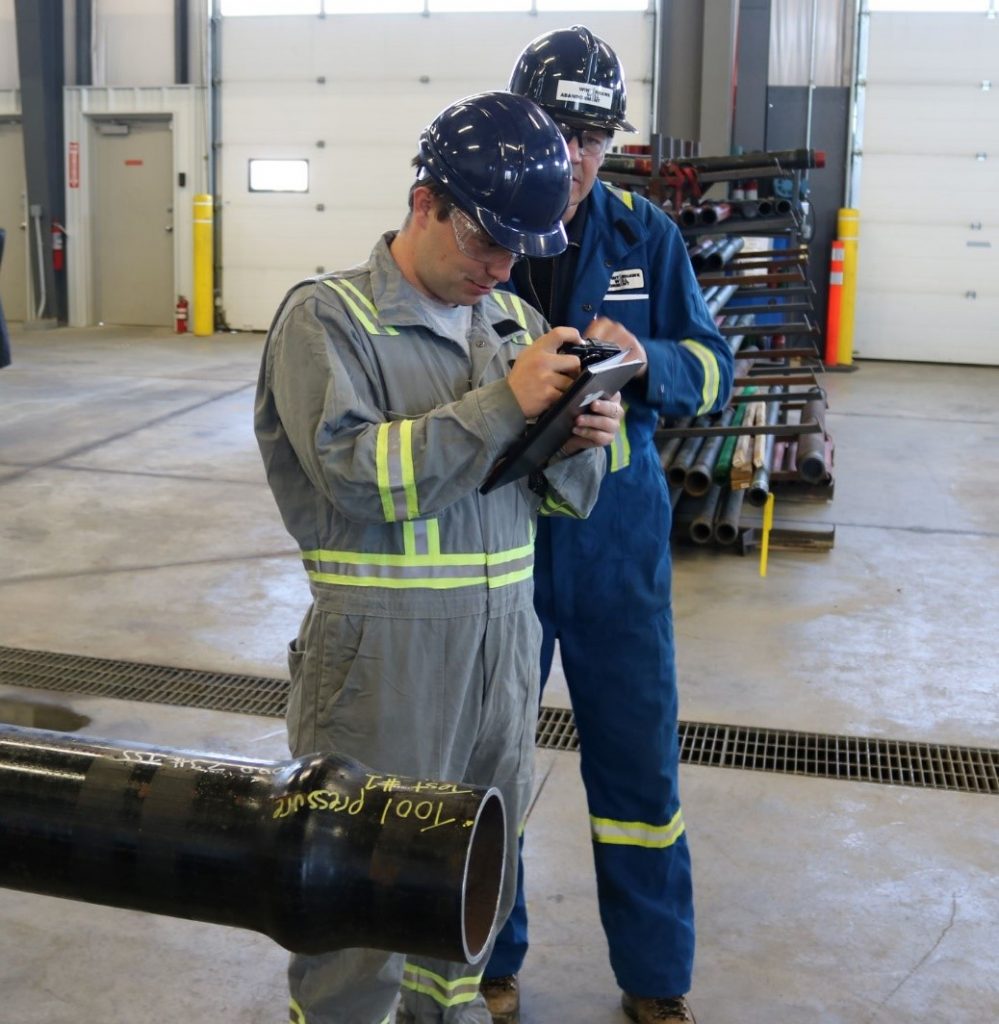
On surface, the CET can significantly expand casing. In this shop test using 7” 23# J55 casing, the tool can easily increase the diameter to 8 ½”. In gauge open hole drilled with an 8 ¾” bit, this would be close to 100% closure.
Post-expansion multi-finger caliper (MFC) logs have proven that in certain conditions, significant expansions can be achieved even in intervals where cement bond logs reveal the existence of cement. The following illustration is an MFC log of this same casing using a dual-element CET that was set five times in a single run.
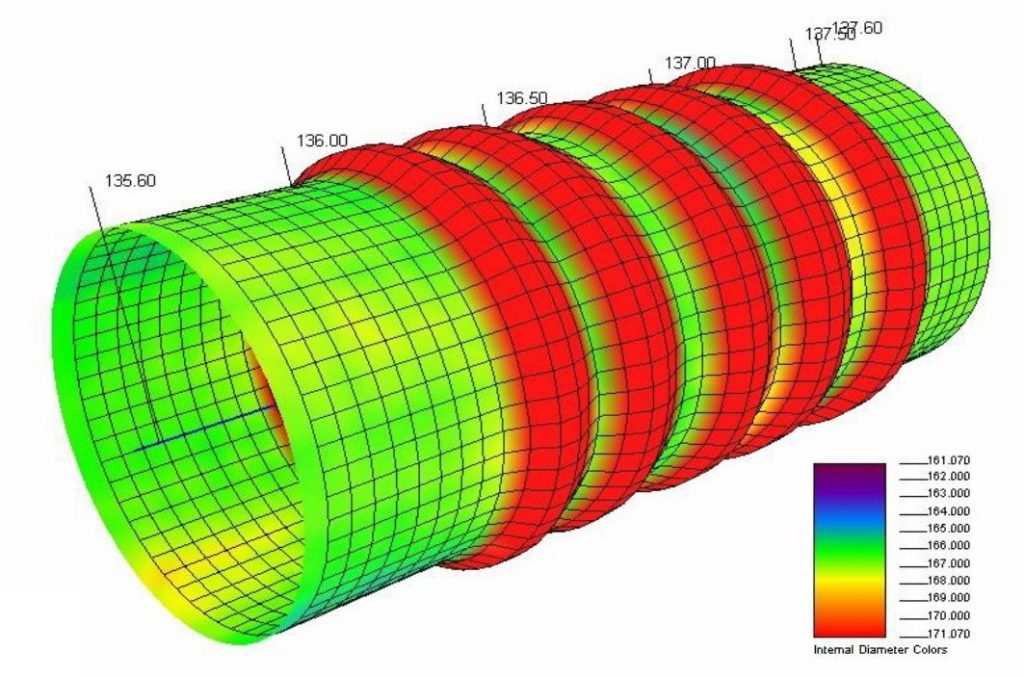
In this case the MFC revealed that the greatest expansion increased the internal diameter (hence the external diameter) by 1.25”, making the casing 8 ¼” OD. The smallest achieved over 1.125”, making the casing 8 ⅛” OD.
This would materially change the behavior of the annulus at that interval if the remediation procedures required either a restriction to reduce or stop the flow of gas or fluid, or a suitable barrier for the containing the injection of a sealing or re-sealing material such as cement.
Winterhawk had identified three applications for using the CET in wellbore annular remedial operations. Once the industry understands the purpose and versatility of the casing expansion process, many more applications will surely be conceived in the future.
REMEDIAL CEMENTING IN WELLBORES WITHOUT CEMENT TO SURFACE
For wells drilled without cement to surface, to secure a reclamation certificate in certain jurisdictions the operator must demonstrate to regulators potential future contamination of near-surface zones such as aquifer or permeable intervals has been mitigated by sealing with cement. Called remedial cementing, this is a common procedure whereby the casing is perforated at an appropriate depth and a cement squeeze is conducted. Ideally this will result in cement returns to surface.
Winterhawk believes the CET would a useful contribution to this process by providing a lower barrier to cement flow such that most or all of the cement will travel upwards to achieve its desired purpose.
Because there exists no cement in the annulus, the CET should provide significant expansion thus achieving its intended purpose.

CASING EXPANSION TO REDUCE OR ELIMINATE INTERZONAL COMMUNICATION
A major challenge for production engineers is interzonal communication in the annulus that impairs production such as water or gas. Depending on the distance between the source and the perforations, using conventional methods such as perforating and squeezing can make the problem worse.
Winterhawk believe the CET could provide an elegant, low-cost, non-damaging solution to either reduce or eliminate interzonal communication in the annulus.

IMPROVED CEMENT SQUEEZE
In wellbores with severe vent flow issues such as channeling or very poor cement, the cement squeeze is often the best option for secure and permanent shutoff.
However, getting the cement to travel to and set in the exact desired interval remains a challenge.
Winterhawk believes the CET can contribute to more successful cement squeezes by providing barriers above, below, or on both sides of the target interval.

Casing expansion as a wellbore remediation tool is in its infancy. There are two components of making this unique procedure a useful component of future downhole operations.
The first is the behavior of the CET inside the casing. This has materially advanced in the past two years. After scores of shop tests in a powerful vertical press and shop tests on surface – and now dozens of expansions and release in wellbores (both the tool for 7” or 177.8mm casing and 5 ½” or 139.7mm casing) – Winterhawk is now confident that the CET is dependable and predictable in a variety of wellbore conditions.
The second is what to do with it and where in the wellbore it will be most effective.
We at Winterhawk look forward to discussing with operators how casing expansion can improve and reduce the cost of a variety of wellbore remediation procedures.
For further information go to www.winterhawkwellabandonment.ca
Share This:






















INSIGHT: Canada’s Economy Falling Behind Despite Misleading Headlines – Fraser Insitute