


 CDN NEWS |
  US NEWS







By Javier Blas
On Wall Street, money speaks louder than words. The way Big Oil is currently allocating dollars suggests the supermajors are, quietly, preparing for leaner times. It’s the right approach: Oil is a cyclical business, and lower prices are always around the corner. This time, they may be even closer.
In many ways, the downturn is already here — 150-plus days since the Iran war started, West Texas Intermediate crude is hovering at about $75 a barrel, down 35% from its conflict peak. It may sound hyperbolic with the Middle East conflict still raging but, increasingly, the risk isn’t triple-digit oil prices but the possibility of $50-a-barrel, at least for a short period, in 2027 or 2028.
In public, oil executives continue to warn about the risk of higher prices if the Strait of Hormuz remains closed. They aren’t wrong. Little is said, however, about the downside if the waterway opens. The clues to what they’re really anticipating can be found in their profit statements and, even better, on their balance sheets.
Clearly, the sector could afford to give investors even more money in the form of share buybacks or larger dividends if it wanted to. The April-June period was a time of bonanza, with sky-high oil prices. Together, ExxonMobil Holdings Corp., Chevron Corp., Shell Plc, TotalEnergies SE, and BP Plc reported net income of more than $47 billion, up more than 160% from a year earlier.
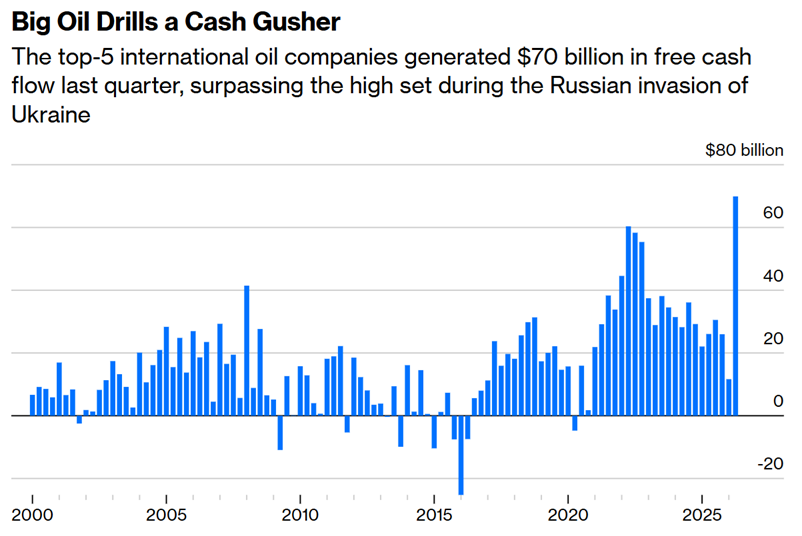
Their free cash flow — the measure between cash generation and expenses — is even more striking. The top five international oil companies generated nearly $70 billion during the second quarter, the most ever, surpassing a peak of $60 billion during the same period in 2022 after Russia invaded Ukraine, according to data compiled by Bloomberg. Yet, rather than returning that huge war windfall to shareholders, the oil majors focused on paying down debt and restructuring operations.



Source: Bloomberg
Chevron, for example, reduced its leverage by about $8 billion – the most in a quarter ever. Exxon also slashed its debt. BP, which is cutting costs after years of bad investments, told staff the industry faced “potential oversupply and lower oil and gas prices” in the coming months. Meanwhile, Shell and Total have kept their share buybacks below the level of a year ago, even though oil and refining margins are much higher now than they were in mid-2025.
Setting aside money is also a good PR exercise. President Donald Trump has blasted both Exxon and Chevron for “making too much money.” Politically, the oil majors can defend themselves better from such attacks if they can show they’re prudently reducing indebtedness than if they were announcing multi-billion dollar share repurchases and special dividends.
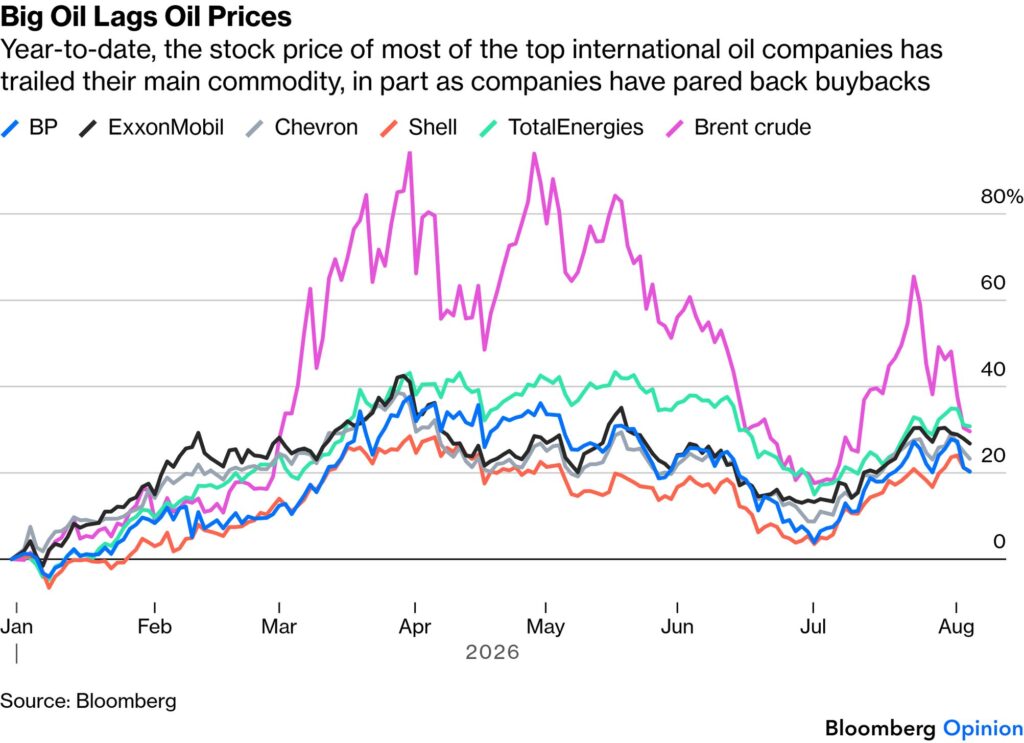
The sector is paying a price, though, for its newfound financial discipline. Of all the majors, only TotalEnergies has managed to beat the main commodity they pump. Year-to-date, oil is up about 32%, while the share prices of most of the large energy companies lag with gains of 20% to 25%. But today’s headwind can become tomorrow’s tailwind.
Big Oil is finally doing something it hasn’t being very good at in the past: acting counter-cyclically, saving money during the boom to spend it during a bust. The industry still doesn’t have many allies on Wall Street, and even fewer in the greener financial hubs of Europe. In the climate-crisis era, Fossil Fuels Inc. needs to shower shareholders with money just to keep investors — particularly the large generalists — onside, and that’s even more pressing when commodity prices drop.
By putting cash aside today, the oil majors are building war chests to keep dividends growing, and perhaps even buybacks, when energy prices inevitably fall. It makes financial sense, too; it’s better to repurchase shares when their price is low – as undoubtedly would happen when the cycle turns — than now, when stocks are pricy and trading close to or even at record highs. Perhaps that’s what Sinead Gorman, the chief financial officer at Shell, had in mind when she told a Wall Street analyst that she preferred to do buybacks “when the time is right” — an approach I heard echoed, with some nuances, by many other executives in the industry during earnings season.
If, for once, Big Oil convinces investors that it can deliver strong distributions throughout the cycle, then maybe — just maybe — it can lure back the many shareholders that have abandoned the industry for its boom-and-bust mentality.
Share This:



















