


 CDN NEWS |
  US NEWS







By Fabiola Zerpa, Mie Dahl, and Peter Millard
The US-backed venture will struggle to reach its production goal, experts say.
The success of the Trump administration’s blockbuster Venezuela oil deal is riding on fields that are aging, degraded or expensive to access.
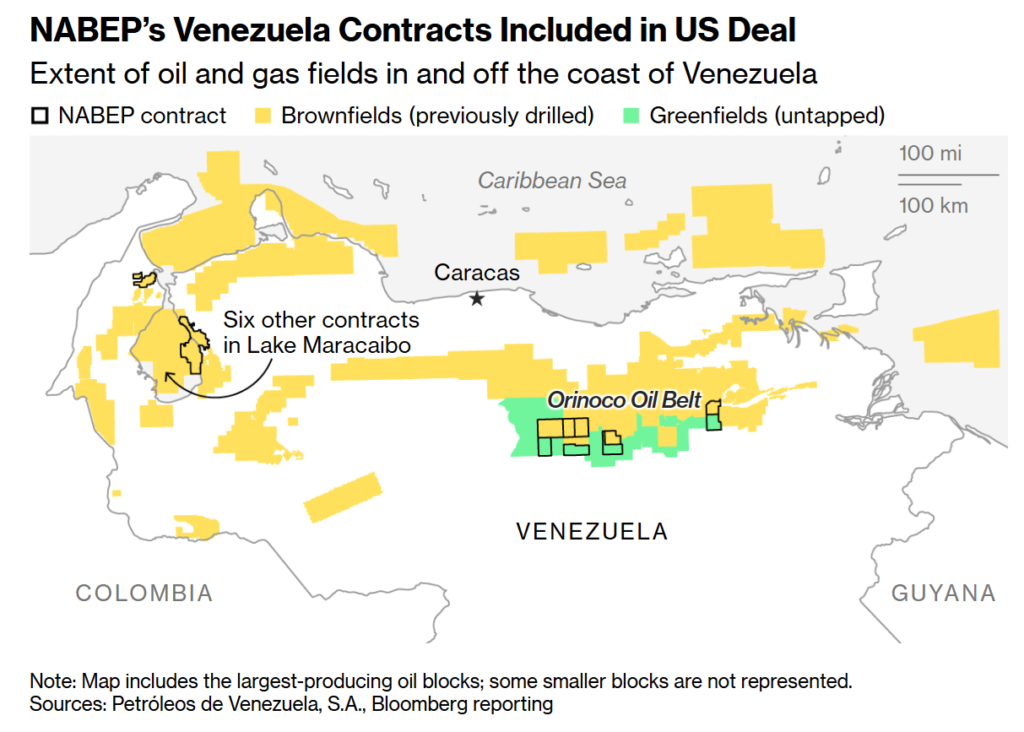
The agreement last month with Alejandro Betancourt, an energy mogul with a controversial history, includes 17 fields and gives the US majority control of a huge amount of Venezuela’s oil wealth. Betancourt’s North American Blue Energy Partners has said it aims to more than double crude production, adding about 300,000 barrels a day in just over two years. But conversations with more than a dozen industry executives and analysts suggest that the company will struggle to reach that goal. The names of the 17 fields were identified by Bloomberg News but haven’t been officially listed.
A few legacy sites in the Lake Maracaibo region in northwestern Venezuela, the cradle of the country’s oil industry, have the best chance of rapid output gains. The rest are in the Orinoco Belt in central-eastern Venezuela, an area that’s difficult to drill because it’s remote and produces heavy, tar-like crude that must be extracted using specialized equipment.
Betancourt’s company is under pressure to deliver a quick boost to help calm oil markets upended by the Iran war, and generate enough revenue to win support on the ground. The deal with the US faces blowback from both sides of the political aisle in Venezuela, with some describing it as an abdication of sovereignty. But the Trump administration is betting that the pact will spur other producers to plow money into oil reserves that are now firmly within the US sphere of influence.
Read more: Trump’s Oil Deal Riles Both Sides of Venezuelan Politics
“Venezuelan oil production could help diversify away from other geopolitical hotspots, but growth will likely be too gradual to be the only solution given the extent of the Middle East supply disruptions,” Luisa Palacios, a senior research scholar at Columbia’s Center on Global Energy Policy, said in an interview.
White House spokesperson Taylor Rogers said the Trump-Venezuela oil pact “will greatly benefit both the United States and Venezuela for years to come. This historic deal marks a major step toward stabilizing Venezuela’s economy after years of hyperinflation and almost no new investment, while more than doubling the United States’ oil reserves.”
Among the 17 fields, a handful near Lake Maracaibo — the region that helped turn Venezuela into one of the world’s biggest oil producers and exporters by the middle of the 20th century — could add roughly 200,000 barrels a day in about two years without requiring massive investments, according to industry estimates. That’s still shy of NABEP’s target, and even some of the most promising assets will require rehabilitation after decades of neglect.
The company’s track record is limited, but it has experience in partially restoring output in Venezuela by repairing existing infrastructure, according to people familiar with the matter. Betancourt, who amassed his fortune in power turbines and oil during former President Hugo Chávez’s rule, has seen his influence grow despite repeated legal controversies inside and outside Venezuela.
“NABEP has a proven ability to operate successfully in challenging conditions,” a spokesperson for the company said in response to questions. “Our deep on-the-ground expertise and demonstrated ability to scale production rapidly in Venezuela give us confidence that we will meet our production targets.”
The company has said it expects to fund its planned 300,000-barrel-a-day production increase with internal cash flow and the deal with the US government “only accelerates the trajectory.” NABEP said earlier this month its growth has been financed by significant free cash flow from its Venezuelan wells.
NABEP is a proven operator that knows how to scale up production and by the end of November, there will be at-cost oil flowing to the market to help bring down gasoline prices in the US, according to a White House official.
Read more: Trump’s Venezuela Fixer Is Promoting ‘America First’ Oil Deals
The Petrozamora project in Maracaibo, which encompasses six fields, was producing around 96,000 barrels a day before the agreement, according to production data reviewed by Bloomberg. That’s down from 225,000 barrels a day in 2008 before Venezuela’s industry began to collapse under mismanagement, corruption and sanctions.



In Maracaibo, the Bachaquero, Lagunillas and Ceuta fields, along with Lago Cinco and Lagunillas Lago, could together add nearly 200,000 barrels a day over the next 18 to 24 months, Francisco Monaldi, director of Latin American energy policy at Rice University’s Baker Institute for Public Policy in Houston, said in an interview. Some additional barrels could come from existing operations in the Orinoco belt, Monaldi said.
Monaldi added that roughly half of that potential comes from Lago Cinco and Lagunillas Lago, two shallow-water fields currently producing very little.
But the US and Betancourt would be taking on enormous environmental liabilities at properties previously operated by China Concord Petroleum Co., he said. A company with that name was sanctioned by the US in 2019 for alleged involvement in Iranian oil transactions.
“The lake is a massive environmental disaster,” Monaldi said. “Projects in the lake produce very little because the infrastructure of the lake is completely destroyed.”
Other sites in the Maracaibo area are aging fields with declining production. Many of them would need substantial investment in technology to stimulate reservoirs that, in some cases, were first tapped a century ago, said Juan Szabo, a former vice president at state oil producer Petróleos de Venezuela SA’s exploration and production division.
The uneven quality of the package partly reflects how the assets became available. Some had been controlled by operators that failed to maintain production or whose contracts are being unwound as President Delcy Rodríguez reshuffles deals made under her predecessor Nicolás Maduro, according to people familiar with the process who asked not to be identified.
Read more: Trump’s Big Venezuela Deal Leaves US Oil Industry Blindsided
Inflated Reserves?
When the Trump administration announced the deal, it said the pact gave the US majority control of 65 billion barrels of proven oil reserves. But that number appears inflated, since most of the reserves are an extra-heavy grade of oil that is difficult to pump, Szabo said.
Like Monaldi, Szabo said four to five of the most promising fields in the Maracaibo area offer the best chance for quick production gains. The areas in the Orinoco would require billions of dollars in investments, and some are so remote that the economics could be a challenge, he said.
A lack of infrastructure, extremely heavy crude in many areas, high electricity costs and potential contract disputes are the key risks to the venture, said Szabo. NABEP’s plans to double output by 2028 isn’t achievable, he added.
“Reaching 500,000 barrels per day in two years is impossible, even if they subcontract one or several of the 17 blocks,” Szabo said. About 70,000 extra barrels a day over that time frame, bringing the total to 270,000 a day, is a more realistic target, he added. NABEP didn’t directly respond to questions about the reserves estimate.
Still, Paula Henao, Venezuela’s hydrocarbons minister, expressed optimism about the country’s future crude output in an interview on Venezuelan television earlier this month. She sees the country’s overall oil production rising to 1.4 million barrels a day by the end of this year, up from about 1.2 million as of August. Some other observers are also bullish.
Venezuela could reach 3 million barrels a day in 2030 as long as electrical infrastructure keeps pace with the needs of the oil industry, according to Oswaldo Felizzola, an independent energy expert and professor at the International Center for Energy and Environment at IESA, a Caracas-based business school. Radhika Bansal, a senior vice president at consultancy Rystad Energy, said up to 450,000 barrels a day in incremental production over the next several years is possible from NABEP’s projects with existing infrastructure. It will take until the 2030s for unbuilt projects in the Orinoco to start producing, she said.
But some oil technologies, like using steam and natural gas to coax crude from depleted reservoirs, are not widespread in Venezuela.
International oil service providers like SLB Ltd. are among the first movers looking to capitalize on the developments in Venezuela, though it remains to be seen how fast NABEP can deploy their expertise. While the Trump administration is sending a “message of certainty” to the market with the US-Venezuela deal and oil operators are interested in sending technical teams to the South American country, much remains uncertain, Adrian Lara, an analyst at Wood Mackenzie Ltd., said in an interview.
“Information is scarce,” Lara said. “The new investment the project will inject remains unclear.”
— With assistance from Jennifer A Dlouhy
Share This:



















