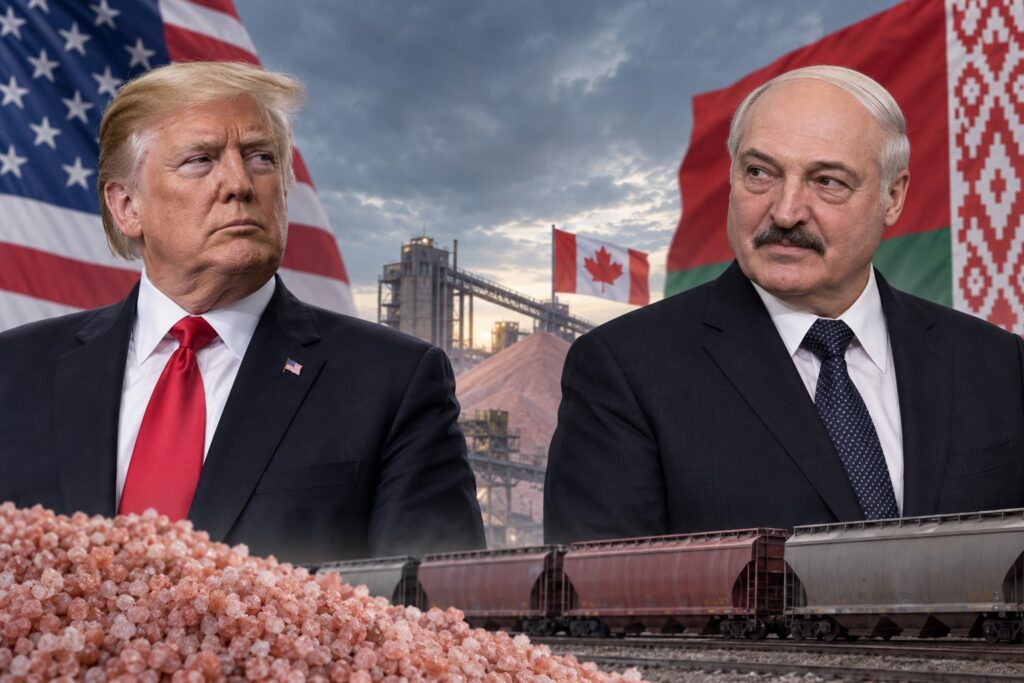
Belarusian leader Alexander Lukashenko says his country has little uncommitted potash available, complicating Trump’s attempt to replace lower-cost Canadian supplies.
U.S. President Donald Trump’s latest attempt to reduce America’s reliance on Canadian resources has encountered an unexpected obstacle: Belarus may not have enough potash available to deliver the “massive” supply agreement Trump is promoting.
Trump announced that Washington was working on a major agreement to purchase Belarusian potash for substantially less than the United States currently pays Canada.
Get the Latest Canadian Focused Energy News Delivered to You! It's FREE: Quick Sign-Up Here
“The United States is working on a massive Deal with respect to the purchase of Potash from Belarus,” Trump wrote on Truth Social, adding that lower prices would be “very good news for our Farmers and Ranchers.”
However, Belarusian President Alexander Lukashenko appeared to undercut Trump’s announcement before negotiations had produced a firm agreement.
Lukashenko said Belarus had successfully redirected much of its potash production toward eastern markets after Western sanctions restricted its traditional export routes. As a result, the country’s available production is already committed to existing customers.
“We simply don’t have the volume. It’s all under contract,” Lukashenko said, according to reports citing his office.
The statement was not a formal rejection of trade with the United States. Belarus recently resumed some potash sales to American customers following the easing of U.S. sanctions. Nevertheless, Lukashenko’s comments raise serious questions about whether Belarus can provide enough additional supply to replace Canadian imports or deliver the steep price reductions Trump has promised.
Canada dominates the U.S. potash market
Potash is a potassium-rich mineral primarily used in fertilizer. It improves crop yields, water retention, disease resistance and overall plant quality, making it essential to American corn, soybean, wheat and other crop production.
Canada—and particularly Saskatchewan—possesses an enormous logistical advantage in serving American farmers.
Saskatchewan reports that it supplies approximately 86.9 per cent of U.S. potash imports. The province accounted for about one-third of global potash production in recent years, while its established rail network can move fertilizer directly to agricultural customers throughout the United States.
By comparison, Belarus is landlocked and has lost access to its former primary export route through Lithuania’s port of Klaipeda. Belarusian potash destined for North America would likely have to travel through Russia and then be shipped across the Atlantic, adding transportation, financing and insurance costs.
Reuters reported that sanctions and the closure of the Lithuanian route have made Belarusian potash substantially more difficult and expensive to move to the United States.
That logistical reality prompted Saskatchewan Premier Scott Moe to challenge Trump’s price argument.
“Does anyone believe Belarusian blood potash shipped through Russia is going to be more affordable, more sustainable or more ethical than potash shipped from Saskatchewan—right here in North America?” Moe wrote on social media.
Analysts question Trump’s price claim
Fertilizer-market analysts are also skeptical that Belarusian imports would meaningfully reduce costs for U.S. farmers.
StoneX analyst Josh Linville told Reuters that the United States does not currently face a significant shortage of potash. Instead, the more pressing fertilizer concerns involve nitrogen and phosphate supplies.
“We have more than enough to go around,” Linville said of potash. “It is phosphate and nitrogen that we need help with.”
Because potash has a relatively low value compared with its weight and shipping volume, moving it over long distances can quickly erase any apparent price advantage at the mine. Even if Lithuania reopened its port to Belarusian exports, Linville questioned whether transatlantic shipments could compete economically with fertilizer delivered by rail from Saskatchewan.
A geopolitical trade-off
Trump’s proposal also carries geopolitical implications.
The European Union continues to prohibit imports of Belarusian potash as part of sanctions imposed over Lukashenko’s domestic repression and his government’s support for Russia’s war against Ukraine. Those restrictions have been extended until February 2027.
The United States has taken a different approach, gradually easing certain sanctions in exchange for Belarus releasing political prisoners. Washington’s renewed interest in Belarusian potash could provide Minsk with additional export revenue while weakening the coordinated Western sanctions regime.
Lukashenko has also asked Washington to release more than US$40 million in Belarusian money currently frozen in the American banking system, suggesting that any broader commercial arrangement may involve more than the price of fertilizer.
Canadian supply remains difficult to replace
Trump’s announcement may give Washington another bargaining tool in its widening trade dispute with Canada. But geography, infrastructure and contracted Belarusian production make replacing Saskatchewan potash considerably more difficult than a social-media announcement suggests.
Canada offers the United States a large, reliable and nearby supply delivered through an integrated North American rail network. Belarus offers another major source of potash—but one constrained by sanctions, limited export routes, higher transportation costs and existing commitments to Asian and other customers.
The apparent contradiction between Trump’s “massive deal” and Lukashenko’s warning that Belarus has no substantial uncommitted supply illustrates the difference between political leverage and commercial reality.
For American farmers, the central question is not whether Belarus possesses potash underground. It unquestionably does. The question is whether Belarus can deliver enough fertilizer to the U.S. Midwest—reliably and at a lower landed cost than Saskatchewan.
For now, the evidence suggests Canadian potash will be much harder to replace than Trump’s announcement implies.
 CDN NEWS |
  US NEWS









 These translations are done via Google Translate






















GRETCHEN WHITMER IS AT IT AGAIN: The Michigan Governor has Threatened to Shut Down Line 5 “Within Months” – Jim Warren