


 CDN NEWS |
  US NEWS







By Yogi Schulz
Large artificial intelligence (AI) data centre proposals face considerable opposition in many communities. The large scale of these data centres, the newness of the concept, AI fears, and rapidly spreading misinformation are raising apprehension.
AI data centre proponents are realizing they need to communicate the characteristics of their proposals in much more detail and patiently address various concerns, real and imagined, to build community support.
As is often the case with industrial development proposals, minor issues and temporary disruptions receive far more attention than significant, ongoing economic benefits. This article explores the issues further: AI Data Centre Opposition Elsewhere Creates Opportunity for Alberta.
In addressing these topics, AI data centre proponents’ goal of minimizing operating costs aligns well with communities’ goal of avoiding cost increases and minimizing adverse impacts.
AI data centre proponents and the communities that will benefit and may be impacted can dramatically reduce potential risks by addressing the following topics.
Reduce water consumption
Communities are often concerned that data centres will consume large volumes of water, which will adversely impact them by:
- Leading to shortages.
- Increasing the price of water.
Data centre water use is small nationally, but it can cause localized problems in dry regions. The best way to address this concern is to require data centres to recycle water. Most designers already do this to reduce their operating costs.
Data centres widely use closed-loop and evaporative systems for their water efficiency. This technology addresses concerns about high water consumption in some locations. However, water cooling technologies face several challenges, including:
- High energy consumption.
- High maintenance costs.
- Risk of downtime.
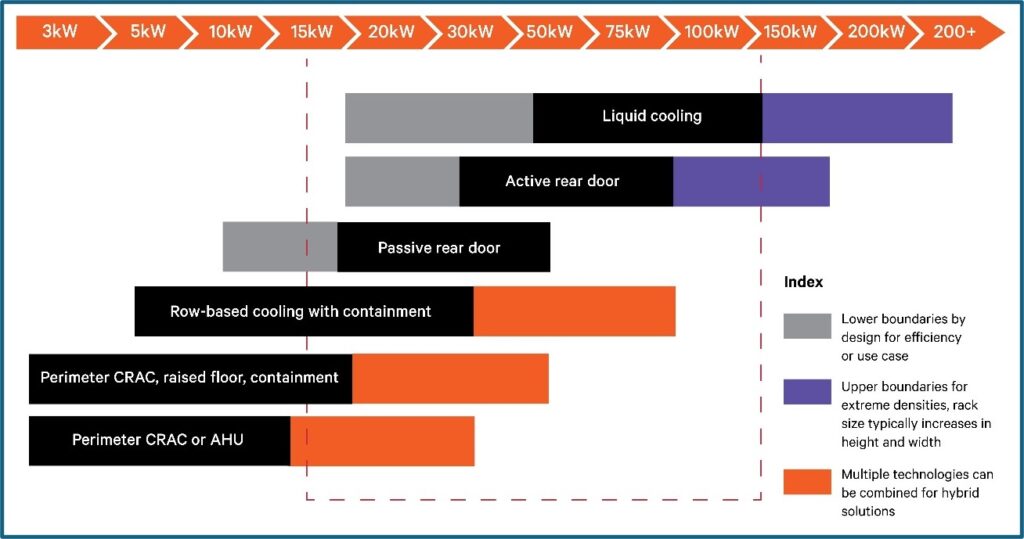
Instead, newer, larger data centers are being built with liquid cooling technologies such as direct-to-chip and immersion cooling because they remove heat better at high server density and can handle large-scale cooling requirements.
The diagram below summarizes where various cooling technologies are most effective relative to the data centre size, measured in kW of power consumption.
Source: Liquid cooling versus air cooling: How thermal management systems are evolving, Vertiv
Generate dedicated electricity
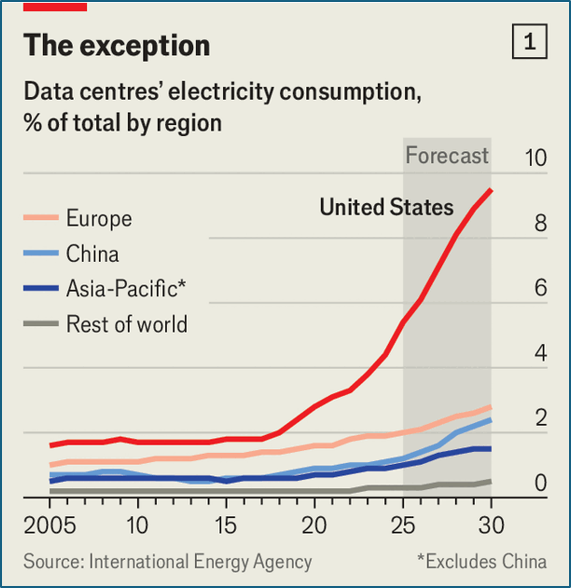
Communities understand that data centres will consume large amounts of electricity, as shown on the chart below, which could adversely impact them by:
- Increasing the price of electricity due to competition driving up the price in the absence of more capacity.
- Increasing the price of electricity to pay for new electricity generation capacity and distribution infrastructure.
- Triggering a price increase for natural gas.
- Leading to more unplanned outages.
The best way to address this concern is to require data centres to:
- Generate enough electricity to meet their consumption.
- Operate enough stand-by generation to minimize the frequency and impact of unplanned outages.
Unfortunately, some jurisdictions have not insisted on these conditions, leading to friction with residents.
Source: The data-centre backlash is brewing in America, The Economist, October 30, 2025
Pay for electricity distribution grid upgrade
Communities understand that the large amounts of electricity that data centres will consume will require an electricity distribution grid upgrade. The upgrade may adversely impact them if they end up paying part of it. This concern has also unexpectedly revealed how regulators in multiple jurisdictions have insisted utilities underinvest in the grid for many years to keep consumer prices low.
The best way to address this concern is for data centres to pay for required grid upgrades to maintain stability. At the same time, communities should upgrade their grids to improve reliability.
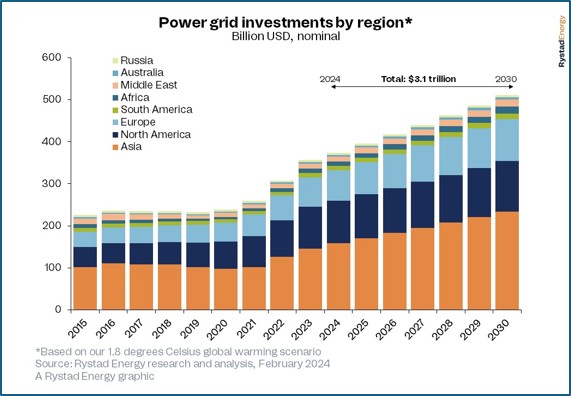
The chart below forecasts an acceleration in electricity grid capital investments due to:
- Increased per capita electricity consumption.
- The energy transition.
- Data centre electricity consumption, most importantly for AI, bitcoin mining, enterprise systems and content streaming.
- Upgrades to improve grid reliability.
Unfortunately, some jurisdictions have not insisted on these conditions, leading to friction with residents.
Source: Enable or inhibit: Power grids, key to the energy transition, require $3.1 trillion in investments by 2030, Rystad Energy, February 2024
Dampen increased noise
Communities are concerned that data centres generate ongoing noise that will adversely affect them by raising neighbourhood noise levels.



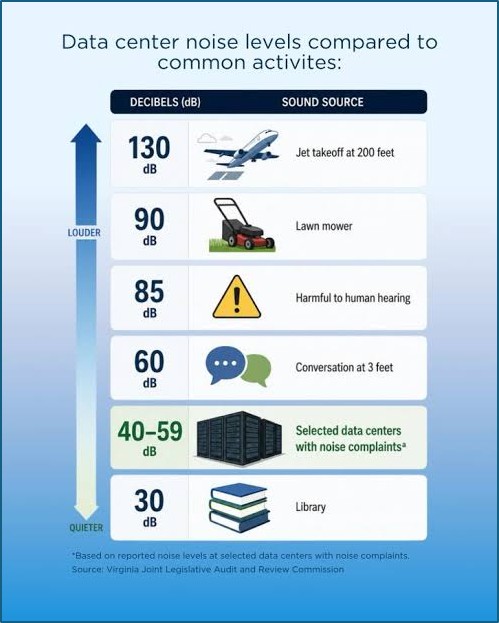
Data centres produce no more noise than other industrial facilities. Noise at the perimeter ranges from 40 to 59 dBA. That’s comparable to a commercial HVAC unit or a running dishwasher. The chart below compares noise levels at data centres to other activities.
Data centre proponents can further reduce noise by installing noise-dampening equipment.
Source: Data Centers in Virginia, Joint Legislative Audit and Review Commission, 2024
Upgrade local infrastructure
Communities are concerned that data centres will generate significant traffic and perhaps a population increase, which will adversely impact them by increasing taxes to pay for:
- More road capacity to handle more traffic.
- Expanded utilities to support additional housing.
- Additional school construction to handle increased enrolment.
Data centres and their employees pay the following taxes, just like other industrial facilities and citizens:
- Property tax.
- Sales tax – except in Alberta.
- Income tax.
Communities often do not recognize that new tax revenue from data centres will more than cover the cost of infrastructure expansion.
Contain increased GHG emissions
Some communities worry that data centres will generate additional GHG emissions from increased electricity generation, which could undermine efforts to reduce air pollution and advance the energy transition.
Most data centres produce modest GHG emissions, similar to other natural gas-fired electricity generation stations. Annual direct emissions for 1,000 megawatts (MW) of electricity generation capacity, a common size for a large data centre, are 3.0 to 3.6 million tonnes. For a size comparison, the Enmax Shepard Energy Centre produces 860 MW of electricity and similar emissions. That’s enough electricity to meet almost half of Calgary’s current needs.
To further reduce GHG emissions, some data centres are considering renewable electricity generation plus batteries to provide 24/7 continuous power.
Choose a remote location
Some data centre developers have proposed data centres close to suburban neighbourhoods. That has irritated residents.
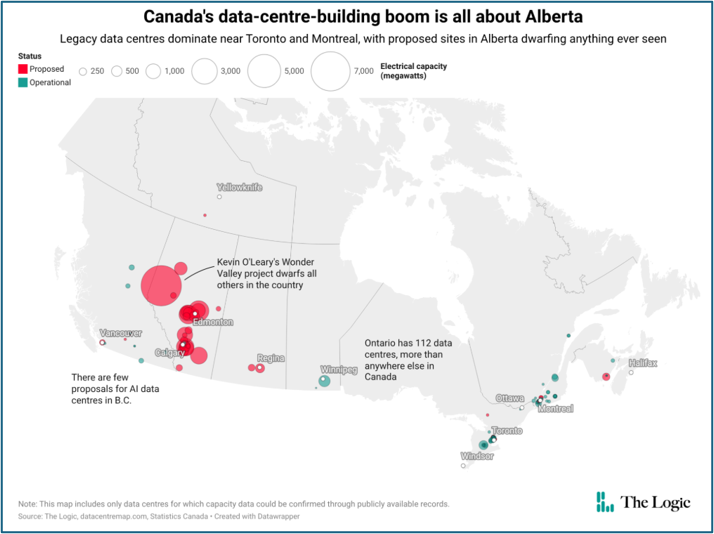
Data centres are best located in industrial or rural areas. Those locations lower land costs for proponents and reduce concerns about consuming prime land.
The chart below illustrates the distribution of data centres by size in Canada. To view a more detailed map, click here.
Source: We found every data centre in Canada, The Logic
Emphasize economic benefits
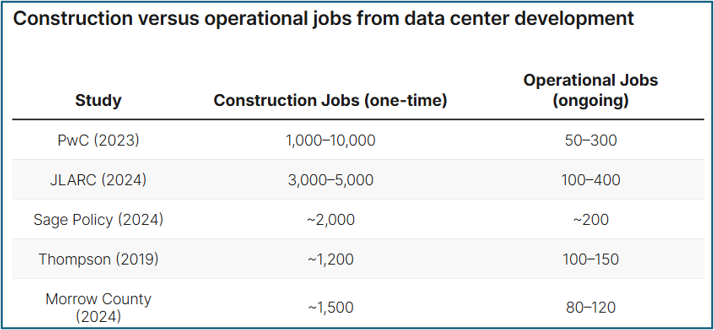
Some communities, especially rural ones, are skeptical of data centre economic benefits. Once construction is complete, large data centres employ about 100 to 400 permanent workers, as shown in the table below. The employment range depends on data centre size.
The best way to address this concern is to remind citizens that their communities gain employment, tax revenue and infrastructure investments from data centres.
Because Alberta offers many advantages for businesses, it’s reasonable to expect data centre owners and others to locate more related operations in Alberta’s urban centres over time.
Source: Turning the data center boom into long-term, local prosperity, The Brookings Institution, 2026
Respond to AI skepticism
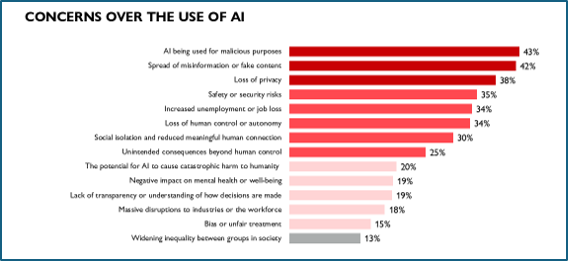
Some communities view these data centres as symbols of rushed, poorly regulated AI expansion that will bring more societal risks than benefits. People concerned about AI risks may forget that data centres also support government and business systems our society depends on. The chart below summarizes Canadians’ concerns.
Most data centre owners and operators have limited influence over the pace or direction of AI development. The best way to address these concerns is to encourage citizens to lobby national governments for AI regulations.
Source: Optimism Meets Uncertainty and even Fear in Canada’s AI Landscape, Abacus Data, July 25, 2025
Conclusion
To ease community concerns and win support, proponents are communicating more and designing data centres as described above. Governments are responding by publishing guidelines. Canada’s Responsible Data Centre Development Principles is one example.
Share This:




















DATA CENTRE INSIGHT: Best Practices for AI Data Centre Design and Community Support – Yogi Schulz