


 CDN NEWS |
  US NEWS







By Yogi Schulz
Opposition to AI data centres is growing in many US states and a few Canadian provinces. Sadly, the concerns are mostly based on misunderstanding and misinformation. This unfortunate situation increases Alberta’s opportunity to attract the economic benefits AI data centres represent, perhaps even beyond the $100 billion goal that the province has set. All Albertans should be excited about this opportunity.
Public opposition to data centres is surging due to concerns over higher consumer electricity rates, massive water consumption for cooling, and persistent noise pollution. These issues are typically overblown or entirely imagined.
Growing opposition to AI data centres
By one estimate, Q1 2026 marked an unprecedented surge in blocked and delayed projects, instigated by many local groups, as illustrated on the chart below. At least 75 US data center projects worth approximately $130 billion were blocked or delayed in a single quarter — roughly matching the scale of all of 2025 in just three months.
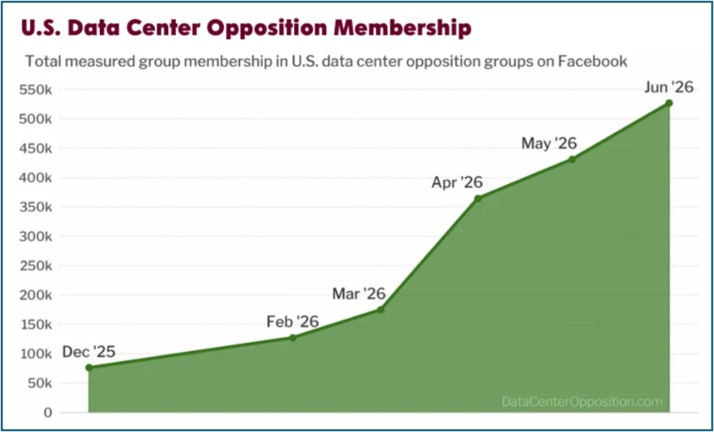
Source: Map Shows Huge Surge in Data Center Opposition Groups Across 40 States, Newsweek, July 09, 2026
Alberta’s opportunity
AI data centre developers face enormous schedule pressure to complete these multi-billion-dollar facilities as quickly as possible to compete in the skyrocketing AI services market. Noisy demonstrations by opponents slow the permitting process, as politicians and regulators attempt to address the concerns.
If developers can find suitable jurisdictions for their facilities without local opposition, such as Alberta, they’ll gladly locate there. Data centres aren’t as tied to specific local natural resources or transportation infrastructure as mining, manufacturing or distribution facilities are.



The Alberta advantage
Alberta offers many advantages for AI data centre developers compared to other regions. The long list of advantages includes:
- A pro-business culture.
- Abundant natural gas with a significant pipeline distribution system.
- Streamlined regulatory approvals, using Alberta’s well-defined Bring Your Own Generation (BYOG) permitting framework.
- Competitive electricity costs.
- A government focused on attracting investment.
- A cooler climate that reduces cooling costs by 20 to 30% compared to Texas.
- An extensive fibre optic telecommunications network.
- A skilled workforce for construction and operation.
- Lots of available office space at low occupancy rates.
- Significant amounts of land available at an attractive price.
- Excellent airline connections to many parts of the world.
- A time zone that works well for US companies.
An early win for the Alberta advantage occurred when Meta Platforms Inc. recently announced its $13-billion, one-gigawatt AI data centre in Sturgeon County. It’s one of the biggest private-sector technology investments in Canadian history.
The win was the result of Alberta doing the hard policy work that New York, which just instituted a one-year moratorium, and other jurisdictions have refused to do.
Addressing concerns of AI data centre opponents
The most frequently cited concerns of AI data centre opponents and the reality are as follows:
- Increase consumer electricity prices: AI data centres typically generate their own electricity for on-site consumption under Alberta’s BYOG permitting framework. That eliminates the possibility of impact on local electricity consumers.
- Consume huge volumes of water: AI data centres recycle most of their water to reduce their operating costs and conserve water. Water loss due to evaporation is not significant.
- Generate excessive noise: AI data centres produce no more noise than other industrial facilities. Noise at the perimeter ranges from 55 to 65 dBA. That’s comparable to a commercial HVAC unit or a running dishwasher.
- Increase in electricity outages: Electricity regulators expect large loads, like AI data centres, to pay for grid upgrades to prevent outages.
- Burden local infrastructure such as roads: New tax revenue more than covers the cost of infrastructure expansion.
- Increase GHG emissions: AI data centres produce the same modest GHG emissions as other natural gas-fired electricity generation stations.
- Drive up the cost of housing: AI data centres operate with only 50 to 150 employees. The large teams that develop related software and support customers are located elsewhere.
- Consume valuable land: AI data centres are best located in industrial or rural areas. Those locations lower land costs for proponents and reduce concerns about prime land consumption.
Local opposition to data centres, often most visible during land-use fights, may not be about these concerns at all. The opposition concerns may be a proxy for broader public anxiety about AI’s effects on jobs and daily life, given that AI is a new phenomenon that has rapidly come to dominate discourse in our society.
Alberta’s competitors
It would be foolish for Alberta to discount the following competitors for this AI data centre opportunity:
- US private companies: AI data centre permitting may be slowing down in the US. However, the US is by far the world leader by hosting roughly 75% of AI compute capacity. Many companies have expressed ambitions to expand.
- US federal government: To accelerate development of AI data centres in the US and circumvent the opposition, the US federal government is working with hyperscalers and large investors to develop federal lands in Kentucky, Nevada, Ohio, and South Carolina while bypassing local permitting. The goals are to create jobs, ensure national security aspects are addressed, and advance a key technology as the US competes with rivals like China.
- China: Ranks second in AI compute capacity and advanced chips. It’s home to leading AI model developers. It’s pursuing self-reliance alongside overseas expansions in energy and AI data centres.
- United Arab Emirates (UAE): Investing heavily in gigawatt-scale AI data centres backed by Middle East abundant energy and a national strategy to lead AI adoption.
- India: Accelerating AI data centre development through state policy support, massive local digital demand, and financial incentives to build sovereign AI compute.
- South Korea and Singapore: Competing at the top of regional readiness indexes for AI data centres through private investment.
- European Union (Germany, France, UK): Launching multi-billion-euro funding initiatives to catch up on AI data centre deployment.
Conclusion
The US will continue to be a major competitor, despite opposition in various states, because the hyperscalers, Amazon Web Services (AWS), Google Cloud, Meta Platforms, and Microsoft Azure, are all headquartered there. One significant example is OpenAI’s proposal to lease a massive 10-gigawatt data center campus in southern Ohio from SoftBank. The SoftBank project is estimated to cost over $500 billion.
China will be a major competitor because of its determination to win the competition for AI leadership, enormous state resources and demonstrated talent.
Alberta needs to promote its advantages and not allow misinformation to slow permitting.
Share This:



















