


 CDN NEWS |
  US NEWS







By EnergyNow Editorial Staff
Canada is an energy-exporting powerhouse, but parts of the country remain surprisingly dependent on American crude oil, natural gas, condensate and refined fuels
EnergyNow recently examined President Donald Trump’s claim that the United States does not need Canadian energy. View that article here. The evidence in that article strongly contradicts that assertion. Canadian oil, natural gas, natural gas liquids and electricity remain deeply embedded in the American economy, particularly in the Midwest, northern border states and major refining centres.
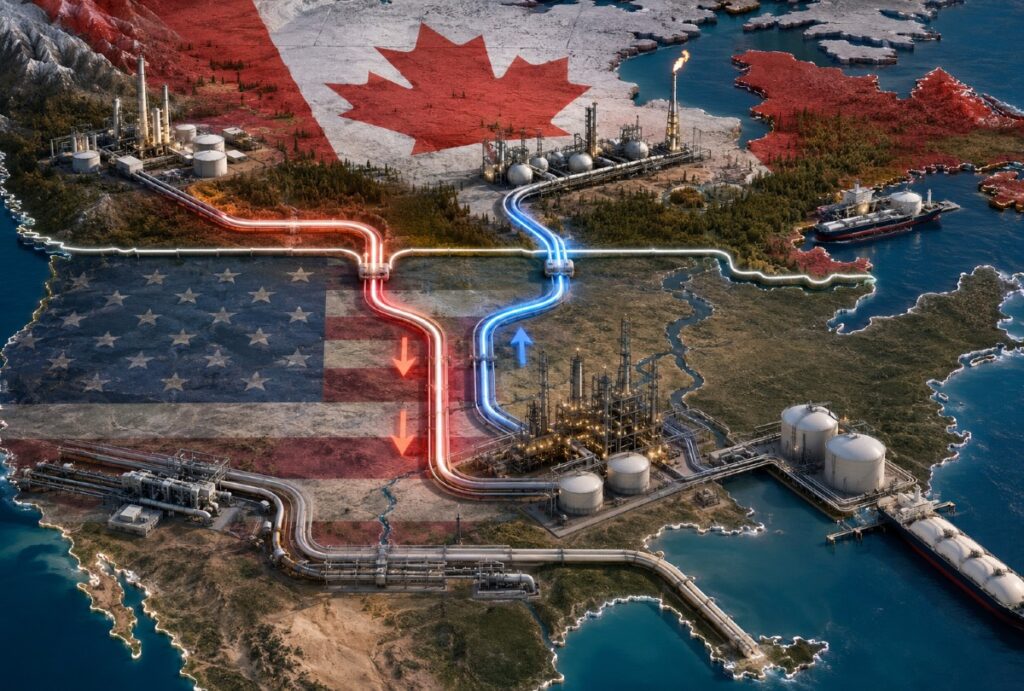
But the integrated North American energy system works in both directions.
Canada may be one of the world’s largest oil and natural gas producers, but it also imports substantial volumes of American energy. Eastern Canadian refineries buy U.S. crude oil. Ontario and Quebec consume American natural gas. Alberta imports U.S. condensate to dilute oil sands bitumen. Canadian fuel distributors purchase gasoline, diesel, jet fuel and other petroleum products from American refineries.
In some cases, Canadian crude oil is shipped to the United States, processed in American refineries and then sold back into Canada as gasoline, diesel or another finished product.
The larger lesson is not that Canada is as dependent on the United States as the United States is on Canada. It is not. Canada remains a very large net exporter of energy to its southern neighbour. The lesson is that neither country’s energy system can be understood properly by looking only at national production totals.
Energy moves according to geography, infrastructure, refinery configuration, price and transportation costs—not political borders.
Canada Imported $34.4 Billion of U.S. Hydrocarbons in 2025
Canada exported approximately $157.5 billion worth of crude oil, refined petroleum products, natural gas and natural gas liquids to the United States in 2025. However, Canada also imported approximately $34.4 billion worth of those products from the United States. All figures are in Canadian dollars.
By volume, Canada imported approximately 1.5 million barrels of oil equivalent per day of hydrocarbons from all countries in 2025. The United States supplied 83.8% of that total. Of the hydrocarbons imported from the United States, crude oil represented 30.1%, natural gas 31.1%, refined petroleum products 30.4% and natural gas liquids 8.4%.
Canada’s hydrocarbon exports to the United States were therefore worth more than four and a half times its imports from the United States. That is an important distinction: the relationship is highly integrated, but it is not numerically equal.
Nevertheless, $34.4 billion in annual imports is not a trivial amount. It demonstrates that being a major energy producer does not automatically make every region of a large country self-sufficient.
Why Does an Oil-Producing Country Import Oil?
Canada imported approximately 506,000 barrels per day of crude oil in 2025. About 75.6%, roughly 383,000 barrels per day, came from the United States. Canada spent approximately $17.8 billion on imported crude from all countries, including about $13.2 billion on U.S. crude.
The explanation is primarily geographic.
Most Canadian oil is produced in Alberta and Saskatchewan, while some of the country’s largest refineries and fuel markets are in Ontario, Quebec and New Brunswick. Moving a barrel from Alberta to Saint John, New Brunswick, is not always cheaper or logistically easier than purchasing a barrel arriving by tanker from the U.S. Gulf Coast.
New Brunswick imported approximately 270,000 barrels per day in 2025. Its Irving Oil refinery in Saint John, the largest refinery in Canada, is not connected to a crude oil pipeline and therefore relies heavily on marine deliveries. About 147,000 barrels per day of New Brunswick’s imported crude came from the United States.
Quebec imported approximately 126,000 barrels per day, virtually all from the United States. Ontario imported approximately 87,000 barrels per day, again almost entirely from the United States. Ontario refineries receive most of their crude from Western Canada, but U.S. light crude remains part of their feedstock mix.
Crude quality also matters. Ontario and Quebec refineries are generally optimized for lighter crude oils. While Western Canada produces substantial volumes of light oil and synthetic crude, the increasing share of heavy oil sands production does not always match the preferred feedstock of every eastern refinery. Price, availability, pipeline capacity and refinery design all influence purchasing decisions.
Central Canada Depends on Pipelines That Cross the United States
There is another complication in describing Canadian energy independence: much of the infrastructure connecting Western Canada with Ontario passes through the United States.
The Enbridge Mainline begins in Edmonton, enters the United States in southern Manitoba, runs through the American Midwest and re-enters Canada at Sarnia. From there, Line 9 transports crude eastward toward refineries in Ontario and Quebec. In 2024, Mainline flows into Sarnia averaged approximately 733,000 barrels per day. Most of that oil was Canadian, but about 104,000 barrels per day was produced in the United States.
Canada therefore has no major crude oil pipeline running entirely within Canada that connects Western Canadian production with eastern Canadian refineries. Even Canadian-owned crude supplying Canadian consumers can depend on infrastructure located on American soil. An extended disruption to those cross-border systems could create significant supply challenges in Central Canada.
This does not make the oil American. It does, however, demonstrate how difficult it is to separate the two countries’ energy-security interests.
U.S. Natural Gas Heats Canadian Homes and Supplies Canadian Industry
Canada is one of the world’s largest natural gas producers and exported approximately 8.6 billion cubic feet per day to the United States in 2025, excluding LNG Canada exports to Asia.
At the same time, Canada imported approximately 2.5 billion cubic feet per day. About 92.4% of those imports came from the United States. The Canada Energy Regulator valued U.S. natural gas imports at approximately $3.6 billion in 2025.
Using U.S. trade measurements, the Energy Information Administration estimated that American natural gas exports to Canada averaged 2.8 billion cubic feet per day in 2025, up 4% from 2024. Most flowed from northeastern U.S. production areas into Ontario.
Again, geography explains the apparent contradiction.



Most Canadian natural gas is produced in Alberta and British Columbia. Ontario, Quebec and the Maritimes are much closer to the enormous Marcellus and Utica shale fields in Pennsylvania, Ohio and neighbouring states. Depending on pipeline tolls and market prices, it can be less expensive to move Appalachian gas north into Ontario than to transport Western Canadian gas thousands of kilometres east.
Several pipeline border points that once moved Canadian gas into the United States have been reversed or made bidirectional. The Niagara and Chippawa points now bring Marcellus and Utica gas into Ontario, while U.S. gas has increasingly entered New Brunswick as offshore Nova Scotia production declined.
U.S. imports have recently supplied between 1.6 and 1.7 billion cubic feet per day to Ontario and Quebec—just under half of Central Canada’s combined natural gas use. That gas heats homes, supports electricity generation and supplies industries including chemicals, steel and manufacturing.
Refined Petroleum Products Come Back Across the Border
Canada imported approximately 485,000 barrels per day of refined petroleum products in 2025, an increase of 3% from 2024. The United States supplied approximately 386,000 barrels per day, or 79.6% of the total. Those imports were valued at approximately $16.9 billion under the Canada Energy Regulator’s Canada-U.S. trade accounting.
The category includes gasoline, diesel, jet fuel, heating oil, naphtha, condensate and several other petroleum products. It should not be interpreted as 386,000 barrels per day of gasoline and diesel alone.
Alberta was the largest importing province, receiving approximately 200,000 barrels per day in 2025. Most of that volume was condensate rather than consumer fuel. Condensate is blended with heavy oil sands bitumen so it can move through pipelines. The Southern Lights and Cochin pipelines carry large quantities of U.S. condensate north and west into Alberta, with both systems recording historically high volumes in 2025.
This creates one of the most interesting forms of Canada-U.S. energy interdependence: Canada imports a lighter American hydrocarbon so it can export larger volumes of Canadian heavy oil.
Quebec imported approximately 103,000 barrels per day of refined products in 2025, while Ontario imported 36,000 barrels per day and British Columbia imported 34,000 barrels per day. In those provinces, imports are more heavily weighted toward transportation fuels such as gasoline, diesel and jet fuel.
Is Canada Buying Its Own Oil Back?
To some extent, yes, but the precise volume cannot be isolated from publicly available aggregate trade statistics.
Canada exported approximately 3.9 million barrels per day of crude oil to the United States in 2025. Much of that oil was processed in American refineries, particularly in the Midwest and Gulf Coast. Canadian distributors then imported substantial volumes of petroleum products from those same U.S. refining regions. Ontario, for example, receives refined products from U.S. Midwest refineries as well as from Quebec.
Once crude oil enters a refinery, however, it is mixed with other feedstocks and transformed into numerous products. A refinery may process Canadian heavy oil, North Dakota light oil, domestic U.S. shale oil and other crude grades during the same operating period. Public trade data record the gasoline, diesel or jet fuel entering Canada from the United States, but do not provide a molecule-by-molecule history of the crude used to produce it.
It would therefore be inaccurate to claim that all U.S. refined products imported by Canada were made from Canadian oil.
It is equally unrealistic to claim that none were.
Given the enormous volume of Canadian crude processed by U.S. refineries and the flow of finished fuels back into Canadian markets, some portion of Canada’s imports will inevitably represent Canadian crude that was refined in the United States and subsequently sold back across the border.
This is not necessarily an economic failure. A U.S. refinery may be closer to a Canadian fuel market, have available capacity, produce a required fuel specification or offer a lower delivered price than a more distant Canadian supplier. Seasonal demand, refinery maintenance and unexpected outages can also cause neighbouring markets to exchange fuels in both directions.
Canada Is a Net Exporter, Not an Energy Island
None of this changes the basic imbalance in the relationship.
The United States imports far more Canadian energy than Canada imports from the United States. Canada supplies millions of barrels of crude oil per day to U.S. refineries and remains the dominant foreign supplier of American natural gas, natural gas liquids and electricity. The economic value of Canadian hydrocarbon exports to the United States greatly exceeds the value moving north.
But Canada is not an energy island.
Central Canada relies on U.S. crude and Appalachian natural gas. Alberta relies on U.S. condensate to move growing oil sands production. Canadian airports, motorists, farmers and industries sometimes rely on fuels produced by American refineries. Even the pipeline system,carrying Western Canadian oil to Ontario, depends on routes passing through the United States.
That is the opposite side of the argument surrounding Trump’s claim.
The United States would face serious economic and logistical consequences if it attempted to replace Canadian energy. Canada would also face regional shortages, higher transportation costs and significant infrastructure challenges if American energy supplies or cross-border systems suddenly became unavailable.
The most accurate conclusion is not that one country needs the other, while remaining unnecessary in return.
It’s that Canada and the United States have spent decades building a continental energy system in which both countries benefit from buying, selling, transporting, processing and sometimes repurchasing each other’s energy.
Politicians may speak about energy independence. The pipelines, refineries and trading patterns tell a more complicated story.
Share This:






















INSIGHT: Canada’s Economy Falling Behind Despite Misleading Headlines – Fraser Insitute