


 CDN NEWS |
  US NEWS







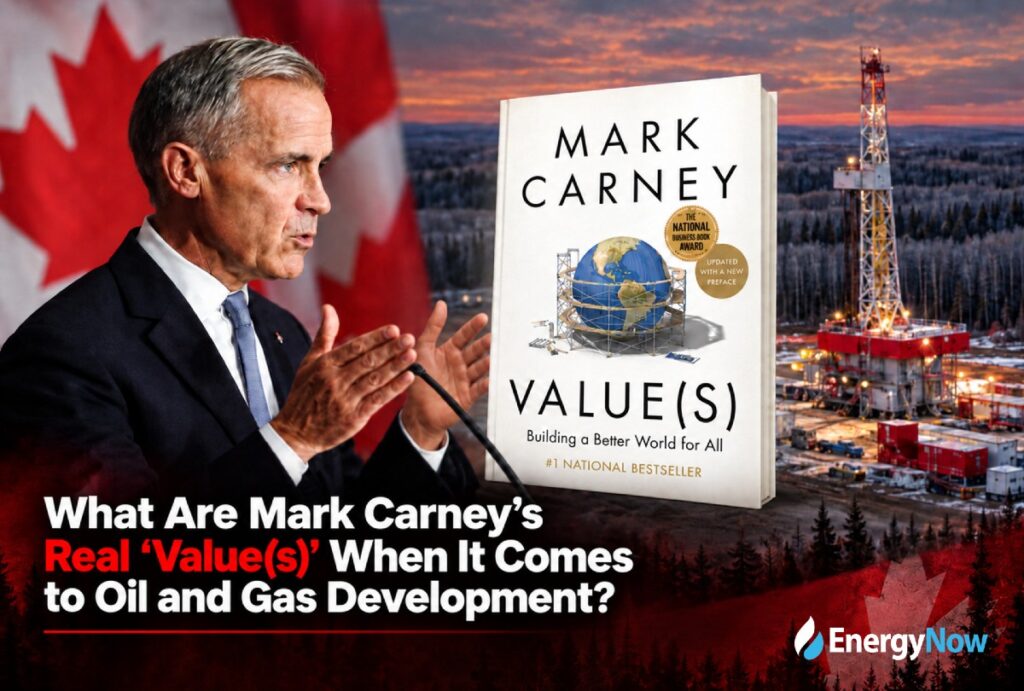
His 2021 book suggests, as Canada’s Prime Minister, he is not opposed to oil and gas production but he believes the industry’s future must be determined by climate policy, carbon economics and the ability of projects to remain competitive during a global transition.
By EnergyNow Editorial Staff
Mark Carney has recently sounded much more enthusiastic about Canadian energy development than many oil and gas executives might have expected.
He has spoken about making Canada an energy superpower, attracting enormous amounts of private investment, accelerating major projects and reducing the country’s dependence on the United States. His government’s support for new energy infrastructure and closer cooperation with Alberta has even generated criticism from environmental organizations and members of his own political coalition.
But what does Carney actually believe about oil and gas?
One place to look for an answer is his 2021 book, Value(s): Building a Better World for All. Written before he entered elected politics, the 608-page book is more than a memoir or economic treatise. It is a detailed account of how Carney believes governments, financial markets and corporations should respond to major social challenges—particularly climate change.
The book does not portray Carney as someone who wants to shut down the oil and gas industry tomorrow. Nor does it present him as an uncomplicated champion of expanding fossil-fuel production.
Instead, it reveals a leader who believes markets must be deliberately reshaped so that environmental and social values influence investment decisions. Under that system, oil and gas projects would not necessarily be prohibited, but they would face progressively tougher tests involving emissions, carbon prices, financial disclosure and long-term climate compatibility.
That distinction is crucial for Canada’s energy industry.
Markets must serve public values
The central argument of Value(s) is that modern societies have confused market value with human value.
Carney argues that markets are extremely effective at allocating capital, encouraging innovation and raising living standards. But markets cannot decide society’s ultimate objectives. When monetary value becomes the only measure of importance, he says, essential principles including fairness, responsibility, resilience and sustainability can be pushed aside.
Carney identifies seven values that should guide public policy and economic activity. These are solidarity, fairness, responsibility, resilience, sustainability, dynamism and humility. His answer is not to abolish capitalism, but to create what might be described as a more purposeful form of capitalism in which corporations consider their responsibilities to workers, communities and the environment alongside shareholder returns. The Guardian’s 2021 review of Value(s) summarized the book as a critique of market fundamentalism and a case for stakeholder capitalism.
Applied to oil and gas, this means profitability alone is not enough to justify development. A project may generate royalties, employment and export revenue, but Carney’s framework would also ask whether its environmental costs have been properly priced, whether it is resilient under future climate policies and whether it supports or obstructs the transition to net zero.
That is not an anti-development philosophy. It is, however, a philosophy that gives government considerable power to define the conditions under which development proceeds.
Climate change as a financial risk
Carney’s climate thinking is rooted in his experience as a central banker.
He sees climate change not only as an environmental concern but as a threat to financial stability. Physical risks—including fires, floods, droughts and extreme weather—can destroy assets and disrupt economic activity. Transition risks emerge when regulations, technologies and consumer preferences change, reducing the value of carbon-intensive investments.
For oil and gas companies, those transition risks could include higher carbon prices, stricter methane rules, falling demand, restricted access to capital or the premature retirement of facilities.
Carney’s answer is to make financial markets recognize those risks before they become crises. That requires companies to disclose their emissions, climate exposure and transition plans so that investors can distinguish between businesses prepared for a lower-carbon economy and those depending on governments indefinitely postponing climate action.
This is one of the most consequential ideas in Value(s).
Carney does not need government to order investors to abandon every hydrocarbon project. If emissions are priced, climate risks disclosed and financial institutions aligned with net-zero objectives, capital markets will impose their own discipline. High-cost, high-emission or long-lived projects may become harder to finance, while lower-emission producers and credible carbon-reduction projects attract investment.
In Carney’s model, finance becomes an instrument of climate policy.
Not an immediate end to oil and gas
It would be misleading, however, to interpret Value(s) as a demand for the immediate elimination of fossil fuels.
Carney recognizes that an economic transition of this magnitude requires investment, technology and time. Modern economies cannot simply switch off the fuels supporting transportation, industry, heating, agriculture and global trade. Natural gas can also help displace coal, support electricity reliability and complement intermittent renewable generation.
His philosophy leaves room for oil and gas during the transition.
The projects most likely to pass Carney’s test would be those demonstrating several qualities:
- Competitive production costs and strong global demand.
- Credible reductions in operational emissions and methane leakage.
- The ability to remain economic under higher carbon prices.
- Investment in carbon capture, electrification and other abatement technologies.
- Transparent emissions reporting and a believable transition plan.
- Meaningful economic participation by Indigenous communities.
The Canadian industry can reasonably argue that its resources meet important tests of resilience and responsibility. Canada offers political stability, regulated production, environmental oversight and greater transparency than many competing suppliers. Canadian natural gas and LNG could also reduce global emissions when they replace coal, although that benefit depends on controlling methane emissions across the supply chain.



Yet Carney’s philosophy contains a warning. “Responsible” production cannot simply be a slogan attached to expanding output. It must be demonstrated through measurable performance.
The meaning of his recent energy pivot
Carney’s actions in government suggest that he is more pragmatic about hydrocarbons than some climate activists expected now that he is Prime Minister.
His support for major projects and energy infrastructure does not necessarily contradict Value(s). The book emphasizes resilience, and Canada’s dependence on one dominant export customer is plainly a resilience problem. New pipelines, LNG facilities and international markets can therefore be defended as tools of national sovereignty and economic security.
That helps explain why Carney can support an oil pipeline or natural gas development while continuing to advocate net zero. In his framework, the central question is not whether a project involves fossil fuels. It is whether that project is economically resilient, environmentally credible and consistent with Canada’s longer-term transition.
The danger for the industry is assuming Carney’s current support represents an unconditional return to traditional resource development. His deeper philosophy suggests otherwise. He may accelerate projects, but he will expect industry to accept industrial carbon pricing, emissions accountability and large-scale investment in decarbonization in return.
His bargain appears to be: Canada can produce and export more energy, but it must steadily reduce the carbon associated with doing so.
The European connection
Carney’s effort to establish a closer Canadian relationship with the European Union makes this issue even more important.
He has described the objective as a “unique alliance,” not full EU membership. Discussions reportedly include deeper cooperation in energy, critical minerals, defence, artificial intelligence and economic security. The exact institutional arrangement remains uncertain, and talk of Canada becoming an EU “associate member” should not be mistaken for a completed agreement. Reuters reported that Carney emphasized shared priorities while stopping short of seeking membership.
Closer European ties could create substantial opportunities. Europe wants secure supplies from stable democratic partners. Canada can offer uranium, critical minerals, LNG, hydrogen, nuclear expertise and potentially lower-carbon oil. European investment could help finance Canadian infrastructure, electricity systems and clean technology.
But the EU is not merely a trading partner. It is a regulatory superpower.
Its climate policies influence supply chains far beyond Europe. Its emissions-trading system, sustainable-finance rules, methane requirements and carbon-border policies increasingly affect companies wishing to sell into or raise capital from the European market. The EU’s methane regulation, for example, is designed to apply progressively stronger monitoring and emissions-intensity requirements to imported oil, gas and coal.
Canada would not automatically be required to adopt every EU rule under a closer partnership. CETA did not transfer Canadian sovereignty to Brussels, and any new arrangement would have to be negotiated and approved. Nevertheless, closer economic integration normally creates pressure for regulatory compatibility.
That could mean stronger Canadian methane standards, more extensive climate disclosure, tougher lifecycle-emissions accounting and increased scrutiny of government support for oil and gas. European investors could also demand transition plans consistent with EU climate objectives before financing Canadian projects.
For conventional oil and gas development, these requirements could increase costs and narrow the range of projects considered acceptable.
Influence must not become veto power
Canada could work with Europe, but it must not allow European climate preferences to become a back-door veto over Canadian resource development.
It’s imporant to remember that Europe’s energy circumstances differ fundamentally from Canada’s. It is a major energy importer with limited domestic hydrocarbon resources. Canada is a large producer whose oil and gas industry supports employment, Indigenous partnerships, provincial revenues, exports and national prosperity.
Policies designed in Brussels may therefore place a different value on hydrocarbon development than policies designed in Edmonton, Calgary, Regina, St. John’s or Ottawa.
Canada must retain the authority to decide how its resources are developed. Regulatory cooperation should focus on achieving measurable environmental results, not importing rigid classifications that declare entire industries unacceptable regardless of technological improvement.
Carney’s own concept of resilience supports that argument. A resilient Canada needs diversified trade, reliable energy, strong domestic industries and the financial capacity to invest in new technologies. Weakening the country’s largest export industry before replacement industries are commercially established would not be a responsible transition. It would be economic self-harm.
The real test of Carney’s values
Value(s) shows that Carney does not view climate policy and financial policy as separate subjects. He wants markets structured so that capital flows toward activities governments consider compatible with long-term environmental and social objectives.
That presents both an opportunity and a risk for Canadian oil and gas.
The opportunity is for Canada to become the world’s preferred supplier of responsibly produced energy—combining secure resources, declining emissions, advanced technology and democratic governance.
The risk is that increasingly demanding climate conditions, amplified through closer EU alignment, could delay investment until Canadian projects become uneconomic and global demand is supplied by countries with weaker environmental standards.
Carney’s real values will therefore be revealed not by his speeches, but by the balance he strikes and the action he takes. So far, there has be little of the latter.
Can he recognize that Canadian oil and gas generate value beyond their market price, jobs, sovereignty, public revenue, Indigenous opportunity and energy security? Can he ensure climate policy rewards genuine emissions reductions rather than simply reducing Canadian production? And can he build closer ties with Europe without surrendering Canada’s right to develop its own resources?
Value(s) suggests Carney believes oil and gas must earn their place in a changing economy. The question now is whether his government will give Canada’s industry a realistic opportunity to do so.
Share This:




















DATA CENTRE INSIGHT: Best Practices for AI Data Centre Design and Community Support – Yogi Schulz