


 CDN NEWS |
  US NEWS







By EnergyNow Media
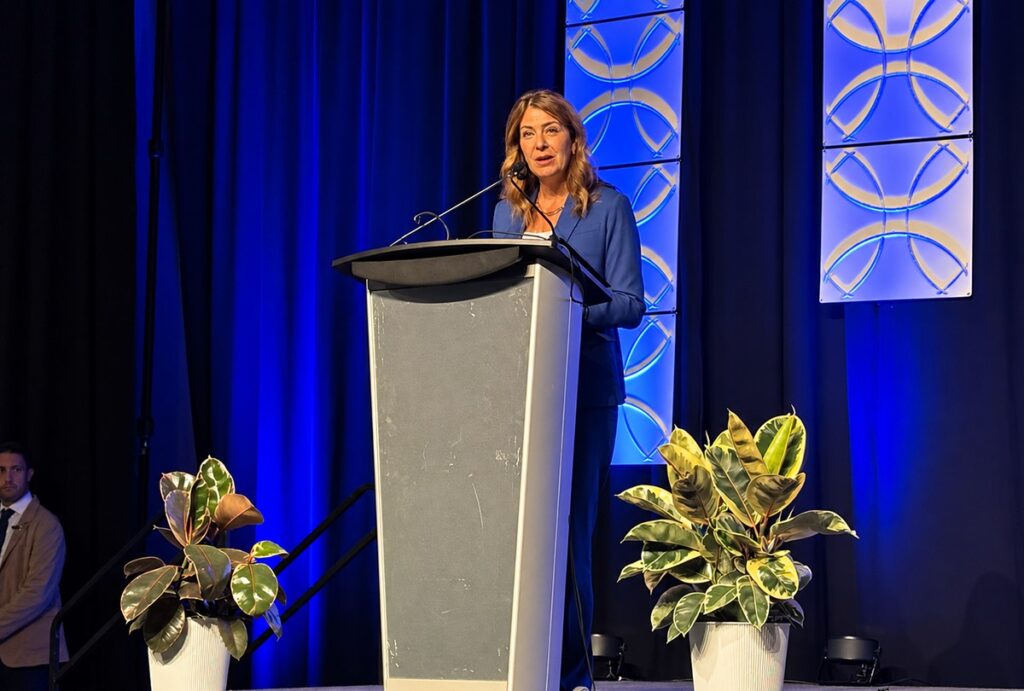
CALGARY — Alberta Premier Danielle Smith says Canada is entering its most significant period of pipeline development in decades, arguing that faster project approvals, artificial intelligence and advanced integrity-management technology can expand energy exports without compromising safety.
Speaking Tuesday at the International Pipeline Conference & Expo 2026 in Calgary, Smith told pipeline professionals that the political and regulatory environment surrounding energy infrastructure has shifted dramatically during the past 18 months.
“After a decade of headwinds and missed opportunities, Alberta’s energy sector is surging forward,” Smith said. “Pipelines have gone from impossible to a national imperative.”
The biennial conference brings together pipeline operators, engineers, regulators, researchers and technology providers from around the world. This year’s event includes more than 300 exhibitors highlighting advances in pipeline materials, monitoring systems, robotics, artificial intelligence and integrity management.
Smith Points to Regulatory Shift
Smith said Alberta’s energy agreement with Ottawa has eliminated the proposed federal oil and gas emissions cap and helped establish a “one project, one review” approach intended to reduce regulatory duplication.
Alberta has also introduced a legislated 120-day timeline for major provincial project approvals, while the federal government is pursuing a one-project, one-review, one-year model for projects considered to be in the national interest, she said.
“Less duplication, fewer delays,” Smith told delegates. “I think that everybody’s gotten the message.”
The premier said Alberta has submitted its proposed new West Coast oil pipeline to the federal Major Projects Office to test the new regulatory framework.
The proposed pipeline would carry more than one million barrels per day to the West Coast, largely following the existing Trans Mountain corridor. Alberta is working with Trans Mountain Corporation and Pembina Pipeline Corporation on the proposal.
Ottawa and Alberta formally advanced the project in July, describing it as a major step toward expanding Canada’s access to global energy markets.
Smith also pointed to plans for a west-to-east energy corridor between Hardisty, Alberta, and Sarnia, Ontario—an initiative Ontario Premier Doug Ford has called the “Northern Shield.”
Meanwhile, Enbridge, Trans Mountain, South Bow, Pembina and ATCO are advancing expansions or new infrastructure projects, she said.
“This is the greatest expansion of pipelines in decades,” Smith declared.
Faster Approvals Must Not Mean Lower Standards
While Smith emphasized the need to accelerate construction, she warned that faster approvals must not come at the expense of pipeline integrity or environmental protection.
“Faster approvals do not mean lower standards,” she said. “Speed and safety are not in conflict, and the reason they’re not is because of the people in this hall.”
Public confidence, Smith added, will ultimately depend on the technical work performed by pipeline operators, engineers, inspectors and safety specialists.
“That trust isn’t won in a press release,” she said. “It is won in the details—in coatings and corrosion control, in crack management and inline inspection, in hydro testing, leak detection and facility integrity, and in the integrity programs that keep the product in the pipe year after year.”
The Alberta Energy Regulator reported that the province’s pipeline incident rate declined to 0.61 incidents per 1,000 kilometres in 2025, down from 1.05 in 2016, even as the total length of regulated pipelines increased. The regulator attributed the improvement partly to better industry practices and stronger integrity-management systems.
Alberta Looks to AI for Pipeline Safety
A central theme of Smith’s address was the growing role of artificial intelligence in detecting corrosion, forecasting equipment problems and preventing pipeline failures.



The premier said she has asked the Alberta Energy Regulator to hire a technology specialist to study how international energy producers—including Saudi Aramco and Abu Dhabi National Oil Company, or ADNOC—are using AI and automation to improve infrastructure safety.
“The lesson is clear: integrity management is moving from periodic inspection to continuous prediction—from finding damage after it happens to preventing it before it starts,” Smith said.
She pointed to Aramco’s collection of more than 10 million corrosion readings annually across approximately 20,000 pipeline segments. Machine-learning systems can analyze those readings to identify early corrosion patterns, recommend preventative action and assess aging pipelines that cannot be examined using conventional inspection tools.
Smith said AI can also predict water accumulation and changes in pipeline flow, allowing operators to inject corrosion inhibitors or run inspection pigs before pipeline walls begin to thin. Drones equipped with ultrasonic technology can conduct thickness measurements without requiring workers to climb scaffolding.
In the United Arab Emirates, ADNOC is using machine learning, digital twins, autonomous robots, thermal cameras and lidar systems to identify leaks, equipment problems and hotspots in hazardous locations, she said.
“Alberta has the data, the engineering talent and the industry partners to lead that shift,” Smith said. “Our job in government is to make sure that our regulator understands these tools and that our rules encourage their adoption rather than stand in their way.”
New Pipelines for New Energy Products
Smith stressed that pipeline innovation will extend beyond conventional oil and natural gas.
As Alberta develops hydrogen, carbon capture and storage, lithium extracted from brines and geothermal energy, the province will require infrastructure capable of transporting products under very different operating conditions.
That includes hydrogen and carbon dioxide transported at high pressure, as well as the handling of hot and potentially corrosive brines.
Smith said research and technical standards being developed by organizations such as the American Society of Mechanical Engineers will be essential to safely building and operating that infrastructure.
The conference itself is placing significant emphasis on integrity management, digital tools, robotics and pipeline systems for hydrogen and carbon dioxide.
Alberta Wants to Be the “Supplier of Choice”
Smith framed pipeline expansion as both an economic opportunity and a matter of energy security for countries seeking reliable supplies from politically stable producers.
“When a buyer in Asia or Europe chooses Alberta energy, they are choosing a supplier with some of the highest environmental, safety and labour standards anywhere,” she said. “Safe, reliable production is what makes Alberta the supplier of choice.”
The premier cited a provincial resource assessment estimating that Alberta has approximately 1.8 trillion barrels of oil in place, with about 177 billion barrels considered recoverable using current technology. Alberta also has an estimated 1.36 quadrillion cubic feet of natural gas in place, including approximately 144 trillion cubic feet considered recoverable under current conditions.
Smith valued that resource base at between $12 trillion and $15 trillion.
“We have the resource, and we intend to make sure that it gets to the people who need it,” she said.
Developing those resources responsibly, Smith argued, could generate tens of billions of dollars for healthcare and education, create substantial employment and provide greater ownership and economic opportunities for Indigenous communities.
“And none of this happens without pipelines,” she told delegates. “And none of these pipelines happen without you.”
Smith concluded by telling international attendees that Alberta’s improving regulatory environment, vast resource base and growing focus on technology have created a new investment window.
“Now is the right time to invest in Alberta and to invest in Canada,” she said.
Share This:



















GRETCHEN WHITMER IS AT IT AGAIN: The Michigan Governor has Threatened to Shut Down Line 5 “Within Months” – Jim Warren