


 CDN NEWS |
  US NEWS







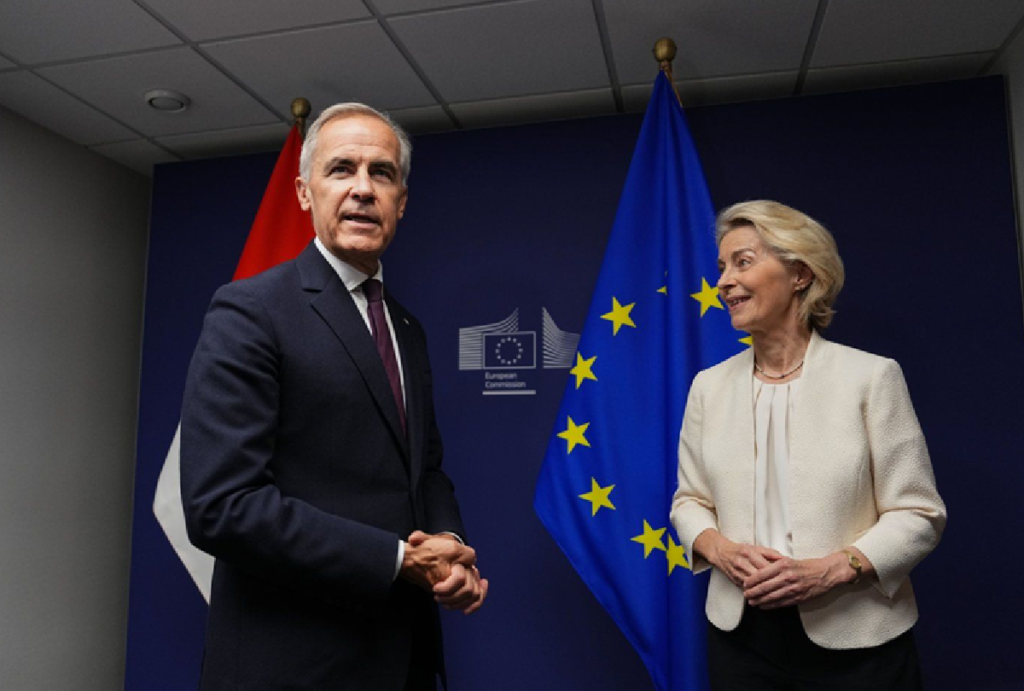
Mark Carney’s speech to the European Parliament should set off alarm bells across Canada, and the West in particular. In it, Carney praised the EU’s power to impose rules and standards “that the world frequently adopts,” otherwise known as the “Brussels Effect”. While intended as a compliment, as an example of what Europe brings to the table in talks for closer cooperation, Canadian provinces, and Alberta and Saskatchewan in particular, should hear it as a threat and ask: Is closer integration necessary, and what are its implications?
EU President Ursula von der Leyen, after 18 months of behind-the-scenes negotiation with Carney’s team, has invited Canada to discuss becoming an “associate member” of the EU, a newly invented category just for Canada. Carney accepted the invitation.
During the much-touted Canadian investment summit, Carney indicated Canada was prepared to accept the EU’s “four freedoms”: free movement of goods, services, people, and capital. That points to the European Economic Area (EEA) model used by Norway, Iceland, and Lichtenstein, where large portions of the EU rulebook take precedence over national rules. If there’s any doubt that closer relations with the EU means taking on the rule book, a European official, complaining about the delay in transposing EU laws by EEA members, recently said, “The EEA allows the three non-EU countries to participate in much of the single market. In return, they are required to adapt much of EU law into their national acquis. [emphasis added]” Whether it’s an “associate membership” or a “unique alliance”, the effect is the same: the oppressive European regulatory machine will apply in Canada. At a bare minimum, the price will be accepting European laws related to energy, environment, and consumer protection, with more likely to follow.
Let’s be clear: Canada already has quite a “unique alliance” with the EU. Almost all the areas Carney listed for closer cooperation are covered by existing agreements and institutions: Canada-European Trade Agreement (CETA), the defence partnership, Canada’s participation as the first non-European country in the EU’s SAFE defence fund, cooperation on critical minerals, NATO, Five Eyes, and the G7. What Canada has is actually better than what EEA members Norway and Iceland have because current arrangements don’t require Canada to adopt or transpose the 170,000 pages of EU laws, rules, and regulations. The importance of this cannot be overstated.
Just this week, thirteen EU members led by Austria are begging Brussels to stop creating new laws for 12 months. That time, it’s argued, should be used to reduce the red tape of the existing laws because, in large part due to the crushing laws and regulations, the European economies are in significant decline, and businesses are uncompetitive in the global market. They call it an appeal for a “year of simplification.”
Beyond the crushing effect on economic competitiveness, in adopting EU laws, rules, and regulations Canada loses its sovereignty. Sovereignty includes the right and power to decide how the nation develops its resources and economy. Provinces have constitutionally protected authority over natural resources, electricity, agriculture, and land use. Brussels won’t care. It won’t accept “federalism” as an excuse for failing to enforce methane limits, emissions trading, climate-finance rules, industrial regulations, or restrictions on oil, gas, mining, and coal. Europe will demand one Canadian commitment and one rulebook; Ottawa will then force provincial compliance.
What Canada has is actually better than what EEA members Norway and Iceland have because current arrangements don’t require Canada to adopt or transpose the 170,000 pages of EU laws, rules, and regulations. The importance of this cannot be overstated.



The premiers may keep their titles and press conferences, but their real power will be gutted. Instead of governing, they will administer foreign rules for a distant and aloof bureaucracy across the Atlantic. If western provinces already feel they have little say about what happens in Ottawa, how much worse will it be if decisions and rules are made in Brussels?
The implications for Alberta and Saskatchewan will be profound. Oil, natural gas, and coal would face legal restrictions, tighter emission rules, methane limits, and financing restrictions. Mining would be governed by European sustainability classifications and due-diligence requirements. Farmers could face pesticide and herbicide restrictions, prescribed crop rotations, land-use controls, and pressure to shift a certain percentage of acreage from conventional to organic farming. Stringent livestock regulations would make Canadian production uncompetitive and put ranchers out of business. Like Norway and Iceland, a European bureaucratic entity will monitor Canadian compliance with the net-zero policies and binding emissions targets.
Most importantly, Carney’s talk of “integrating financial services” indicates Europe’s debilitating climate-finance rules will likely be applied to Canada. This includes the Emissions Trading System, the Corporate Sustainability Due Diligence Directive, the green taxonomy, transition planning, the Corporate Sustainability Reporting Directive, and the Carbon Border Adjustment Mechanism.
Taken together, these measures make new oil sands barrels progressively harder to finance, permit, and sell as single-market goods. Alberta won’t be able to renegotiate the terms because they will be imported conditions of EU market access. Climate would sit at the centre of every permit, loan, investment and procurement decision. Is this not the system Carney has wanted all along?
Carney and the Liberals won’t need to ban oil sands production; the EU-aligned finance and rules system will do it for them.
This arrangement would also make a mockery of the memorandum of understanding between Ottawa and Alberta. What is the value of negotiating methane rules, pipelines, or energy development with Ottawa if both governments later become subordinate to Brussels? Once these rules become conditions of European market access, provinces can’t change them. Local circumstances and provincial elections won’t matter.
And for what?
Canada already has CETA, the defence arrangement, NATO, Five Eyes, and others, and Canada maintains sovereignty over its economy, development, regulatory framework, and foreign policy. Canada can sell Europe what it “wants and needs” — potash, fertiliser, oil, LNG, uranium, copper, lithium, aluminum, steel, and defence equipment — without this new arrangement. We don’t need this.
A Canadian official told the Wall Street Journal this is “tectonic change by working groups and bureaucracy.” Let that sink in. Tectonic change. Carney’s pitch is that America is the problem, that Donald Trump is a problem, and that the only solution is closer integration with the oppressive European Union. Create a problem when there’s already a preferred solution.
Frankly, this is a return to Canada being a colony. Confederation means the provinces have the power to govern the land, mines, power plants, and farms within their borders; “associate membership” or “unique alliance” takes that away and imposes the European energy, environment, climate and emissions rulebook. The premiers, including those of Alberta and Saskatchewan, will be relegated to administrators and clerks for a jurisdiction an ocean away. The terms are set in Brussels while local governments merely manage compliance. This isn’t a partnership of equals; it’s a return to colonial status and should be rejected.
Share This:




















REALITY: Carney’s EU Deal Threatens Alberta, Energy, & Sovereignty – 170,000 Reasons to Reject Canada’s EU “Associate Membership”