


 CDN NEWS |
  US NEWS







Don’t conflate forecast errors with new oil and gas royalty scheme.
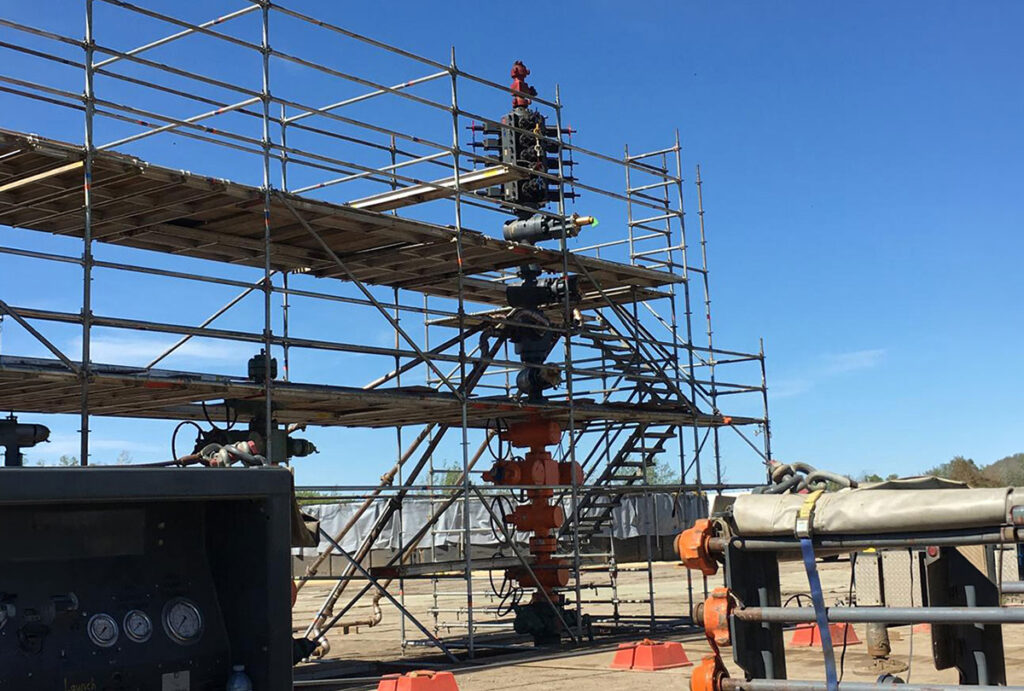
Gas wellhead assembly seen at a B.C. drilling location near Fort St. John. This is where natural gas coming up from underground is brought under control before it flows into pipelines. The stack of valves regulates how much gas flows out, monitors pressure and temperature, and includes emergency shutoff switches to stop production if something goes wrong. All gas from the well passes through this assembly on its way to homes and businesses. Resource Works file photo.
By Resource Works
More News and Views From Resource Works Here
In the coming years, the B.C. government should start earning millions more from oil and gas production when a new oil and gas royalty framework goes into effect.
But it probably won’t be the additional $2.4 billion over five years that Energy Minister Adrian Dix reportedly told Treaty 8 First Nations it might be.
Then again, if natural gas prices were to spike the way they did in 2022, the government could rake in that much in a single year, as it did in 2022-23 when it enjoyed a $2.3-billion royalty windfall on high gas prices. Dix was put in the embarrassing position last week of having to explain why his forecasts for future potential revenue from oil and gas production were off by at least $1.4 billion.
Turns out the NDP government is kind of bad at math.
A series of measurement and currency conversion errors on the part of functionaries in the Ministry of Energy ended up overestimating future royalty revenues to the tune of about $292 million a year over five years. The erroneous forecasts made it into the budget, which Dix cited in a meeting with Treaty 8, according to Business in Vancouver.
Treaty 8 concerns and commodity volatility
Treaty 8 First Nations insist the shortfall will be more in the $500-million-per-year range, not $292 million, and warn the government’s new oil and gas royalty framework will be leaving billions on the table.
“All British Columbians will lose if the B.C. government decides to adopt an unfair and unreasonable royalty system based on bad math,” Roland Willson, chief of the West Moberly First Nation, recently wrote in the Vancouver Sun.
As for why Treaty 8 nations might be concerned that B.C. is not deriving maximum benefit from oil and gas royalties, they have skin in the game here. Located, as they are, in the heart of B.C.’s most prolific oil and gas producing region, they stand to benefit from the oil and gas industry, and clearly want to make sure no one is getting short-changed.
But it may be premature to say whether the new royalty system will be fair or not, because it’s not in effect yet. Currently a transition framework is in place.
Biggest factor in royalty revenue is commodity prices
Moreover, the amount of revenue the province generates from oil and gas royalties is subject to the vagaries of natural gas prices and production levels.
For the 2020-2021 fiscal year, for example, B.C. generated a measly $192 million in natural gas revenue, according to B.C. budget documents. Those are actual numbers from B.C.’s budget, not forecasts, and it is strictly for natural gas, and does not include other related products like oil.
In 2021-2022, natural gas royalties jumped to $920 million, driven by higher natural gas prices and higher production. Royalty revenues then spiked to a whopping $2.3 billion for 2022-23, thanks in no small part to Vladimir Putin and his adventures in Ukraine, which resulted in natural gas prices soaring globally. In 2024-25, natural gas royalties generated $672 million for the government.
In these numbers, one must factor in that production in B.C. has grown substantially in recent years, partly driven by our new LNG industry.
So, how much revenue the province generates through royalties depends to a great extent on natural gas prices and production. Make the cost of producing in B.C. too high with onerous royalties or carbon taxes, or both, and production may simply shift to Alberta and your royalty stream will go down.
Make it too low, and British Columbians will not be getting fair value for a public resource. It’s quite the balancing act the government will need to do here.
Comparing royalty systems and deep-well credits
Compared to Alberta, B.C. has been generating less, on a per-unit basis, in the royalties it collects, though industry insiders will hasten to point out that, on the other hand, carbon prices on production have been higher in B.C. than Alberta.


As the Ministry of Energy reported in 2020, B.C.’s royalties per mcf of production were four cents lower than Alberta’s in 2019-2020: six cents per mcf compared to 10 cents per mcf in Alberta. Those cents add up to millions.
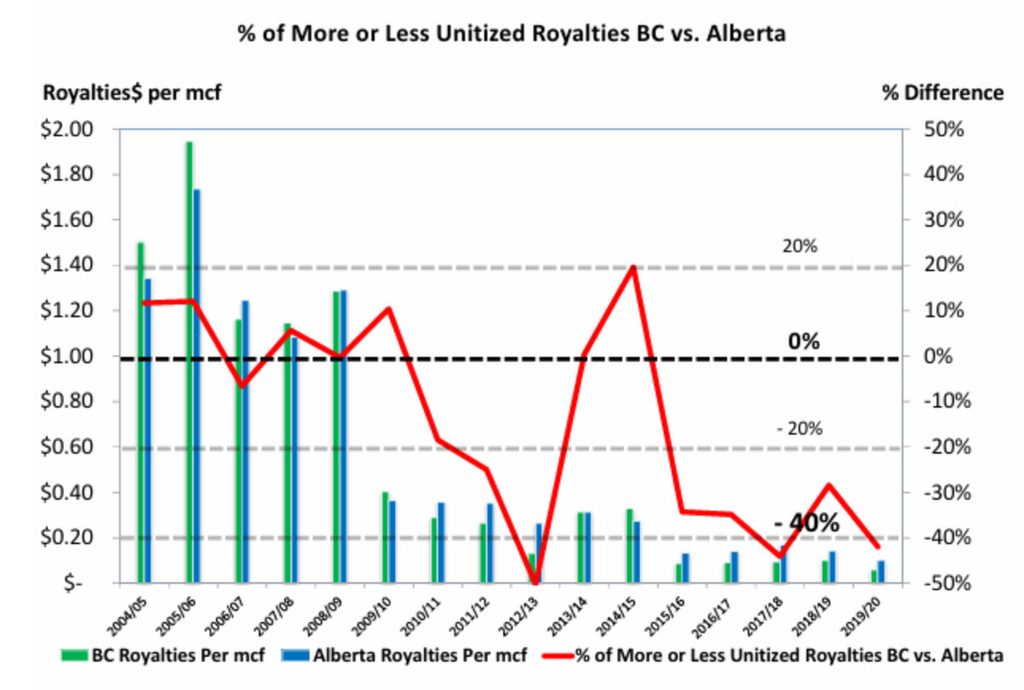
Graph shows Alberta’s gas royalties to be higher than B.C.’s. | CAPP
The culprit for B.C.’s lower royalty rates were certain production credits like the deep well credit. The Green Party hammered away at this for years, saying B.C. was foregoing billions. The Greens weren’t entirely wrong. Deep well credits were introduced in 2003 to offset the high cost of deep well drilling in B.C. But deep well horizontal drilling is now a standard approach, raising questions about whether the incentive was still necessary.
In 2022, the NDP government began a revision of B.C.’s oil and gas royalty scheme, with the notion of phasing out deep well credits and moving to a framework more in line with Alberta’s—a more price-based system. Industry insiders I spoke with said producers are generally supportive of the new framework, though the devil will be in the details.
Untangling calculation errors from structural reform
One concern they have is that the error the government made in its forecasts is now being conflated with the new royalty framework.
The industry is also concerned about harmonizing B.C.’s industrial carbon regime with the new rates being adopted in Alberta, under the MOU struck between Alberta and Ottawa on industrial carbon pricing.
The new oil and gas royalty scheme goes into effect in January 2027. Until then, the B.C. government has been using a transition royalty scheme. In its recent forecasting, functionaries in the Ministry of Energy made some conversion errors that resulted in royalty forecasts being inflated.
In a technical briefing with reporters, ministry officials explained that they use third-party data in their calculations, so that means the data can come in different currencies and measurements. In one case, errors were made when converting measurements like British Thermal Units (Btu) to gigajoules. In other cases, they converted what they thought were American dollar figures to Canadian when, in fact, the currency conversions had already been made.
That all added up to an overestimation of about $292 million per year over five years.
Consultants for Treaty 8 insist the overestimation, in fact, comes from not factoring in transportation and processing costs when considering plant inlet prices for gas. When the province’s estimates were questioned by Treaty 8, Dix said his ministry conducted a review, and discovered the conversion errors. But he was adamant that transportation and processing factors have nothing to do with pricing and forecasts.
“We looked at that in detail – that’s not the case,” Dix told CBC’s Stephen Quinn in an interview.
“Nonetheless, it’s a significant error,” Dix conceded. “It doesn’t mean we’ve lost revenue, though.”
Dix said the forecasts will be updated in the next quarterly report. And sometime this fall, we are told, we should see what the new oil and gas royalty framework will actually look like. The auditor general has also been asked to conduct a review.
Hopefully that report will clear up the question of whether the government’s miscalculations were confined to conversion errors, or also include failure to factor in transportation and processing costs, as Treaty 8 insists is the case. When the new royalty framework was announced in 2022, the government was forecasting it would generate about $200 million more per year than under the framework that’s being phased out.
Generally, the new rates that the government is moving to are intended to be more reflective of natural gas prices and more in line with Alberta’s royalty framework. We’ll have to wait to see what the new royalty rates will actually be before they can be judged as being too high or too low.
“BC is not only competing for investment with Alberta, which holds about half of the Montney gas basin, but also with natural gas producers globally,” said Heather Exner-Pirot, director of natural resources, energy and environment for the Macdonald-Laurier Institute.
“If it can put in place a stable, competitive royalty regime, the prize will be great: more jobs, more LNG terminals, more corporate and property taxes. This is a particularly important moment to communicate competitiveness and stability because we are waiting for FIDs on LNG Canada Phase 2 and Ksi Lisims.
“If BC charges too much, it will become uncompetitive and it will lose those economic benefits to other jurisdictions. There is no world where you can just charge higher royalties and expect production volumes to grow regardless.”
Nelson Bennett’s column appears weekly at Resource Works News. Contact him at [email protected].
Share This:






















INSIGHT: B.C.’s Royal Screw-Up on Royalties – Resource Works