


 CDN NEWS |
  US NEWS







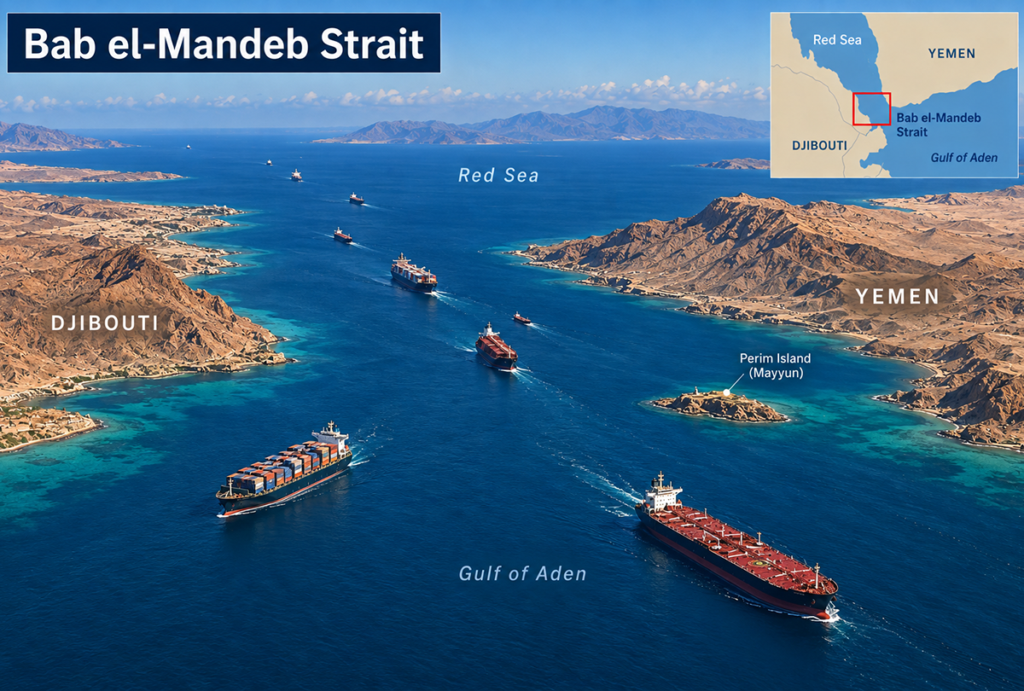
Reuters – A lightning offensive by the Iran-aligned Houthis has put the militants in a position to control a crucial Middle East waterway, creating a major new problem for U.S. President Donald Trump as his war with Iran grinds on in its seventh month.
Widening the Middle East conflict, Houthi fighters have advanced south along Yemen’s coast, increasing their ability to choke off the Bab el-Mandeb Strait — the “Gate of Tears” at the mouth of the Red Sea — giving Tehran potential leverage over both of the region’s main oil-shipping corridors.
The militants reached the island of Perim on Friday, in the middle of the strait between Yemen and Africa. That is bad news for Saudi Arabia, which has been shipping much of its oil from Red Sea ports since the war effectively closed the Strait of Hormuz, on the opposite side of the Arabian Peninsula.
It also comes at a difficult time for Trump, who is already grappling with record-low approval ratings and searching for a way out of the conflict, most recently by announcing an economic pressure campaign designed to force concessions from Iran’s government.
High U.S. gasoline prices driven by the conflict have jeopardized his Republican Party’s chances of keeping control of Congress in the November midterm elections. Iran remains defiant despite being hurt militarily and economically.
“Just weeks ago, Trump adopted a strategy of squeezing Iran’s economy while keeping military conflict at levels too low to squeeze the American economy,” said Stephen Wertheim, a senior fellow at Carnegie Endowment for International Peace. “The Houthis have shattered Trump’s plan.”
DANGER OF JOINING THE FIGHT
The U.S. administration can’t afford to have the Houthis close the strait, driving up energy prices and disrupting global trade.
But at the same time, entering a fight with a foe that has withstood previous attacks by Saudi Arabia and the U.S. would be a dangerous new mission for a U.S. military already stretched by the fighting in Iran.
Saudi Arabia’s de facto ruler, Crown Prince Mohammed bin Salman, phoned Trump on Thursday and asked for U.S. military help fighting the Houthis, three sources told Reuters. He was told Washington would not intervene directly for now but would help with intelligence, the sources said.
Trump confirmed on Saturday that he had spoken to the crown prince, and said the Houthis had also phoned his administration and asked for Washington not to become directly involved in the conflict.
A senior Trump administration official declined to address specific questions, but said the U.S. is focused on national security interests such as ensuring freedom of navigation in the Red Sea “while empowering our regional partners to take the lead in managing and resolving regional security challenges”.
Saudi Arabia, Iran and the Houthis did not respond to a request for comment. Iran’s foreign ministry said in a statement on Thursday that the Yemen conflict could not be solved by blockade or military action against the Houthis and called for dialogue, without addressing Iran’s own role.
A SECOND KEY STRAIT


Iran responded to U.S. and Israeli attacks earlier this year by disrupting the Strait of Hormuz, the outlet to the Gulf through which around a fifth of global oil supplies flowed before the war.
If the Houthis close the Bab el-Mandeb, that would deal another economic blow, constraining another 7% of global petroleum supplies and about 12% of global trade.
“This was always the worst-case scenario, that the Iranians exert control not only of Strait of Hormuz but Bab el-Mandeb, two of the leading energy choke points in the world,” said David Schenker, who served as Assistant Secretary of State for Near East Affairs during Trump’s first term and is now at the Washington Institute for Near East Policy, a think tank.
“It’s an enormous amount of leverage that [the Iranians] have in hand.”
Analysts and former officials say Trump now faces a choice: devote U.S. forces and scarce air-defense munitions to pushing back the Houthis, or leave Saudi Arabia and its allies, a Yemeni government based in the south, to confront them alone.
The Houthis seized Yemen’s capital 12 years ago, and a Saudi-led military intervention has failed to dislodge them since.
Taking on the Houthis would effectively end a deal Trump struck last year in which the U.S. would stop bombing the group in exchange for a halt to strikes on Red Sea shipping. That would be likely to expose U.S. forces to missile attacks from Yemen.
A STRETCHED U.S. MILITARY
It would also be another burden for the U.S. military.
U.S. officials say a fight with the Houthis could require significant naval and aerial resources and divert U.S. intelligence assets, given the need to pinpoint Houthi positions that have changed since last year.
If U.S. Navy vessels and aircraft have to start shooting down Houthi drones and missiles, it could also worsen diminished stockpiles of U.S. munitions and air-defense interceptors.
The senior administration official denied that the U.S. was concerned about its resources being stretched. “The United States Military has more than enough munitions, ammo, and stockpiles to serve all of the Commander-in-Chief’s strategic goals and beyond,” the official said.
Tim Lenderking, who served as U.S. special envoy on Yemen under former President Joe Biden and is now a principal at law firm Squire Patton Boggs, said that with Trump signaling an unwillingness to get directly involved militarily against the Houthis, the U.S. needs to do more to share intelligence with the Saudis for their air campaign and step up diplomatic and material support for Yemen’s internationally recognized government.
“This administration came in asking the question, ‘What can Yemen do for us?’” Lenderking said during a webcast sponsored by the Middle East Institute think-tank in Washington. “Well, Yemen can spoil our day.”
(Reporting by Humeyra Pamuk, Simon Lewis and Matt Spetalnick; additional reporting by Idrees Ali, Jonathan Landay and Timour Azheri)
Share This:






















PERSPECTIVE: Improving Canada’s Energy and Tax Policies Could Increase Business Investment and Restore the Country’s Competitiveness in the Energy Sector