


 CDN NEWS |
  US NEWS







EnergyNow Feature Editorial
What Justin Trudeau, Doug Ford and Quebec promised, where the projects stand – and how much taxpayers committed
Status as of September 2026
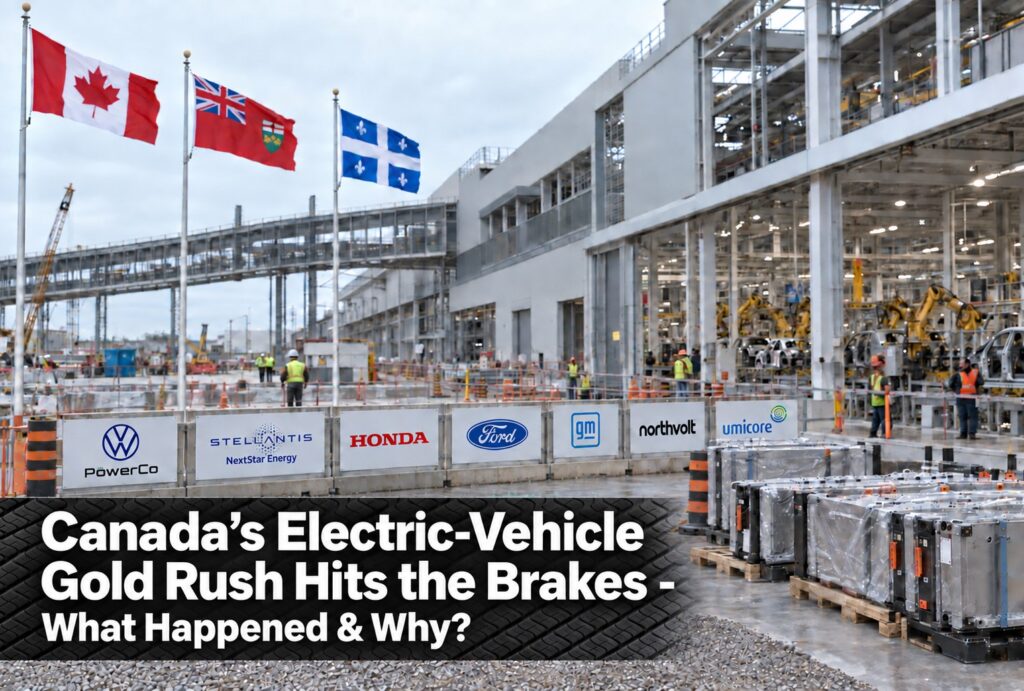
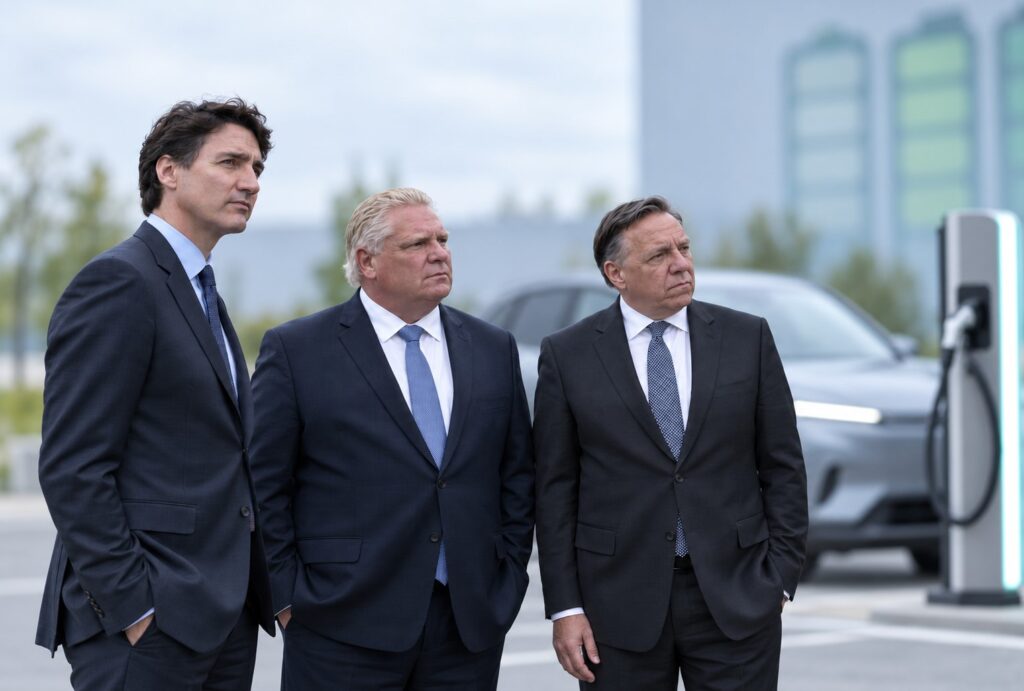
For several years, the federal government of Justin Trudeau, Ontario Premier Doug Ford and Quebec Premier François Legault promoted Canada as the future centre of North America’s electric-vehicle industry.
Governments competed aggressively for assembly, battery-cell and battery-material plants, arguing that Canada had everything manufacturers needed: critical minerals, relatively clean electricity, an established Ontario auto industry and tariff-free access to the United States.
The announcements were enormous. Between October 2020 and April 2024, companies announced $46.1 billion in investments across 13 major Canadian EV supply-chain projects. The Parliamentary Budget Officer estimated that associated federal and provincial support could reach $52.5 billion—more than the announced private capital spending. Ottawa accounted for an estimated $31.4 billion and the provinces $21.1 billion. Parliamentary Budget Officer
But those numbers require context. Much of the headline support was conditional on plants being completed and producing batteries. It was not necessarily money paid upfront.
The results today are mixed. One large Ontario battery plant is operating, another is being built, but several assembly and battery-material projects have been postponed, repurposed or abandoned. Quebec’s Northvolt investment became the most serious failure.
Ontario’s Major Projects
| Project | Original promise | Maximum public support announced | Status in September 2026 |
|---|---|---|---|
| Volkswagen PowerCo, St. Thomas | Up to $7 billion; battery cells for as many as one million EVs annually; approximately 3,000 direct jobs | Up to $13.2 billion in production incentives; $700 million federal construction support; Ontario responsible for one-third of production support, plus infrastructure | Under construction; production targeted for 2027 |
| NextStar Energy, Windsor | More than $5 billion; 49.5-GWh battery plant; approximately 2,500 jobs at full scale | Up to $15 billion in production incentives; $500 million federal capital contribution; Ontario responsible for one-third of production support | Operating and scaling, but Stellantis sold its stake to LG Energy Solution |
| Honda EV supply chain | $15 billion covering EV assembly, battery cells, cathode materials and separators; up to 240,000 EVs annually | Up to $2.5 billion federal tax credits and $2.5 billion in Ontario direct and indirect support | Postponed and subsequently reported as suspended indefinitely |
| Ford Oakville EV hub | $1.8-billion conversion of Oakville Assembly to build five EV models | $295 million from Ottawa and $295 million from Ontario | EV plan abandoned; plant converted to build gasoline-powered Super Duty pickups |
| Umicore, Loyalist Township | $2.76-billion cathode and precursor-material plant; approximately 600 jobs | Up to $551 million federal and $425 million Ontario support | Construction suspended with no restart date; Umicore says it drew no government incentives |
| GM BrightDrop, Ingersoll | Canada’s first full-scale EV assembly operation producing electric commercial vans | Up to $259 million each from Ottawa and Ontario, covering CAMI and Oshawa investments | BrightDrop production permanently ended in October 2025 |
| Stellantis, Brampton and Windsor | $3.6-billion retooling for electrified vehicles | Up to $529 million from Ottawa and $513 million from Ontario | Windsor is producing vehicles, but the Brampton retooling was stopped and planned Jeep Compass production moved to Illinois |
Volkswagen: Still Alive, But Heavily Dependent on Subsidies
Volkswagen’s PowerCo plant is the largest remaining pillar of Ontario’s EV strategy. Construction officially began on its major buildings in October 2025, with production scheduled for 2027.
The plant could qualify for up to $13.2 billion in production incentives, based on the amount of battery cells manufactured and sold. Ottawa also committed $700 million toward construction. The production payments were designed to match the former US$35-per-kWh American battery-cell tax credit. Government of Canada subsidy details
Because the assistance is production-based, taxpayers will not automatically pay the full $13.2 billion. The agreement also provided for adjustments if the corresponding U.S. incentive changed.
This project has not stalled, although its economics are less certain than when announced.
NextStar: Operating, But No longer the Project Originally Envisioned
The Windsor battery plant is Canada’s clearest operational success. It employs more than 1,300 people and is scaling toward a longer-term target of 2,500.
However, Stellantis sold its 49% ownership interest to LG Energy Solution in February 2026 for a nominal $100. LG is broadening the facility beyond automotive batteries to include stationary energy-storage systems. Stellantis remains a customer but is no longer an owner. Stellantis and LG Energy Solution announcement
That does not make NextStar a failed plant. It does show how sharply Stellantis has retreated from its earlier EV forecasts.
Honda: From Flagship Investment to Indefinite Uncertainty
Honda’s proposal was arguably Ontario’s most ambitious: a retooled Alliston assembly plant, a nearby battery-cell factory and separate cathode-material and separator plants elsewhere in Ontario.
Ottawa offered approximately $2.5 billion through investment tax credits, while Ontario promised up to $2.5 billion in direct and indirect support. The project was expected to retain 4,200 jobs and add roughly 1,000.
Honda postponed the project for two years in May 2025, citing the slower EV market. By May 2026, reports indicated that Honda had suspended the Canadian project indefinitely. Because much of Ottawa’s offer consisted of tax credits tied to actual investment, the $5-billion headline figure should not be treated as a completed payment. Federal briefing note
Ford Oakville: The Clearest Ontario Reversal
In 2020, Ottawa and Ontario each promised Ford $295 million toward a $1.8-billion transformation of Oakville Assembly into a battery-electric vehicle hub. Five EV models were expected.
In 2024, Ford first delayed its planned three-row electric SUVs from 2025 until 2027 and then redirected Oakville toward production of approximately 100,000 gasoline-powered Super Duty pickups annually. Ford said EV demand was growing more slowly than anticipated while its EV division was losing billions of dollars. Reuters
The plant and many of its jobs survived, but the principal public-policy objective—turning Oakville into an EV manufacturing hub—did not.
Umicore: A Plant Without Customers
Umicore suspended work on its proposed Loyalist Township battery-materials complex after reviewing its global battery business. The company concluded that supplying North American customers from existing Korean operations was a better use of capital.
The governments had offered approximately $976 million combined, but Umicore said it had not drawn on those incentives. Reuters
This illustrates an important difference between a failed project and a taxpayer loss: the plant stalled, but the largest promised government contributions apparently were not paid.
GM BrightDrop: Built, Opened and Then Closed
GM converted CAMI Assembly in Ingersoll into an electric-commercial-van plant with government assistance. Production began, but demand never approached expectations. GM paused the factory and then permanently ended BrightDrop production in October 2025. General Motors Canada
BrightDrop’s high price, slow commercial-fleet adoption, accumulated inventory and the loss of favourable U.S. incentives undermined the business case.
What Happened in Quebec?
Quebec concentrated on the battery supply chain rather than passenger-vehicle assembly. Its low-cost hydroelectricity, industrial land and access to minerals made Bécancour and the Montreal region attractive—but several projects ran into serious trouble.
| Project | Original promise | Public support announced | Current position |
|---|---|---|---|
| Northvolt Six, McMasterville–Saint-Basile-le-Grand | $7-billion integrated battery-cell, cathode and recycling complex; 3,000 jobs | Up to $4.6 billion in production incentives plus $2.7 billion in federal–Quebec capital commitments | Abandoned; Canadian subsidiary insolvent |
| EcoPro CAM, Bécancour | $1.2-billion Ford/SK On/EcoPro cathode-material plant; 345 jobs | $322 million federal conditional contribution and $322 million Quebec partially forgivable loan | Construction suspended; Ford withdrew |
| Ultium CAM—GM/POSCO, Bécancour | Initial $600-million cathode-material plant, followed by a larger expansion | Approximately $300 million combined; Quebec portion included a $152-million partly forgivable loan | First phase proceeded; second phase paused |
| Lion Electric, Saint-Jérôme/Mirabel | Electric buses and trucks plus a battery-pack plant | At least $100 million jointly for the battery plant; broader public exposure reportedly exceeded $200 million | Creditor protection, restructuring and asset-sale process |
| Volta Energy Solutions, Granby | Copper-foil plant for EV batteries | Quebec support plus up to $70 million recently committed federally | Under construction; commencement expected in 2026–27 |
Northvolt: The Largest Failure
Northvolt Six was supposed to anchor Quebec’s battery industry. Ottawa and Quebec announced:
- Up to $4.6 billion in production incentives, payable only for batteries produced and sold.
- Up to $1.34 billion in federal capital commitments.
- Approximately $1.37 billion in Quebec capital commitments.
The total announced package therefore exceeded $7 billion, although most of the production support was never triggered. Government announcement
Northvolt’s Swedish parent collapsed after production problems, rising costs, lost orders, weak cash flow and the loss of investor support. It filed for bankruptcy with approximately US$8 billion in debt. Quebec stopped funding the Canadian project in September 2025.
Quebec had spent approximately $510 million. Of that, its $270-million equity investment in Northvolt’s parent was written off. The province also sought to recover loans secured against the Canadian assets. The federal government reportedly had not disbursed its principal project funding. Reuters
Northvolt was therefore both an industrial-policy failure and a real taxpayer loss—but not a $7-billion loss.
EcoPro: Caught by Ford’s Retreat
The Ford–SK On–EcoPro plant was to produce 45,000 tonnes of cathode material annually. Ottawa and Quebec offered $644 million toward a $1.2-billion project. Government of Canada
Ford withdrew as it revised its EV and battery strategy. EcoPro then suspended construction, citing weaker EV growth, U.S. tariffs and uncertainty across the battery market. No firm restart date has been announced.
Ultium CAM: Reduced, Not Dead
GM and POSCO’s initial Bécancour cathode-material plant progressed, but a planned second phase was paused because of changing market conditions. The cancellation also eliminated the immediate need for a related Vale nickel-sulphate plant.
Approximately $300 million in federal and Quebec assistance supported the first phase. This is a downsized project, not an outright cancellation. Canadian Press
Why Did So Many Projects Stall?
1. Governments and automakers overestimated the speed of EV adoption
EV sales continued growing, but not at the rate assumed when these factories were designed. Many consumers remained concerned about purchase prices, charging availability, winter range, battery depreciation and resale values.
Manufacturers planned plants around optimistic forecasts of rapid, near-universal electrification. When those forecasts weakened, the proposed North American battery capacity became larger than the foreseeable market.
2. U.S. policy changed the economics
Canada’s largest production subsidies were created to mirror incentives in the U.S. Inflation Reduction Act. Subsequent U.S. policy changes—including reduced EV consumer and commercial-vehicle incentives, relaxed emissions requirements and new tariff pressures—removed part of the market these Canadian plants were supposed to supply.
Since most Canadian-made vehicles and components are destined for the United States, Canada cannot isolate its auto strategy from American policy.
3. Battery technology changed during construction
Some projects were designed around nickel-manganese-cobalt batteries. Automakers increasingly turned toward less expensive lithium-iron-phosphate batteries, especially for lower-priced vehicles and stationary storage.
That made certain proposed cathode plants less attractive before they were completed.
4. Chinese manufacturers drove prices down
Chinese companies achieved enormous scale in batteries and lower-cost EVs. Falling battery prices were good for consumers but weakened the economics of expensive new Canadian plants with higher labour and construction costs.
Canadian governments could subsidize construction and production, but they could not guarantee customers or competitive technology.
5. Automakers were losing money on EVs
Ford, GM, Stellantis and other legacy manufacturers discovered that many EV models were substantially less profitable than gasoline vehicles. They delayed product launches, cancelled models, emphasized hybrids and redirected capital toward profitable pickups and SUVs.
Plants dependent on a particular automaker’s future EV lineup consequently lost their expected customers.
6. Canada subsidized capacity before demand was secure
The strategy concentrated on attracting factories while relying heavily on mandates and consumer incentives to create demand. When purchase incentives were reduced or suspended and mandates were reconsidered, manufacturers were left with less certainty.
There was also a sequencing problem: battery-material plants were announced on the assumption that battery-cell plants and Canadian EV assembly would all proceed on schedule. A delay at one point in the chain undermined several other projects.
Was The Entire Strategy a Failure?
Not entirely.
Canada retained NextStar’s operating Windsor plant, Volkswagen’s St. Thomas project is under construction, Volta is advancing in Quebec, and GM-POSCO’s first phase survived. Ontario also preserved major conventional and hybrid-vehicle employment.
However, the original vision was plainly overbuilt and overpromised. Governments presented conditional ten-year subsidy ceilings, proposed construction and job forecasts as though they were near-certain outcomes. They were not.
The fairest conclusion is:
- Ontario has a smaller, slower and more diversified battery industry than promised.
- Quebec’s battery strategy suffered a major failure at Northvolt and serious delays elsewhere.
- Much of the largest production support will not be paid unless plants actually manufacture and sell batteries.
- Real taxpayer losses are much smaller than the $52.5-billion headline but Northvolt, Lion Electric and partially completed infrastructure demonstrate that the losses are not merely theoretical.
- Canada’s EV supply chain is not dead, but it is being reshaped around slower EV adoption, hybrids, stationary battery storage and fewer large projects.
The policy mistake was not believing that electrification would continue. It was assuming the transition would happen on a government timetable and committing public support before manufacturers had demonstrated that their products, technology and customers were secure.
Share This:






















On The Verge: Energy Sector Primed for New Wave of Growth – ATB Economics