


 CDN NEWS |
  US NEWS







By EnergyNow Editorial Staff
Cheap natural gas is a big part of the story but Alberta’s real advantage may be its ability to turn energy into computing power faster than almost anywhere else in Canada.
Five years ago, few people would have predicted that Alberta might emerge as the centre of Canada’s artificial-intelligence infrastructure boom.
Today, some of the largest technology and infrastructure companies in the world are looking at the province.
Meta has announced a more than $13-billion data centre in Sturgeon County, its first in Canada. Kevin O’Leary’s O’Leary Ventures is proposing the enormous Wonder Valley project near Grande Prairie. Other developers are examining sites from Rocky View County and Olds to Bonnyville, Edmonton, Red Deer County and Yellowhead County. The Alberta government says its data-centre strategy has attracted an estimated $100 billion to $200 billion in potential private investment.
Not all of it will be built. In fact, some major proposals have already been stopped, rejected or confronted by significant public opposition.
But there is little doubt Alberta has become Canada’s data-centre laboratory — a place where Big Tech, natural gas producers, utilities, municipalities, regulators and rural communities are discovering what happens when the AI revolution collides with the physical realities of power, land and infrastructure.
It Started With a Deliberate Government Strategy
Alberta did not simply stumble into the data-centre boom.
Technology and Innovation Minister Nate Glubish has spent the past several years positioning the province to capitalize on the enormous electricity requirements created by artificial intelligence.
In his recent Maclean’s feature, The Farmers Who Fought a Data Centre—and Won, writer Luc Rinaldi recounts how Glubish returned from an AI conference convinced Alberta could become a global destination for data centres. That ambition eventually became formal government policy.
In November 2024, Premier Danielle Smith formally instructed Glubish to develop and implement a provincial Data Centre Strategy. One month later, Alberta released Powering the Future of Artificial Intelligence, built around three pillars: power capacity, sustainable cooling and economic growth.
One of the more unusual pieces of that strategy was the creation of an AI Data Centre Concierge Service.
Instead of leaving a developer to separately navigate ministries, municipalities, the Alberta Utilities Commission, Alberta Environment, Indigenous consultation requirements, natural-gas connections and the Alberta Electric System Operator, the concierge team acts as a central point of contact.
The government describes it as a gateway connecting investors with regulators and provincial expertise while attempting to shorten the path between an initial proposal and an investment decision. Glubish said in July that the concierge team had met with more than 200 developers, investors, power companies, municipalities and other stakeholders since the strategy was launched.
That kind of coordination matters because the global race for AI infrastructure is increasingly a race against time.
Why Alberta? Start With Natural Gas
So, is Alberta’s advantage really about natural gas?
Yes, perhaps more than any other single factor. But natural gas alone doesn’t explain it.
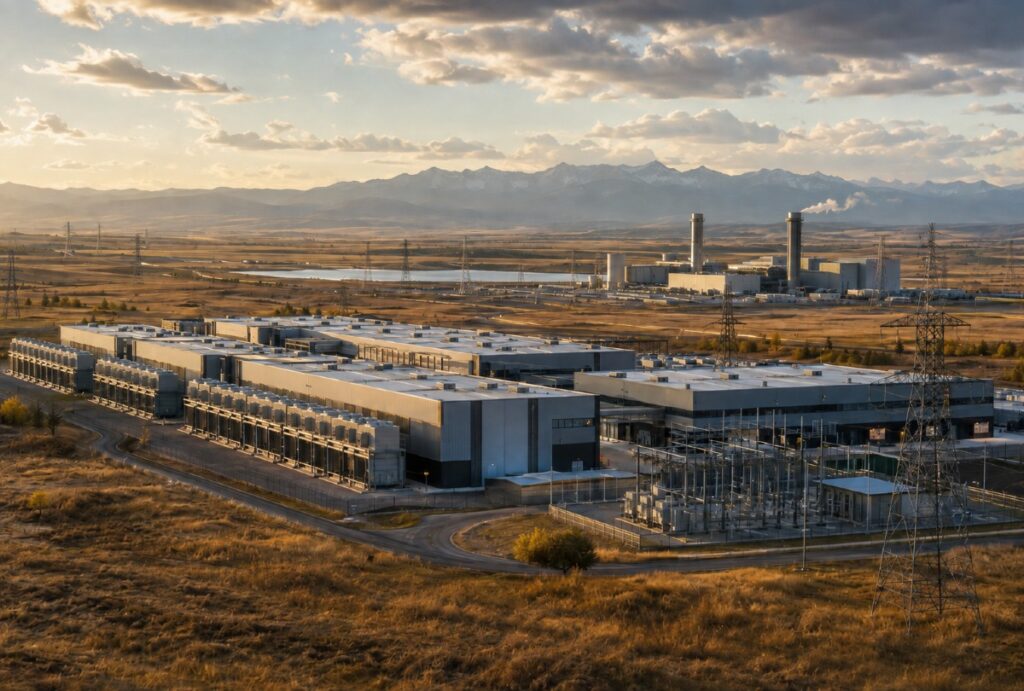
A modern hyperscale AI data centre can require hundreds of megawatts of electricity. The biggest proposed campuses require more than a gigawatt.
Unlike many industrial facilities, data centres need extraordinarily reliable electricity virtually every second of every day.
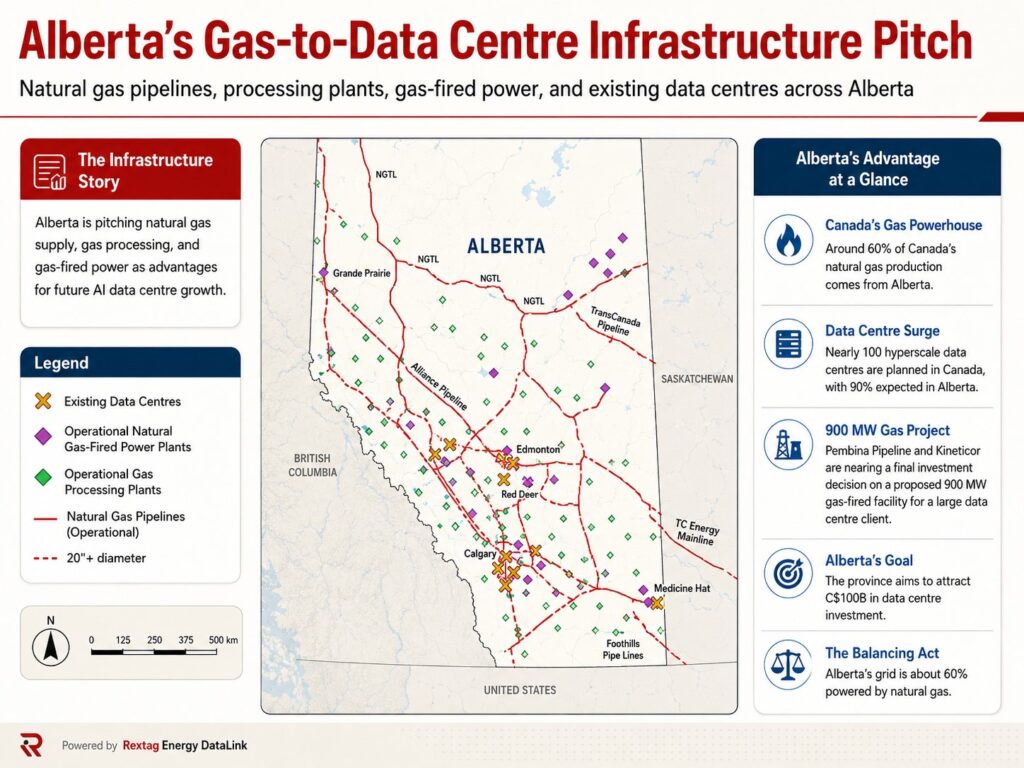
Alberta has enormous natural-gas reserves, a mature pipeline and processing network, power-generation expertise and an energy industry accustomed to developing multibillion-dollar infrastructure projects.
More importantly, Alberta can allow data centres to build or contract their own power generation. That is crucial.
In June 2025, AESO reported that just 29 proposed large-load projects were requesting more than 16 gigawatts of grid capacity. For comparison, Edmonton’s entire load is roughly 1.4 GW. AESO concluded it could initially accommodate only 1,200 MW of additional large loads through 2028 without threatening grid reliability.
Alberta’s response has increasingly been. Bring your own power. This is important because many people that are opposing data centres in Alberta are conveniently ignoring this.
Legislation passed in late 2025 created a clearer pathway for data centres to supply their own generation while requiring developers, rather than existing Alberta electricity customers — to bear transmission costs associated with their projects.
That creates an option few Canadian jurisdictions can match at comparable scale.
Instead of waiting years for a provincial utility to build enough generation and transmission capacity, a developer can potentially locate near a gas pipeline, construct dedicated gas-fired generation and build the data centre beside it.
Essentially, Alberta can convert natural gas into computing power without first transporting all of that electricity hundreds of kilometres across the provincial grid.
Meta May Be the Model
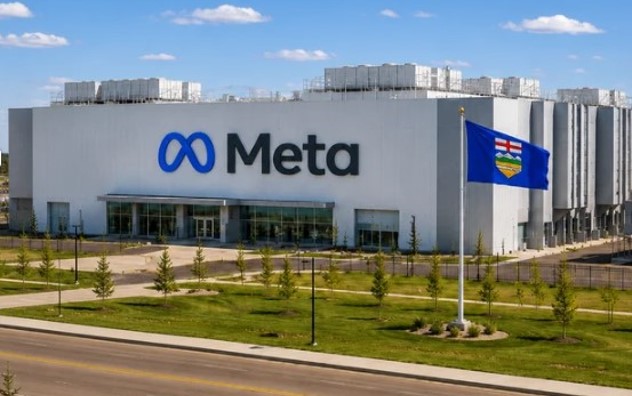
The clearest example is Meta’s Sturgeon County development.
Meta announced in July that it will invest more than $13 billion in a one-gigawatt data centre campus, potentially expandable to roughly 1.8 GW. About 3,000 workers are expected at peak construction and more than 300 permanent positions once operating.
Behind the data centre will sit another enormous industrial project.
Pembina Pipeline, Morgan Stanley Infrastructure Partners and Kineticor have made a final investment decision on the $4.6-billion Greenlight Electricity Centre, a 932-MW combined-cycle natural-gas power plant designed to provide dedicated power to Meta.
Greenlight alone is expected to consume roughly 150 million cubic feet of natural gas per day when operating and is scheduled to enter service in the second half of 2030.
That illustrates why data centres are becoming increasingly important to Alberta’s traditional energy industry.
AI may be a technology story, but in Alberta it is simultaneously becoming a number of stories all at once, a natural-gas demand story, a pipeline story, a power-generation story and an industrial-construction story.
Alberta Has Other Advantages
Gas is only part of the equation. Alberta also has enormous amounts of comparatively affordable industrial land, particularly around Calgary, Edmonton and established industrial corridors.
The province has substantial fibre infrastructure, including the Alberta SuperNet, alongside major telecommunications networks. Its cold climate can reduce the amount of energy required to cool server facilities. Alberta also promotes its relatively low corporate taxes, engineering workforce and existing expertise in constructing complex industrial projects.
Perhaps most importantly, Alberta approaches data centres differently than jurisdictions that see them primarily as technology facilities.
Alberta increasingly treats them as major industrial projects.



A one-gigawatt data centre looks less like an office park and more like a petrochemical complex: huge capital investment, enormous energy requirements, transmission and pipeline connections, cooling infrastructure, environmental approvals and years of construction.
Those are problems Alberta already knows how to solve.
Some of Alberta’s Biggest Data Centre Projects
The scale of the current pipeline is remarkable, although proposed investment should not be confused with committed investment.
Among the more significant projects are:
- Meta — Sturgeon County: More than $13 billion for an initial 1-GW campus, with potential expansion to roughly 1.8 GW. Dedicated electricity will ultimately come largely from the 932-MW Greenlight gas-fired power project.
- Wonder Valley — Greenview/Grande Prairie region: O’Leary Ventures proposes a massive AI data-centre park. Phase One includes a proposed 1.4-GW off-grid energy system, while the provincial Major Projects database lists a potential full build-out value of approximately $70 billion. The project has faced opposition concerning water, environmental impacts and Indigenous consultation.
- Malachite One — Yellowhead County: Tourmaline subsidiary Emerald Energy Technologies is proposing a 1-GW data centre southwest of Edson that could consume approximately 150 MMcf/d of natural gas. Provincial information lists as much as $15 billion for data-centre infrastructure plus up to $5 billion for power generation, with carbon sequestration being considered.
- Crusoe/Kalina projects: Crusoe and Kalina Distributed Power are proposing three Alberta AI data centres associated with three 170-MW natural-gas power plants at Myers, Alsike and Crossfield energy parks.
- Beacon Data Centers: Beacon has proposed multiple campuses around the Calgary and Edmonton regions, including Indus, Foothills, Chestermere, Heartland, Harry Smith and Saunders Lake. The proposed Indus project alone lists almost 1.5 GW of capability, while Heartland is approximately 960 MW.
- eStruxture CAL-3 — Rocky View County: Unlike many megaprojects still on paper, the roughly $750-million CAL-3 project is under construction, with about 205,000 square feet of data-centre space and a 90-MW power component.
- Technologies New Energy/Data District: Phase One proposes four facilities in the Olds, Bonnyville, Calgary and Edmonton regions representing approximately 240 MW and $1.26 billion of development.
And there will almost certainly be more.
But Alberta Is Also Discovering the Limits
The rush has generated significant opposition.
The project featured in the recent Maclean’s article provides one of the clearest examples.
Kineticor proposed the Rocky View Technology Park, covering approximately 1,107 acres northeast of Calgary. After a lengthy public hearing, Rocky View County council rejected the Area Structure Plan in September 2025 by a 6-1 vote.
The issue was not necessarily opposition to data centres themselves. It was largely about where this one was being built.
Local farmers argued that prime agricultural land was being sacrificed for industrial development. Rocky View County ultimately concluded that the location and its impact on agricultural producers were unacceptable.
That distinction could become increasingly important: Alberta may want data centres, but communities may not want them everywhere.
Olds Just Delivered Another Warning
An even more recent example is occurring in Olds.
Synapse Real Estate Corp. proposed a 1-GW AI data-centre campus supported by approximately 1.4 GW of natural-gas generation.
On August 17, the Alberta Utilities Commission denied Synapse’s application for the power plant.
The Commission did not reject the data centre itself — it does not regulate the data centre — but concluded the proposed location was unsuitable for a power project of that size and too close to the surrounding community.
Synapse could potentially redesign, relocate or reapply, but its proposed power source cannot proceed as filed.
It is an important signal that Alberta’s enthusiasm does not guarantee approval.
Opposition Is Becoming Part of the Story
Concerns now extend beyond individual projects.
Residents have raised questions about water consumption, agricultural land, noise, air emissions, natural-gas use, electricity prices, transmission infrastructure and whether the relatively modest number of permanent jobs justifies such enormous facilities.
Those concerns were on vivid display at recent provincial data-centre town halls in central Alberta and Sturgeon County, where Glubish faced pointed criticism from residents worried about electricity, land, water and the scale of development.
The government has responded by stating four principles: Albertans will not subsidize the projects, grid reliability comes first, water will be protected and Albertans must receive an economic return, including municipal taxes, natural-gas royalties and a computing-equipment levy.
The Natural-Gas Advantage Is Also the Challenge
There is another complication.
The same natural gas that makes Alberta attractive could make it controversial.
Many of the world’s largest technology companies have aggressive emissions-reduction and renewable-energy targets. Alberta can offer enormous quantities of reliable gas-fired electricity relatively quickly, but that generation carries a higher carbon footprint than hydroelectric-rich provinces such as Quebec, Manitoba or British Columbia.
That creates a fundamental trade-off.
Other provinces may be able to offer cleaner electricity. Alberta may be able to offer more new firm electricity at industrial scale, particularly when developers are willing to finance the generation themselves.
For AI companies desperate for power, speed and reliability could outweigh almost everything else.
Developers may attempt to bridge the emissions gap through renewable-power purchases, carbon capture, higher-efficiency combined-cycle generation and eventually other technologies. Meta, for example, says it intends to add enough clean energy to Alberta’s grid to match the electricity consumed by its Sturgeon County facility.
From Oil and Gas to “Gas and Compute”
Alberta’s data-centre boom is therefore not really a story about the province abandoning its traditional energy economy.
It may be the opposite. Alberta is attempting to use the infrastructure, natural gas, engineering expertise, industrial land and regulatory experience developed through decades of oil and gas development to create an entirely new customer for Alberta energy.
For decades, Alberta’s economic challenge has been getting molecules to markets.
With data centres, the province can potentially turn those molecules into electricity, turn the electricity into computing power, and sell that computing capacity to companies around the world.
That may be what makes Alberta genuinely different. Alberta does not just have natural gas.
It has natural gas, pipelines, generators, industrial land, fibre, technical expertise, a competitive power market and a government actively trying to connect all of those pieces together.
The question is no longer whether Alberta can attract data centres. Meta’s $13-billion decision suggests that question has been answered.
The bigger question is how many Alberta should build, where they should be located, how they should be powered — and whether the province can capture the enormous economic opportunity without creating equally large problems for its electricity system, communities, farmland, water and emissions.
If Alberta gets that balance right, the province that became synonymous with oil sands and pipelines could also become synonymous with something very different:
The province with the infrastructure powering the artificial-intelligence economy in Canada.
Share This:






















INSIGHT: The Northern Shield Energy Corridor Provides Energy Security for All Canadians – Yogi Schulz