


 CDN NEWS |
  US NEWS







By Dennis McConaghy
Originally Published in the Edmonton Journal
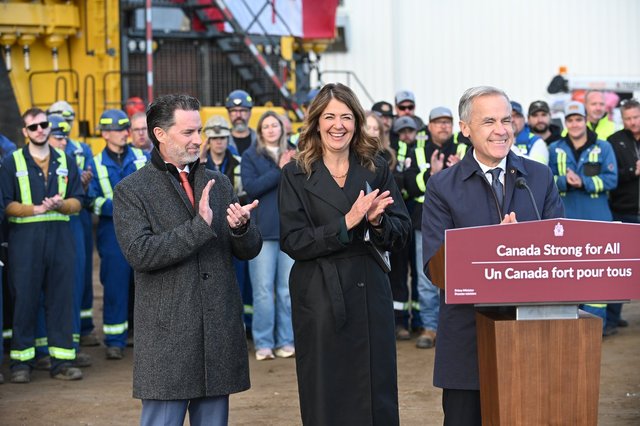
It has been over three months since Mark Carney and Danielle Smith announced a conceptual agreement on a new crude oil pipeline to the B.C. coast, the West Coast Oil Pipeline (WCOP), and its mandated companion carbon capture project, Pathways. But no progress has been achieved in securing oilsands producers committing to move substantial volumes on WCOP or determining what parties would be accountable for the long-term costs of financing and operating Pathways.
The lack of progress is no surprise. Alberta’s oilsands producers face three fundamental risks that Carney has not done enough to mitigate, let alone ideally eliminate. Those risks make it difficult to commit the capital to generate incremental oil production that would make incremental pipeline infrastructure possible, or necessary.
To restate them:
Open-ended carbon taxes on emissions related to oilsands production. No assurance that such taxes will not affect competitiveness over time.
Imposition of decarbonization on incremental oilsands production. This has been represented by the Pathways project, which only imposes costs on oilsands producers and Alberta as the royalty owner, with no means of recovering costs from global oil markets.
A regulatory system where achieving regulatory approval can be obstructed after the fact via protracted judicial review. This is often based on the open-ended risk of Section 35 of the Constitution Act, 1982, which requires governments to consult, and where appropriate, accommodate First Nations on major projects that impact their communities. (Carney’s recently tabled changes to Bill C-39 provide improvement in regulatory process but not in assured outcomes).



These risks are well-known and have persisted for too long.
What credibility is there for the claims by Carney that Canada can be an energy superpower if these risks persist? They are risks of Canadian policy, not markets. Surely, Carney knows this, but to admit that these are enduring risks is too much to expect. Those more charitable to Carney would suggest that he has gone as far as he can and still maintain political consensus within his coalition. That may be true, but the economic losses for Alberta from lost opportunities will be enormous.
Carney has spent most of the last three months embroiled in his trade impasse with the Trump administration. How long will Carney go without accommodation? Or, more bluntly, how long will he persist in avoiding concessions to the Americans related to Canada’s most protected economic and cultural sectors, while failing to gain long-term zero-tariff treatment for Canada’s most competitive sectors? Energy trade.
Does Carney have a trade strategy vis-à-vis the U.S. other than waiting for government change, whether by impeachment or the 2028 election?
He has also indulged in quixotic distractions that defy geography and economic logic. Options are useful if they have inherent value. If they did, they would have long since asserted themselves. Economic integration with the U.S. is fundamentally unavoidable for Canada. He knows this too.
In the interim, Alberta will be expected to “pay up” to mitigate impacts on Canadians most impacted by this trade impasse, regardless of its form.
Losing a million barrels a day of oilsands production for the sake of imposing carbon capture and storage costs in a world that will not impose comparable costs on alternative global oil production is horrific to contemplate. But there we are.
Carney can stand down on open-ended carbon pricing on industrial emissions and decarbonization mandates. But he should also immediately table legislation setting objective standards for what represents adequate consultation and accommodation in respect of Section 35 compliance. Doubtless this will lead to the Supreme Court of Canada, but the sooner the better.
If sanctioned by that court, an objective standard approach would provide reasonable compensation for access but more important land materially less risk for proponents.
Dennis McConaghy, a former executive vice-president at TransCanada Corp., now TC Energy, published his third book, Carbon Change: Canada on the Brink of Decarbonization.
Share This:






















INSIGHT: The Northern Shield Energy Corridor Provides Energy Security for All Canadians – Yogi Schulz