


 CDN NEWS |
  US NEWS







As Ottawa fast-tracks major energy projects B.C. public service enters a multi-month standstill amid deep fiscal deficits
By Karen Graham
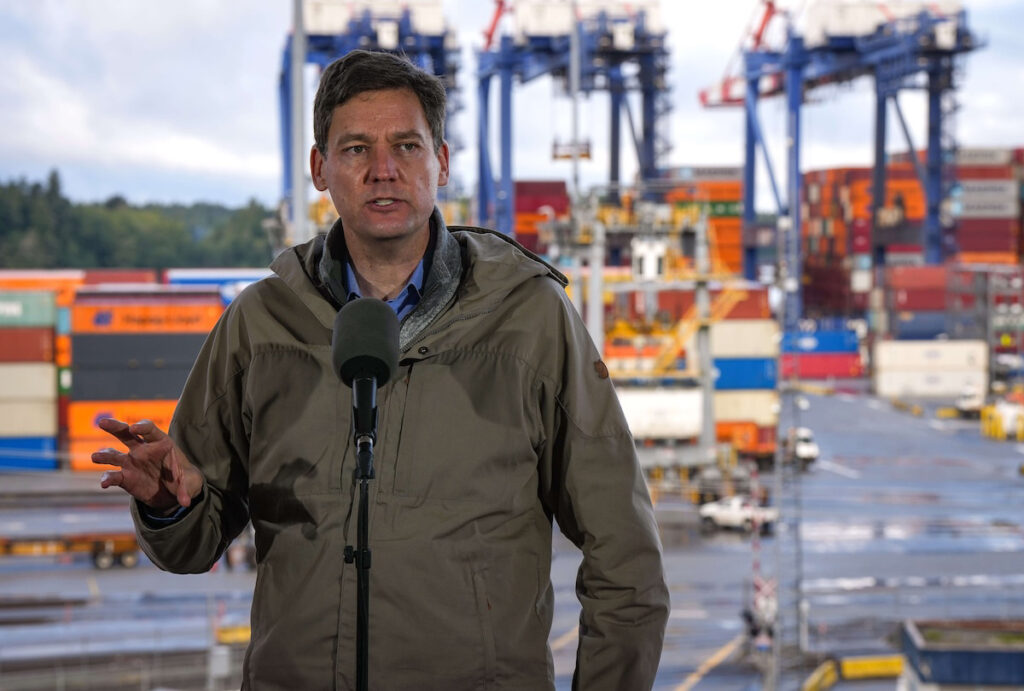
B.C. NDP Leader David Eby speaks during a provincial election campaign announcement at the DP World Fairview Container Terminal at port, in Prince Rupert, B.C., on Monday, Sept. 28, 2026. THE CANADIAN PRESS/Darryl Dyck
The folly—or wisdom—of B.C. Premier David Eby’s election call for Oct. 24, 2026, will doubtless be revealed to voters on a daily basis as the parties’ campaigns unfold.
Among the casualties of the election call are the cancellation of the fall sitting of the legislature and the “down tools” mandate by the public service on every file of significance until after the new government is formed. Since four cabinet members have indicated they will not run again, even if the NDP forms government, there will be new ministers in charge of portfolios relevant to natural resources.
What does this mean for the resource sectors? The divergence from the national project of rapidly strengthening and diversifying Canada’s resource sectors couldn’t be clearer. British Columbia will be stuck in neutral for months. The federal government rolls on, announcing two major projects of deep impact to British Columbia in three days, building on the September whirlwind signalling Canada’s openness for business: having held a widely-praised Investment Summit, and introducing legislation (the Building Canada Strong Act) on the first day the House of Commons returned to begin the nation’s business, thereby putting meat on the bones of much-needed regulatory reform.



Observers should not allow the “fog” of British Columbia electoral pronouncements to obscure the larger picture of LNG Canada’s Phase 2 announcement on Sept. 29, nor the federal government’s announcement to refer the now-named “Pacific Link” west coast oil pipeline to the Major Projects Office on Oct. 1 as a national interest project. LNG Canada’s final investment decision is predicated on much larger factors than B.C.’s muddy regulatory setting, including coordination of five international energy firms’ decision-making in the face of global geopolitical uncertainty, forecast natural gas prices, and yes—a new, highly attractive, 100 per cent “mega” capital investment deduction promised by the federal government.
B.C. leadership candidates took credit for LNG Canada 2 proceeding, but the election will take a toll on the nuts and bolts of projects and activities out of the spotlight. As resource sector leaders—including members of Resource Works’ Advisory Council—point out, uncertainty is the enemy of investment. The pause for the B.C. election represents uncertainty in itself, but it also raises questions about what comes next. There has hardly been time—or rationale—for either main party to produce and release a platform. No one knows what a new British Columbia government will do regarding the resource sectors. And that means businesses poised to launch a new greenfield project, or commit to an expansion, or attract a new round of private capital to be deployed in the province, may hold off until they can properly assess and minimize their risk.
How much is at stake? To answer, we might turn to the B.C. Major Projects Inventory. But there is no current information, as the B.C. government has—without credible explanation—decided to shutter it. As of the last report available, for Q3 2025, $344 billion worth of projects (all categories bar “cancelled”) were on the books. Of these, oil and gas projects represented 13.7 per cent or roughly $47 billion, utility projects represented 16.8 per cent at $57.8 billion, and mining projects accounted for about 15 per cent at $52 billion. Clearly, not all are being paused, but these figures illustrate the magnitude of the shudder of uncertainty now rippling through corporate head offices and their financial backers.
What was lost with the cancellation of the fall legislative session? Among several topics affecting the resource sectors, the Eby government promised clarity on DRIPA, the Declaration on the Rights of Indigenous Peoples Act, and how this piece of legislation intended to foster reconciliation will be addressed (amended? adapted?) to balance constitutional rights of Indigenous peoples with the 21st-century realities of private property ownership and private sector activities on the (often Crown) landbase.
Despite the good news on LNG this week, the election pause comes at nearly the worst possible time for B.C.’s abysmal public finances. Private sector economic activity and job creation, not B.C.’s outsized public sector, are what give British Columbia a chance to grow its way out of the $13-billion—and counting—deficit booked by the government this year.
The views expressed in this article are those of the author, Karen Graham, and do not necessarily reflect the views of the Resource Works Advisory Council.
Share This:






















INSIGHT: The Northern Shield Energy Corridor Provides Energy Security for All Canadians – Yogi Schulz