


 CDN NEWS |
  US NEWS







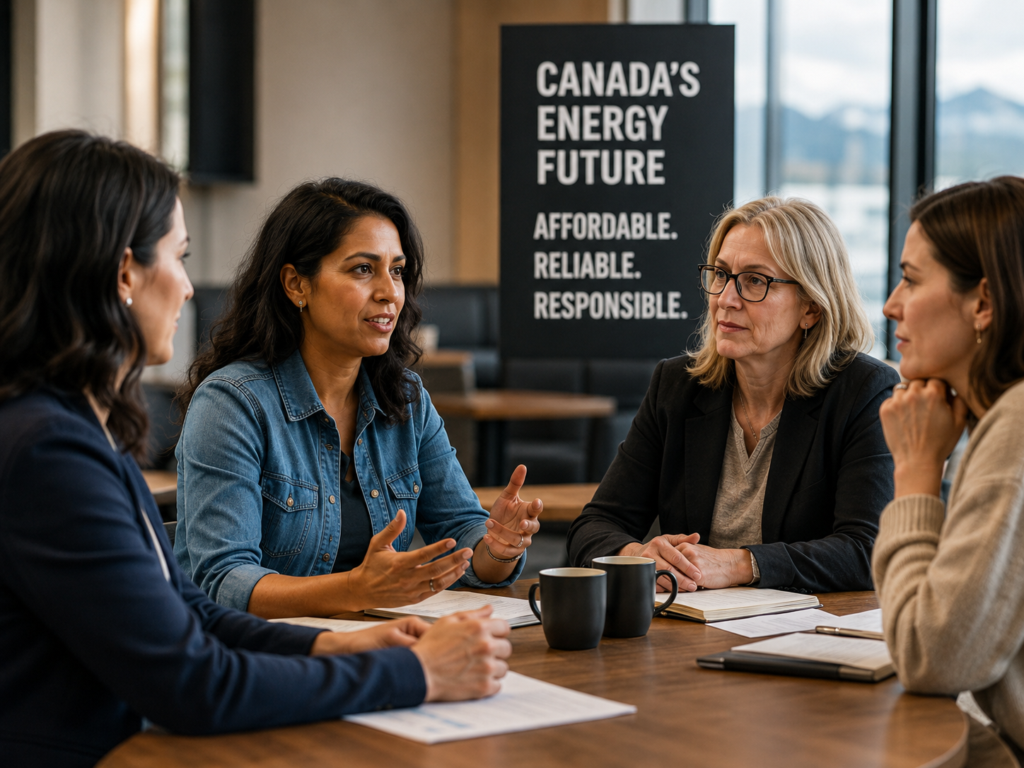
Energy policy is no longer an abstract debate about pipelines, carbon targets or electricity grids. Increasingly, engaged Canadian women see it as a practical question about household affordability, economic security, reliable public services, jobs, climate risk and the kind of country their children will inherit.
The strongest common ground is not necessarily agreement on every technology. Women in Alberta, Quebec, Nova Scotia and British Columbia may favour different energy sources and projects. What increasingly unites them is a demand for policies that produce tangible results: energy that remains affordable and reliable, an economy that creates opportunities, responsible resource development, meaningful environmental progress and governments capable of actually completing projects.
A rapidly growing and influential constituency
Canada Powered by Women, or CPW, defines “engaged women” as women who regularly follow news and politics, are interested in Canada’s economic future and want a voice in decisions about energy and natural resources.
CPW estimated that this group grew from approximately 3.8 million women in 2023 to 5.6 million in 2024 and 6.7 million by spring 2025. A later November 2025 survey placed the number at approximately 6.5 million but found that the intensity of their engagement was increasing. CPW also found that engaged women reported voting at higher rates than Canadians overall: 87 per cent federally, 84 per cent provincially and 74 per cent municipally.
There is an important qualification. CPW’s 2026 survey excluded women identifying as strongly left-wing, while earlier surveys focused on women describing themselves as somewhat left, centrist or right-of-centre. Its findings therefore provide valuable insight into a large, politically influential segment, but they should not be interpreted as representing every Canadian woman.
Broader national polling nevertheless confirms that women across the political spectrum are paying attention to the subject. Women are more likely than men to expect extreme weather to become more frequent—62 per cent compared with 54 per cent—and climate concern remains substantial among Liberal, NDP and Conservative voters, although the intensity differs significantly by party. At the same time, broader Canadian opinion contains two simultaneous beliefs: people generally prefer cleaner energy, but many also believe conventional energy remains important for economic growth and security.
Why energy has become so much more important
1. Energy policy now appears on the household bill
Electricity rates, gasoline, natural gas, heating oil, transportation and the energy embedded in food and manufactured products connect national policy directly to household finances.
In CPW’s November 2025 research, 79 per cent of engaged women identified improving the cost of living as an important element of sound energy policy. Sixty-four per cent identified energy security and reliability, while affordability and reliability increased sharply in importance compared with previous surveys. A separate Nanos poll found that affordability was the single most important energy priority for 39 per cent of Canadians, ahead of emissions reduction, reliability and safety when respondents were asked to choose their first priority.
Women are not inherently more responsible for household budgeting than men, but economic disparities can make price increases especially consequential. Women in Canada are somewhat more likely to live in unaffordable or inadequate housing, and senior women face greater housing-affordability risk than senior men. Meanwhile, 5.6 per cent of Canadian households were classified as experiencing energy poverty in 2021, meaning they spent at least 10 per cent of household income on energy.
2. Energy has become a national-security and sovereignty issue
Trade conflict, geopolitical instability and Canada’s dependence on the United States have changed how women view pipelines, refining, electricity connections and export infrastructure.
In CPW’s 2025 research, 89 per cent supported reducing reliance on U.S. trade, 85 per cent supported expanding Canadian pipeline and refining capacity, and 79 per cent supported a national energy corridor. In 2026, 77 per cent supported expanding infrastructure to reach markets beyond the United States, while 85 per cent supported removing interprovincial barriers to the movement of Canadian resources.
This concern has an economic basis. In 2025, Canada exported approximately $197.8 billion of energy, but 85 per cent of those exports went to the United States. More than 95 per cent of Canadian crude-oil exports were still directed to the U.S. in 2024. Women increasingly see this concentration not merely as an oil-industry issue but as a vulnerability affecting the Canadian dollar, employment, government revenue and the country’s bargaining power.

3. Women increasingly connect energy with jobs and public services
Canada’s energy sector accounted for approximately 9.4 per cent of nominal GDP in 2025. It directly employed about 332,800 people and indirectly supported another 432,000 jobs. Energy-sector enterprises generated an average of $24.4 billion annually for governments between 2019 and 2023.
Those figures help explain why energy discussions are increasingly tied to health care, education, infrastructure, pensions, municipal services and opportunities for younger Canadians. Energy revenues do not automatically guarantee better public services, but women increasingly understand that sustained private investment, employment and government revenue influence Canada’s capacity to fund them.
There is also a representation issue. Women held only 24 per cent of Canadian energy-sector jobs in 2023 and earned, on average, 85 per cent of the hourly wage earned by men in the sector. As energy expands into nuclear power, renewables, carbon capture, data centres, hydrogen, critical minerals and electricity infrastructure, women have a direct interest in whether they receive an equitable share of the resulting careers, leadership positions and business opportunities.

4. Climate change remains important—but women want workable policies
The change in women’s attitudes should not be interpreted as abandonment of environmental concerns. CPW found that 82 per cent of engaged women believe environmental policy and economic growth should be developed together. Only 11 per cent supported prioritizing environmental policy when it was explicitly presented as coming at the economy’s expense.
The distinction is increasingly between environmental objectives and the design of particular policies. Women may support lower emissions while questioning whether a carbon price, mandate, production restriction or subsidy will actually reduce global emissions without raising household costs, moving investment abroad or weakening reliability.
Broader polling suggests women remain especially alert to wildfires, floods, extreme heat, smoke and other climate impacts. This creates demand for emissions reduction, but also for adaptation: resilient electricity systems, wildfire protection, flood infrastructure, emergency preparedness and affordable technologies such as heat pumps and home-efficiency improvements.
5. There is growing frustration with Canada’s inability to build
The debate is shifting from announcing targets to demonstrating results.
CPW’s 2026 research found that 86 per cent considered a strong energy sector fundamental to Canada’s economic stability, yet only 23 per cent had strong confidence in Canada’s ability to approve and complete major energy projects. Seventy per cent supported accelerating regulatory processes, while 61 per cent believed delays were reducing Canada’s international competitiveness.
This does not necessarily mean women want environmental assessment or consultation eliminated. It suggests they increasingly want:

- clear rules established before investment decisions are made;
- fixed and enforceable regulatory timelines;
- fewer duplicative federal and provincial reviews;
- meaningful consultation conducted early;
- transparent explanations of costs and trade-offs; and
- decisions that eventually result in either approval or rejection.
CPW found that 99 per cent of engaged women wanted governments to be transparent about how energy, environmental and trade decisions affect affordability.
The energy policies that matter most to engaged women
Affordable and reliable energy
This is the foundational issue. Women want reasonable gasoline, heating and electricity costs, but they also want confidence that power will be available during heat waves, winter cold, drought, wildfire emergencies and periods of rapidly increasing demand.
Affordability also means examining the total system cost of a policy—not simply the construction cost of an individual wind farm, pipeline, nuclear plant or transmission line.
Canadian energy independence
Women increasingly support producing, processing and moving more energy within Canada. This includes stronger east-west infrastructure, domestic refining, electricity interties, pipelines and reduced exposure to disruptions in foreign markets.
Energy independence does not necessarily mean ending trade with the United States. CPW found that 65 per cent supported maintaining existing U.S. exports while 77 per cent also wanted infrastructure serving new international markets. The emerging preference is diversification rather than isolation.
A national energy corridor
A corridor could accommodate oil and natural-gas pipelines, electricity transmission, hydrogen, carbon-dioxide lines, telecommunications and other nationally important infrastructure.
Women appear attracted to the concept because it promises greater national coordination and fewer repeated disputes over individual routes. But support will ultimately depend on property rights, environmental safeguards, provincial jurisdiction and genuine Indigenous participation.
A diverse, “all-of-the-above” energy system
CPW’s 2025 survey found equal support—82 per cent—for renewables and hydroelectricity, alongside support for emerging technologies such as carbon capture, natural-gas development and oil and gas development.
This suggests that many engaged women reject an overly simple “fossil fuels versus renewables” choice. They are more comfortable with a portfolio that can include:
- hydroelectricity and interprovincial transmission;
- nuclear power and small modular reactors;
- wind and solar where economically and technically suitable;
- natural gas for industry, heating, exports and dispatchable electricity;
- continued oil production and market diversification;
- carbon capture, methane reduction and other emissions technologies;
- energy efficiency, storage and demand management; and
- Indigenous- and community-owned projects.
The mix will differ by province because Canada does not have one energy system. It has a collection of regional systems under provincial jurisdiction.
Technology and innovation that deliver measurable emissions reductions
Women appear receptive to environmental progress when it is connected to practical outcomes. CPW found 82 per cent support for innovation and energy technology intended to reduce greenhouse-gas emissions.
That may include carbon capture, methane controls, lower-emission industrial processes, nuclear power, renewable generation, storage, cleaner fuels and more efficient homes. The key expectation is increasingly that governments demonstrate what a policy will cost, how much it will reduce emissions and whether the same result could be achieved more affordably.
Community and Indigenous participation
Energy projects are more likely to earn lasting public confidence when communities receive employment, contracting opportunities, revenue and equity participation rather than merely being consulted after major decisions have already been made.
This is especially important in remote and northern regions, where energy is frequently expensive and diesel-dependent. Nunavut, for example, has no interprovincial transmission connections, and electricity generation is community-based. Locally owned renewable generation and storage can therefore be economic-development and energy-security policies as much as environmental policies.
The priorities vary by region
On the West Coast, women may place greater emphasis on hydroelectric reliability, wildfire and drought resilience, natural-gas and LNG exports, Indigenous participation and the environmental effects of new infrastructure. British Columbia combines a highly hydroelectric grid with production of roughly 36 per cent of Canada’s natural gas.
Across the Prairies, energy policy is closely tied to employment, provincial revenues, oil and gas exports, pipelines, electricity reliability, industrial competitiveness and emissions-reduction technologies. Alberta has eliminated coal generation but remains heavily reliant on natural gas, while Saskatchewan’s uranium resources connect the region to Canada’s nuclear future.
In Ontario, the focus is increasingly on reliable electricity for manufacturing, housing, electric transportation and data centres. Nuclear power provides the backbone of Ontario’s low-carbon system, making refurbishments, new reactors, small modular reactors and transmission expansion central policy questions.
In Quebec, women are more likely to view energy through hydroelectric capacity, affordability, exports, electrification and the ability to add enough generation and transmission for future industrial growth. Nearly all Quebec electricity generation was renewable in 2023.
In Atlantic Canada, the discussion includes electricity rates, replacing coal generation, offshore wind, stronger regional transmission, offshore petroleum, hydrogen and the economic future of coastal communities. Nova Scotia still generated most of its electricity from coal and natural gas in 2023, while Newfoundland and Labrador combines offshore oil production with an overwhelmingly renewable electricity system.
The central conclusion
Engaged women are becoming more interested in energy because they increasingly recognize that almost every major Canadian concern runs through the energy system:
- the cost of living;
- secure employment;
- national sovereignty;
- climate and extreme weather;
- health care and public revenue;
- Indigenous economic reconciliation;
- regional opportunity;
- housing and transportation; and
- the country’s ability to attract investment and complete major projects.
Across political lines, the common ground is less about selecting one preferred energy source and more about demanding a functioning system.
Engaged women appear to want Canada to develop resources responsibly, expand clean and conventional energy, reduce emissions through technology, strengthen domestic infrastructure, diversify exports and keep energy affordable and reliable. They are increasingly skeptical of policies that offer distant promises but produce immediate costs, and equally skeptical of development that ignores environmental or community consequences.
The political party that understands this balance – prosperity, security and environmental responsibility, together rather than in opposition, is likely to have a considerable advantage with one of Canada’s most attentive and reliable groups of voters.
Share This:























ENERGYNOW FEATURE: Why Energy Policy Is Becoming a Women’s Issue Across Canada