


 CDN NEWS |
  US NEWS







By EnergyNow Editorial Staff
New Pacific and east-west pipelines, a reworked Keystone XL proposal and lower-cost expansions of Trans Mountain and Enbridge’s existing systems could reshape where Canadian oil is sold. The bigger question is which projects will actually be built.
Canada is entering another consequential period for pipeline development.
After years in which most attention centred on completing the Trans Mountain Expansion, governments and pipeline companies are now advancing projects that could increase Canadian oil transportation capacity by nearly three million barrels per day.
That headline number is significant, but it needs qualification. Some projects are sanctioned expansions of existing infrastructure. Others have commercial support but have not reached a final investment decision. The largest proposals remain at the political, feasibility or early development stage.
Several projects could also compete for the same barrels, customers and capital. Some expansions overlap because additional capacity on one pipeline segment requires downstream capacity on another. The Alberta-to-Ontario proposal would initially supply Canadian refineries rather than directly move oil onto international tankers.
Nevertheless, the direction is clear: Canada is again preparing for oil production growth and seeking more than one export route.
The economic rationale has strengthened since the Trans Mountain Expansion entered service in May 2024. Statistics Canada reported that Canadian crude exports to countries other than the United States increased nearly 60 per cent in 2024, reaching a record 10.6 million cubic metres. The Bank of Canada has also credited Trans Mountain with helping keep the Western Canadian Select discount to West Texas Intermediate near US$12 per barrel through much of 2025.
The Pipeline Scorecard
| Project | Potential incremental capacity | Current timeline and status |
|---|---|---|
| New West Coast Oil Pipeline | 1,000,000 bpd | National-interest decision expected by Oct. 1, 2026; construction could begin as early as Sept. 1, 2027; no public in-service date |
| Trans Mountain Optimizations | 300,000 bpd | First 90,000 bpd targeted for early 2027; another 210,000 bpd expected by the end of 2028 |
| Northern Shield Alberta-to-Ontario Pipeline | 500,000 bpd initially; expandable to 800,000 bpd | Feasibility study expected by the end of 2026; no proponent, cost, FID or construction date |
| Prairie Connector, the Reworked Keystone XL Concept | 550,000 bpd initially | Final investment decision targeted for mid-2027; analysts estimate two to three years of construction after approval |
| Enbridge Mainline and Express-Platte Expansions | Up to 430,000 bpd | Initial 150,000 bpd beginning in 2027; another 250,000 bpd potentially by late 2028; 30,000-bpd Express-Platte expansion expected in 2028 |
Taken at face value, those proposals represent approximately 2.78 million to 3.08 million barrels per day of potential capacity. That total should not be interpreted as a forecast: not every project is likely to proceed on its current schedule, some capacity is intended for domestic markets, and portions of Enbridge’s downstream projects overlap with its Canadian Mainline expansion.
New West Coast Oil Pipeline – One Million Barrels a Day to the Pacific
The largest and most strategically important proposal is the new West Coast Oil Pipeline being advanced by Alberta and the federal government.
The preliminary concept is a roughly 1,250-kilometre pipeline capable of transporting one million barrels per day from a receipt terminal in the Bruderheim area northeast of Edmonton to a new deepwater marine terminal in southern British Columbia. It would include approximately 11 pump stations, storage facilities and marine-loading infrastructure. The corridor would largely follow the existing Trans Mountain route, although the final alignment and terminal location have not been determined.
The project is being structured around a new company owned by Trans Mountain Corporation, the Alberta Petroleum Marketing Commission and Pembina Pipeline Corporation. Pembina would hold a 10-per-cent economic interest during construction, with the opportunity to acquire another 10 per cent after commercial operations begin. Trans Mountain and Alberta would divide the remaining ownership, and the governments have committed to providing meaningful Indigenous equity participation. Trans Mountain would design, permit, construct and operate the system.
The Major Projects Office is reviewing the proposal and beginning consultations with affected Indigenous communities. The federal and Alberta governments expect a decision on whether the pipeline will be listed as a project of national interest by October 1, 2026. Alberta says construction could begin as early as September 1, 2027, provided consultations, permits and regulatory approvals are completed. No reliable public in-service date has been announced.
The pipeline is also tied politically and economically to advancement of the Pathways carbon capture and storage project. Its southern route means the federal Oil Tanker Moratorium Act covering the northern B.C. coast would remain intact.
Unlike incremental expansions directed toward U.S. refineries, virtually all of the new line’s capacity would represent access to international markets. It could more than double Canada’s current Pacific pipeline capacity and make Asian refiners a much larger part of the Canadian crude market.
Trans Mountain Optimizations – Could Grow Capacity to 1.19 Million Barrels Per Day
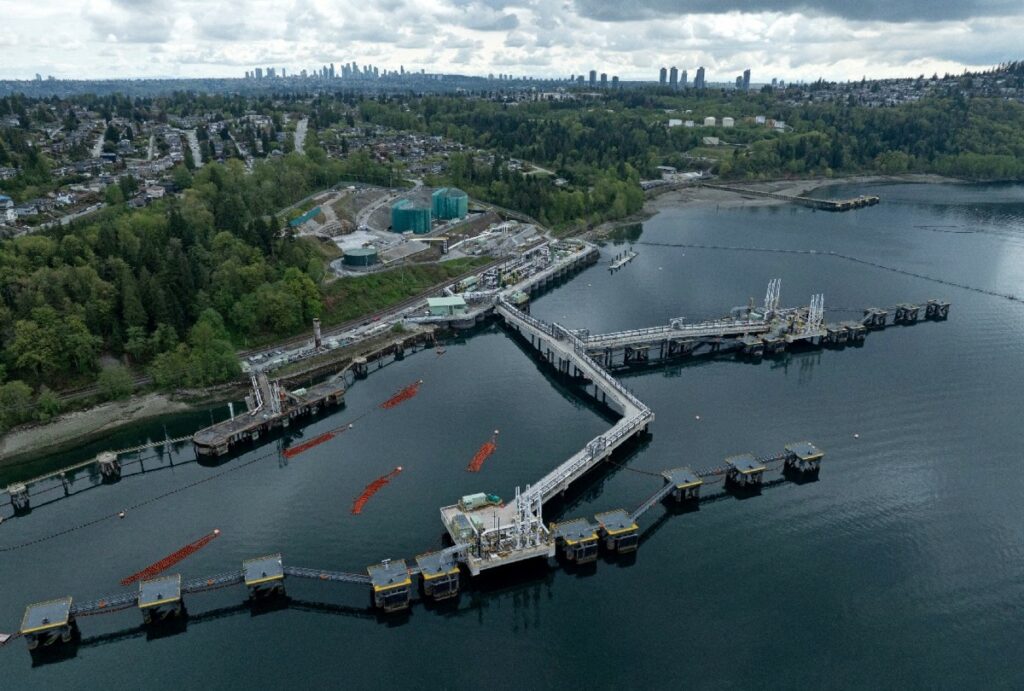
Before a completely new Pacific pipeline is built, Trans Mountain is working on lower-cost ways to increase the capacity of its existing system.
The expanded pipeline currently has nominal capacity of 890,000 barrels per day, up from approximately 300,000 barrels per day before the expansion entered service in 2024. Trans Mountain reported that the system reached full capacity during the second quarter of 2026, demonstrating that the additional egress is already being absorbed by producers and refiners.
Trans Mountain’s optimization plan would add approximately 300,000 barrels per day without constructing another full-length pipeline. The first stage is expected to add about 90,000 barrels per day by early 2027. A larger Mainline Optimization Project would add another 210,000 barrels per day by the end of 2028, raising total system capacity to approximately 1.19 million barrels per day. The company’s broader project information describes the optimization window as extending from 2027 through 2030, reflecting the need for open seasons, engineering and regulatory approvals.
The work is expected to rely on additional pumping capability, drag-reducing agents and improvements to terminals and operating procedures. Marine-terminal capacity and shipping logistics will also be important because additional pipeline throughput is only useful if the oil can be loaded efficiently onto tankers.
The expansion would build on Trans Mountain’s demonstrated ability to diversify markets. Since the enlarged system opened, approximately two-thirds to three-quarters of Pacific cargoes have reportedly gone to Asia rather than the United States.
Northern Shield Alberta-to-Ontario Pipeline – Hardisty to Sarnia
The Northern Shield Energy Corridor proposed by Alberta and Ontario would revive the idea of moving large volumes of western Canadian crude east through an all-Canadian route.
The proposed 3,300-kilometre pipeline would begin at Hardisty, travel through Saskatchewan and Manitoba, and terminate at the Sarnia refining and petrochemical complex. It would initially transport approximately 500,000 barrels per day and could eventually be expanded to 800,000 barrels per day.
Its initial purpose would be somewhat different from the new West Coast pipeline. Northern Shield would improve domestic energy security, supply Ontario refineries and reduce Canada’s reliance on pipeline routes that enter the United States before returning to Canada. It could also reduce the need for imported crude.
The international-export opportunity would come from possible future extensions to Atlantic, Great Lakes or other tidewater ports. Alberta has suggested that an eventual Atlantic connection could provide access to European markets, but that concept remains considerably less developed than the Hardisty-to-Sarnia segment.



A feasibility study examining route options, costs, commercial structures, electricity infrastructure and Indigenous participation is expected by the end of 2026. No pipeline company has agreed to serve as proponent, and no construction or in-service schedule has been published.
Northern Shield is therefore the least commercially advanced of the major proposals. Its 500,000-to-800,000-barrel capacity should be viewed as a design concept rather than committed export egress.
The proposal is partly motivated by the continuing dispute surrounding Enbridge Line 5, which transports as much as 540,000 barrels per day of crude oil and natural gas liquids through Michigan before reconnecting with Canadian infrastructure. Enbridge’s Great Lakes Tunnel project would protect that existing capacity rather than increase it, but the Line 5 dispute has reinforced provincial interest in an entirely Canadian route to Ontario.
Prairie Connector, the Reworked Keystone XL Concept
What is often described as a revived Keystone XL is now being advanced as the Prairie Connector Project by South Bow Corporation and U.S. partner Bridger Pipeline.
The distinction matters. TC Energy completed the spinoff of its crude-oil pipeline business into South Bow in October 2024. TC Energy is now primarily a natural-gas infrastructure and power company, while South Bow owns the Keystone Pipeline System and is responsible for Prairie Connector.
Prairie Connector would include approximately 530 kilometres of 36-inch pipeline from Hardisty to the Canada-U.S. border. It would reuse about 150 kilometres of Keystone XL pipe and two pump stations that were previously installed and preserved in Canada. Bridger would provide the downstream connection through Montana to Guernsey, Wyoming, where the oil could reach pipelines serving U.S. Midwest and Gulf Coast markets.
The initial system would transport approximately 550,000 barrels per day. South Bow has secured 20-year binding transportation commitments from shippers and is targeting a final investment decision by mid-2027.
Prairie Connector does not follow the original Keystone XL route through the United States, but it would use portions of the former project’s Canadian infrastructure. A new U.S. cross-border permit has been granted, although South Bow has said it needs confidence that the permit will remain valid through future changes of government.
South Bow has not issued a formal construction completion date. Analysts cited by Reuters estimate the project could take two to three years to build after a final investment decision, suggesting an earliest plausible startup around 2029 or 2030 if approvals and financing proceed without major delays. That is an outside estimate, not a company commitment.
Enbridge Mainline and Express-Platte Expansions – The Fastest Incremental Barrels
Enbridge’s strategy is less dramatic than building a new coast-to-coast pipeline, but it may deliver some of the earliest additional export capacity.
Its Mainline Optimization Program is intended to add as much as 400,000 barrels per day of Canadian egress through improvements to pipelines, pumping systems, terminals and downstream connections.
Phase 1 has reached a final investment decision and is expected to add 150,000 barrels per day beginning in 2027. The project will use drag-reducing agents, piping reconfigurations, crossovers, additional storage and terminal improvements. Enbridge will also add approximately 100,000 barrels per day to Flanagan South, improving full-path access from Edmonton to Houston through the Seaway Pipeline. The Flanagan South capacity is a downstream connection and should not be added separately to the 150,000 barrels of new Canadian Mainline egress.
Phase 2 could provide another 250,000 barrels per day as early as the end of 2028. Enbridge has launched open seasons for additional service on Flanagan South and the Southern Access Extension and is evaluating upgrades between Edmonton and Flanagan, Illinois.
A separate 30,000-barrel-per-day Express-Platte expansion is expected to enter service in 2028 as part of Enbridge’s Southern Illinois Connector initiative. The connector would establish 100,000 barrels per day of additional long-haul service toward the Gulf Coast, but 70,000 barrels would use existing Spearhead capacity. The net addition to Canadian border egress is therefore approximately 30,000 barrels per day.
Combined, Enbridge describes these initiatives as potentially moving up to 430,000 additional barrels per day of Western Canadian production to U.S. markets. Its Mainline averaged approximately 3.2 million barrels per day during the first quarter of 2026 and was apportioned, or oversubscribed, throughout the quarter.
Which Projects Are Most Likely to Proceed?
The clearest additions before the end of 2028 are the Trans Mountain optimizations and Enbridge’s phased expansions. Both rely primarily on existing rights-of-way and infrastructure, reducing costs and regulatory complexity compared with constructing entirely new pipelines.
Together, those programs could provide approximately 730,000 barrels per day of incremental capacity by the end of 2028 if each component proceeds as scheduled.
Prairie Connector is further behind, but its long-term shipper commitments give it a stronger commercial foundation than most greenfield proposals. Its largest unresolved issues are permit durability, final costs, financing and the mid-2027 investment decision.
The new West Coast pipeline has unusually strong federal and provincial backing, an identified ownership structure and a proposed construction manager. However, it still requires route development, Indigenous consultation, regulatory approvals, marine-terminal planning, financing and progress on the Pathways project.
Northern Shield remains an energy-security vision awaiting a feasibility study and commercial proponent.
Canada is therefore unlikely to add the full three million barrels per day currently under discussion. Enbridge itself has cited Western Canadian production growth of approximately 500,000 to 600,000 barrels per day by the end of the decade. The Canada Energy Regulator’s 2026 outlook also shows wide variation in future production depending on prices, policies and producer investment decisions.
But the significance of the current pipeline push is not limited to how many projects are ultimately constructed. For the first time in years, Canadian producers could have competing routes to the Pacific, Ontario, the U.S. Midwest and the Gulf Coast.
That competition could reduce dependence on a single customer, support a narrower Canadian oil discount and give producers more leverage over where—and at what price—their oil is sold.
Share This:






















On The Verge: Energy Sector Primed for New Wave of Growth – ATB Economics